
We read your photo as:
Identify the physical changes of water described in the following scenarios: melting, condensation, evaporation, and steam formation.
ScanSolve AI Answer
Answer
Melting
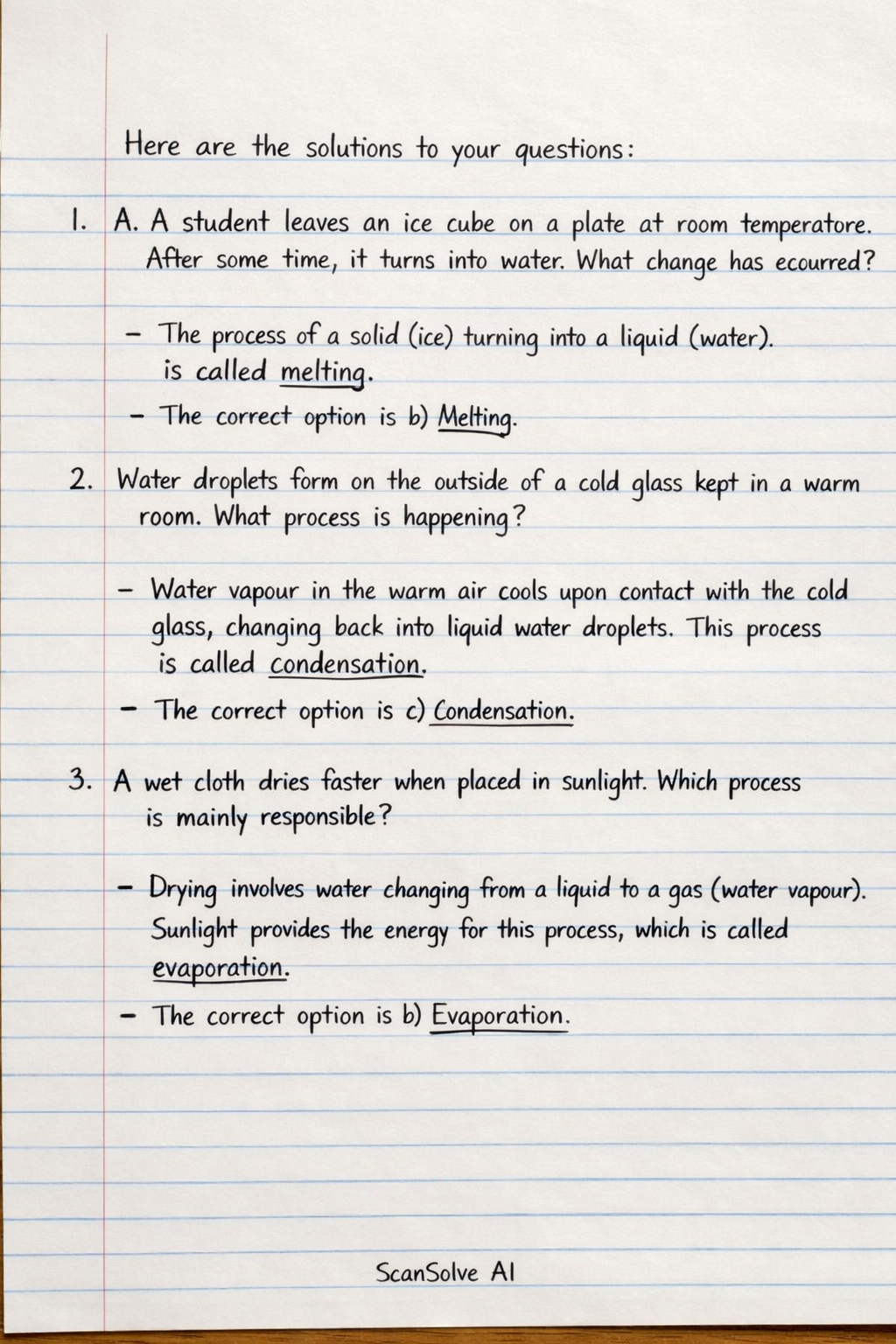
Here are the solutions to your questions:
-
A student leaves an ice cube on a plate at room temperature. After some time, it turns into water. What change has occurred?
- The process of a solid (ice) turning into a liquid (water) is called melting.
- The correct option is b) Melting.
-
Water droplets form on the outside of a cold glass kept in a warm room. What process is happening?
- Water vapour in the warm air cools upon contact with the cold glass, changing back into liquid water droplets. This process is called condensation.
- The correct option is c) Condensation.
-
A wet cloth dries faster when placed in sunlight. Which process is mainly responsible?
- Drying involves water changing from a liquid to a gas (water vapour). Sunlight provides the energy for this process, which is called evaporation.
- The correct option is b) Evaporation.
-
Which form of water is seen as steam when water is boiling?
- When water boils, it changes from a liquid state to a gaseous state. Steam is water in its gaseous form, also known as vapour.
- The correct option is c) Gas (vapour).
-
A child observes fog forming on a cold winter morning. This happens because water vapour in the air changes into tiny water droplets. What process is this?
- The change of water vapour (gas) into liquid water droplets is known as condensation. Fog is a visible example of this process occurring near the ground.
- The correct option is a) Condensation.
-
Draw and label the water cycle; write 3 sentences explaining each step in own words.
- I cannot draw, but I can explain the water cycle.
- The water cycle begins with evaporation, where the sun's energy turns liquid water from oceans, lakes, and rivers into water vapour, which rises into the atmosphere. This vapour then undergoes condensation, cooling and forming clouds made of tiny water droplets or ice crystals. Finally, precipitation occurs when these droplets or crystals grow heavy and fall back to Earth as rain, snow, or hail, eventually collecting in bodies of water to restart the cycle.
Try one yourself
A new problem that tests the same skill.
Still stuck on this one?
Ask a follow-up, and the answer starts from this question.
More Chemistry Questions
Handwritten Step-by-Step Solution
Get this as a handwritten image on WhatsApp — like a tutor wrote it for you.
Try on WhatsApp