
We read your photo as:
Explain the changes of state for water: solid to liquid, and identify the boiling point and a safety precaution.
ScanSolve AI Answer
Step-by-step solution
9 stepsHere are the answers to your questions:
Question 2: Explain how ice changed from a solid into a liquid.
Ice, in its solid state, absorbs heat energy from its surroundings.
As the ice absorbs heat, its particles gain kinetic energy and begin to vibrate more vigorously.
The increased vibration weakens the strong intermolecular forces holding the particles in a fixed, rigid lattice structure.
Once enough energy is absorbed, the particles overcome these forces and can move past each other, causing the ice to melt and change into liquid water.
Question 2: What boiling point of water was recorded during the experiment?
Refer to the "Observation Table" provided.
Locate the row for "Gas (steam)" which represents water in its gaseous state.
The temperature recorded for "Gas (steam)" is 1.6.
This is the temperature at which the water was observed as steam, indicating it has reached its boiling point.
The boiling point of water recorded during the experiment was .
Question 4: State ONE precautionary measure that should be taken into consideration when conducting this investigation.
When conducting experiments involving heating substances, safety is crucial.
A key precautionary measure is to protect your eyes from potential splashes or steam.
One precautionary measure is to .
Still stuck on this one?
Ask a follow-up, and the answer starts from this question.
More Chemistry Questions
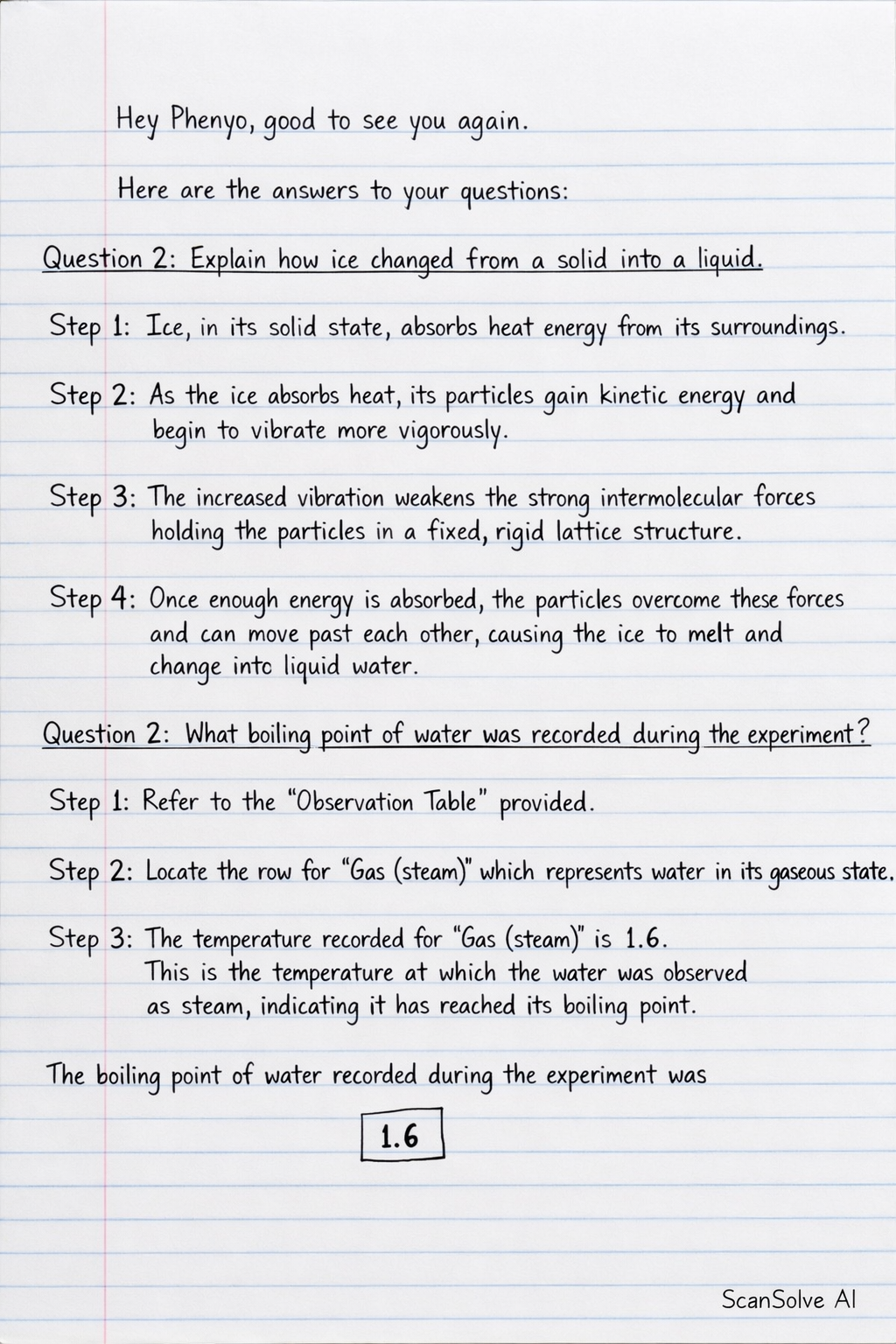
Handwritten Step-by-Step Solution
Get this as a handwritten image on WhatsApp — like a tutor wrote it for you.
Try on WhatsApp