We read your photo as:

If 60 cm³ of a saturated solution of KNO, contains 15.6 g of the salt at 25 °C, calculate the solubility of KNO3 in mol dm-3 at that temperature. [K=39.0, 0=16.0, N=14.0]

Chemistry

ScanSolve AI Answer

Answer

b(ii)

2.57 mol dm−3\text{2.57 mol dm}^{-3}

Step-by-step solution

4 steps

Here are the solutions to the questions:

Part b(ii)· 4 steps

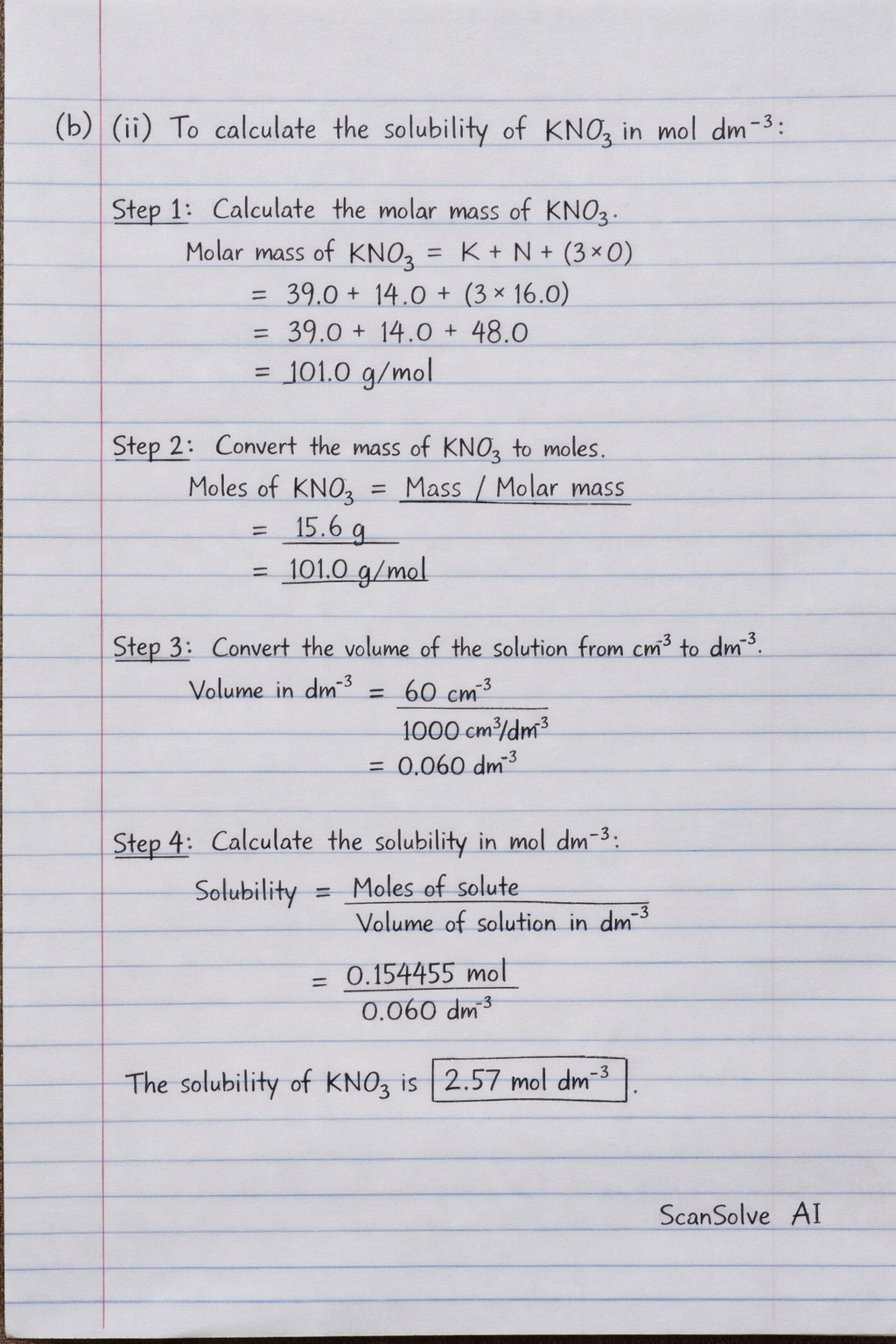
To calculate the solubility of KNO3\text{KNO}_3 in mol dm−3\text{mol dm}^{-3}

  1. Calculate the molar mass of KNO3\text{KNO}_3.

    Molar mass of KNO3=K+N+(3×O)\text{Molar mass of } \text{KNO}_3 = \text{K} + \text{N} + (3 \times \text{O}) =39.0+14.0+(3×16.0)= 39.0 + 14.0 + (3 \times 16.0) =39.0+14.0+48.0= 39.0 + 14.0 + 48.0 =101.0 g/mol= 101.0 \text{ g/mol}
  2. Convert the mass of KNO3\text{KNO}_3 to moles.

    Moles of KNO3=MassMolar mass\text{Moles of } \text{KNO}_3 = \frac{\text{Mass}}{\text{Molar mass}} =15.6 g101.0 g/mol= \frac{15.6 \text{ g}}{101.0 \text{ g/mol}} =0.154455 mol= 0.154455 \text{ mol}
  3. Convert the volume of the solution from cm3\text{cm}^3 to dm3\text{dm}^3.

    Volume in dm3=60 cm31000 cm3/dm3\text{Volume in dm}^3 = \frac{60 \text{ cm}^3}{1000 \text{ cm}^3/\text{dm}^3} =0.060 dm3= 0.060 \text{ dm}^3
  4. Calculate the solubility in mol dm−3\text{mol dm}^{-3}.

    Solubility=Moles of soluteVolume of solution in dm3\text{Solubility} = \frac{\text{Moles of solute}}{\text{Volume of solution in dm}^3} =0.154455 mol0.060 dm3= \frac{0.154455 \text{ mol}}{0.060 \text{ dm}^3} =2.57 mol dm−3= 2.57 \text{ mol dm}^{-3}

    The solubility of KNO3\text{KNO}_3 is 2.57 mol dm−3\boxed{\text{2.57 mol dm}^{-3}}.

Part c(i)

To prepare PbCl2\text{PbCl}_2 from Pb(NO3)2\text{Pb(NO}_3)_2 and a mineral acid

Dissolve lead(II) nitrate (Pb(NO3)2\text{Pb(NO}_3)_2) in water to form an aqueous solution. Add a mineral acid containing chloride ions, such as dilute hydrochloric acid (HCl\text{HCl}), to the lead(II) nitrate solution. Lead(II) chloride (PbCl2\text{PbCl}_2) will precipitate out as a white solid. Filter the mixture to separate the solid PbCl2\text{PbCl}_2, then wash the precipitate with distilled water and dry it.

Part c(ii)

The equation for the reaction is

Pb(NO3)2(aq)+2HCl (aq)→PbCl2(s)+2HNO3(aq)\text{Pb(NO}_3)_2 \text{(aq)} + 2\text{HCl (aq)} \rightarrow \text{PbCl}_2 \text{(s)} + 2\text{HNO}_3 \text{(aq)}

Part d(ii)

The two oxidation states of iron in its chlorides are +2\boxed{\text{+2}} and +3\boxed{\text{+3}}. These correspond to iron(II) chloride (FeCl2\text{FeCl}_2) and iron(III) chloride (FeCl3\text{FeCl}_3).

(i) The electron configuration of copper is 1s22s22p63s23p63d104s11s^2 2s^2 2p^6 3s^2 3p^6 3d^{10} 4s^1 and not 1s22s22p63s23p63d94s21s^2 2s^2 2p^6 3s^2 3p^6 3d^9 4s^2 because a completely filled d-subshell (3d103d^{10}) is more stable than a partially filled d-subshell (3d93d^9). An electron from the 4s4s orbital is promoted to the 3d3d orbital to achieve this greater stability.

Part d(iii)

One chemical process in which iron is used as a catalyst is the Haber process\boxed{\text{Haber process}}.

Was this helpful?

Try one yourself

A new problem that tests the same skill.

Still stuck on this one?

Ask a follow-up, and the answer starts from this question.

Got a different question?Ask your own question
Handwritten step-by-step solution preview

Handwritten Step-by-Step Solution

Get this as a handwritten image on WhatsApp — like a tutor wrote it for you.

Try on WhatsApp