
We read your photo as:
Ii. What mass in grams of sodium trioxocarbonate (IV) is needed to prepare 250 cm³ of 0.2 moldm³ solution? [Na = 23, O=16, C=12]
ScanSolve AI Answer
Step-by-step solution
5 stepshere are the solutions to the chemistry questions:
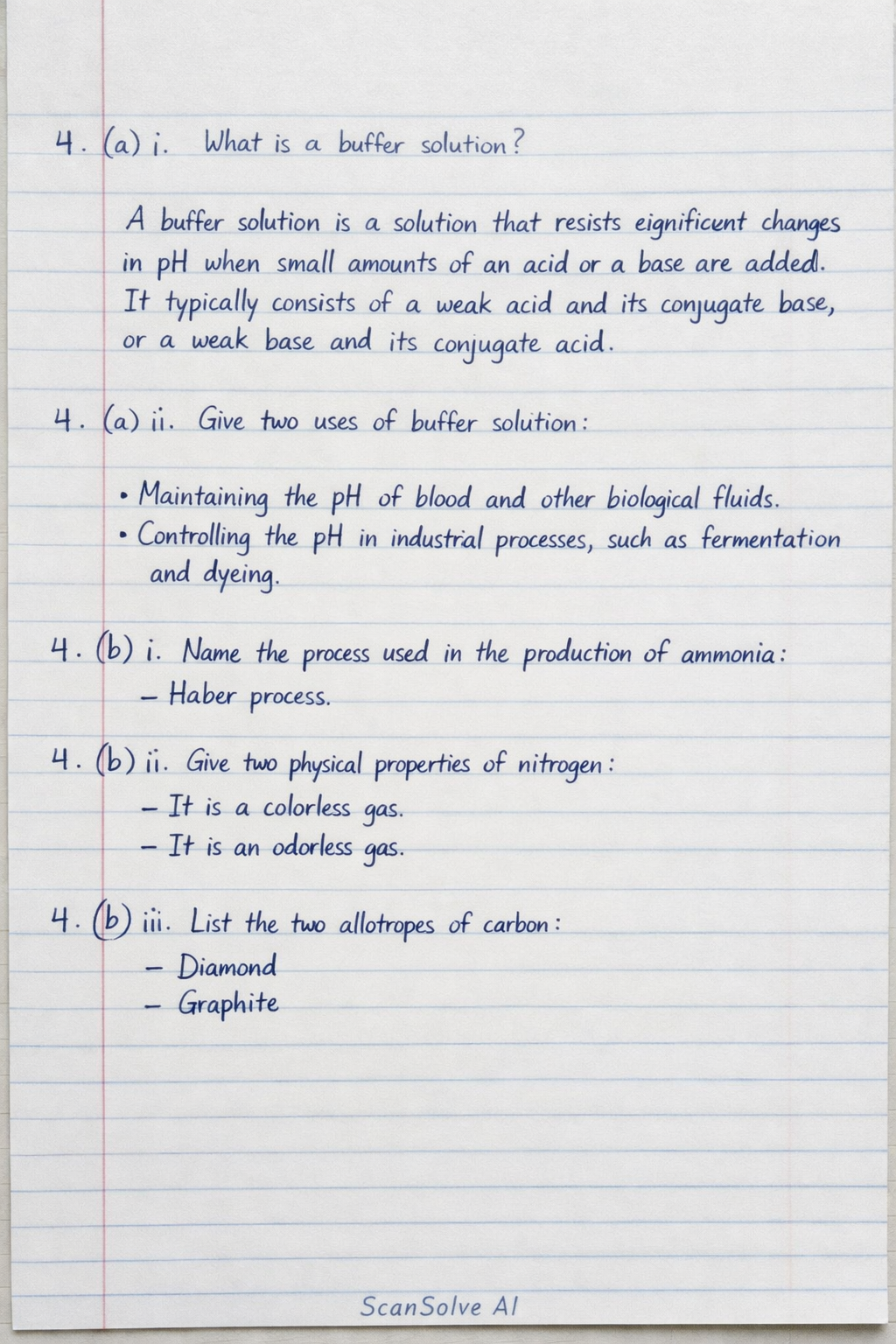
4. (a) i. What is a buffer solution?
A buffer solution is a solution that resists significant changes in pH when small amounts of an acid or a base are added. It typically consists of a weak acid and its conjugate base, or a weak base and its conjugate acid.
4. (a) ii. Give two uses of buffer solution.
- Maintaining the pH of blood and other biological fluids.
- Controlling the pH in industrial processes, such as fermentation and dyeing.
4. (b) i. Name the process used in the production of ammonia.
- Haber process
4. (b) ii. Give two physical properties of nitrogen.
- It is a colorless gas.
- It is an odorless gas.
4. (b) iii. List the two allotropes of carbon.
- Diamond
- Graphite
4. (b) iv. Mention the structure of each allotrope in (b)iii.
- Diamond: Each carbon atom is covalently bonded to four other carbon atoms in a tetrahedral arrangement, forming a giant covalent network structure.
- Graphite: Each carbon atom is covalently bonded to three other carbon atoms in a trigonal planar arrangement, forming hexagonal layers. These layers are held together by weak intermolecular forces.
4. (b) v. Give one use of charcoal.
- Used as a fuel.
4. (c) i. Give the general molecular formula for:
I. Alkenes:
II. Alkynes:
4. (c) ii. Write out the possible structural isomers of .
I.
II.
4. (c) iii. Give the IUPAC names of the isomers in (c)ii.
I.
II.
4. (c) iv. Calculate the molecular formula of a compound with the following composition by mass; 60% carbon, 13.3% hydrogen and 20.7% oxygen with a molar mass of 60.
Note: The given percentages (60% C, 13.3% H, 20.7% O) sum to 94%. For the problem to be consistent with a molar mass of 60 g/mol, we assume the oxygen percentage is .
Determine the mass of each element in 100 g of the compound.
Mass of C = 60 g
Mass of H = 13.3 g
Mass of O = 26.7 g (assumed)Convert the mass of each element to moles.
Determine the simplest whole-number mole ratio by dividing by the smallest number of moles.
The smallest number of moles is 1.66875 (for Oxygen).
The empirical formula is .
Calculate the empirical formula mass.
Determine the molecular formula.
The given molar mass is 60 g/mol. Since the empirical formula mass (60 g/mol) is equal to the molar mass (60 g/mol), the molecular formula is the same as the empirical formula.
The molecular formula is .
Still stuck on this one?
Ask a follow-up, and the answer starts from this question.
More Chemistry Questions
Handwritten Step-by-Step Solution
Get this as a handwritten image on WhatsApp — like a tutor wrote it for you.
Try on WhatsApp