
In a simplest and easier form explain synthesis Michael reaction
ScanSolve AI Answer
Step-by-step solution
3 stepsThe Michael reaction is a fundamental way to create new carbon-carbon bonds. It involves two main types of molecules:
- A nucleophile: This is an "electron-rich" molecule, often a carbon atom with a negative charge (a carbanion), which is eager to donate its electrons.
- A Michael acceptor: This is an "electron-poor" molecule, specifically an -unsaturated carbonyl compound, which has a double bond next to a carbonyl group. This structure makes a specific carbon atom (the -carbon) attractive to the nucleophile's electrons.
In simple terms, the nucleophile adds itself to the Michael acceptor, forming a new, larger molecule.
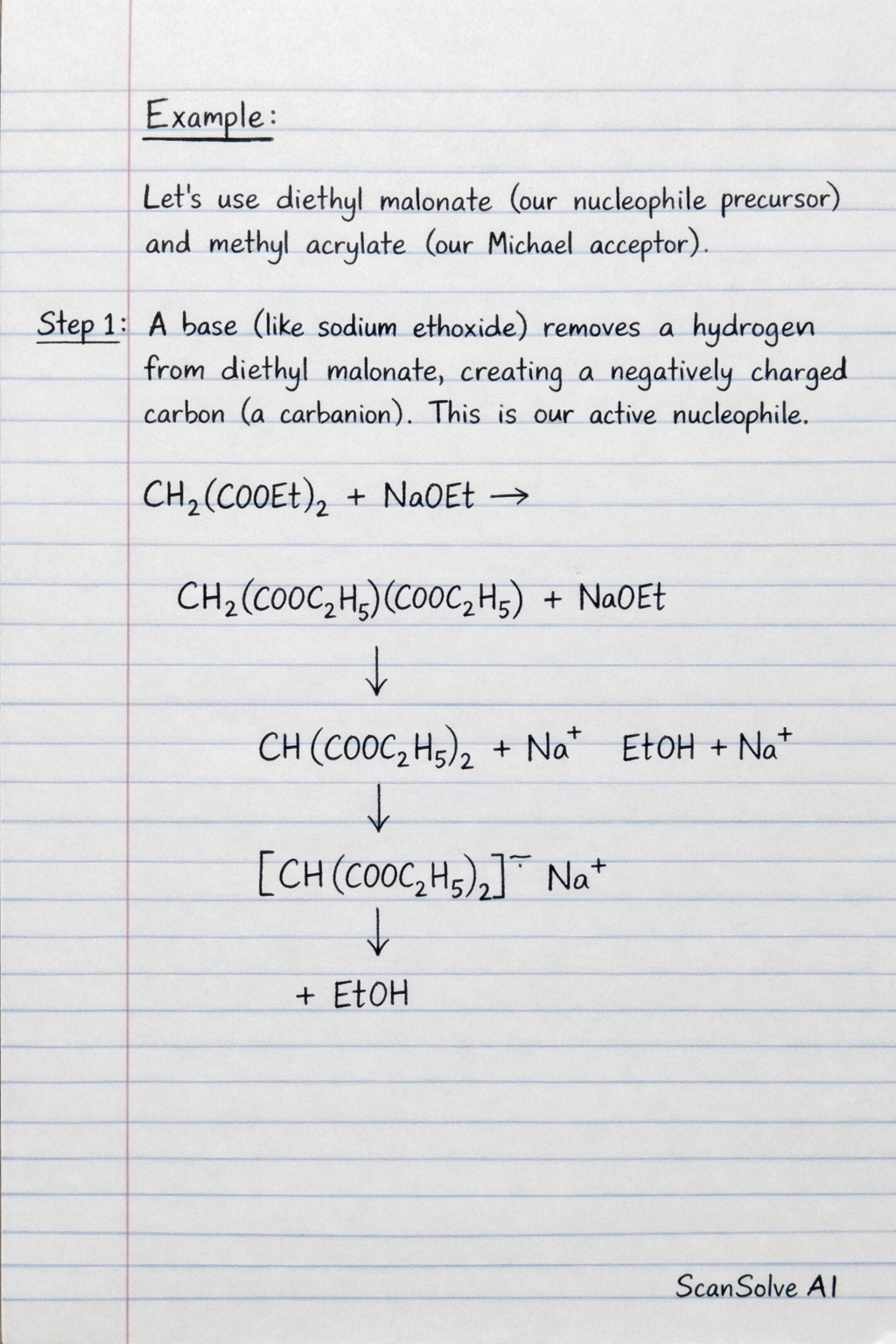
Example:
Let's use diethyl malonate (our nucleophile precursor) and methyl acrylate (our Michael acceptor).
A base (like sodium ethoxide) removes a hydrogen from diethyl malonate, creating a negatively charged carbon (a carbanion).
This is our active nucleophile.
This negatively charged carbon then attacks the -carbon of methyl acrylate.
This is where the new carbon-carbon bond is formed, creating an intermediate.
The intermediate product then quickly picks up a hydrogen atom (from the solvent or acid), becoming a stable, neutral molecule.
This reaction effectively joins the two starting molecules, creating a longer carbon chain with a new carbon-carbon bond.
Still stuck on this one?
Ask a follow-up, and the answer starts from this question.
More Chemistry Questions
Handwritten Step-by-Step Solution
Get this as a handwritten image on WhatsApp — like a tutor wrote it for you.
Try on WhatsApp