
This chemistry question involves key chemical concepts and calculations. The detailed solution below walks through each step, from identifying the reaction type to computing the final answer.
ScanSolve AI Answer
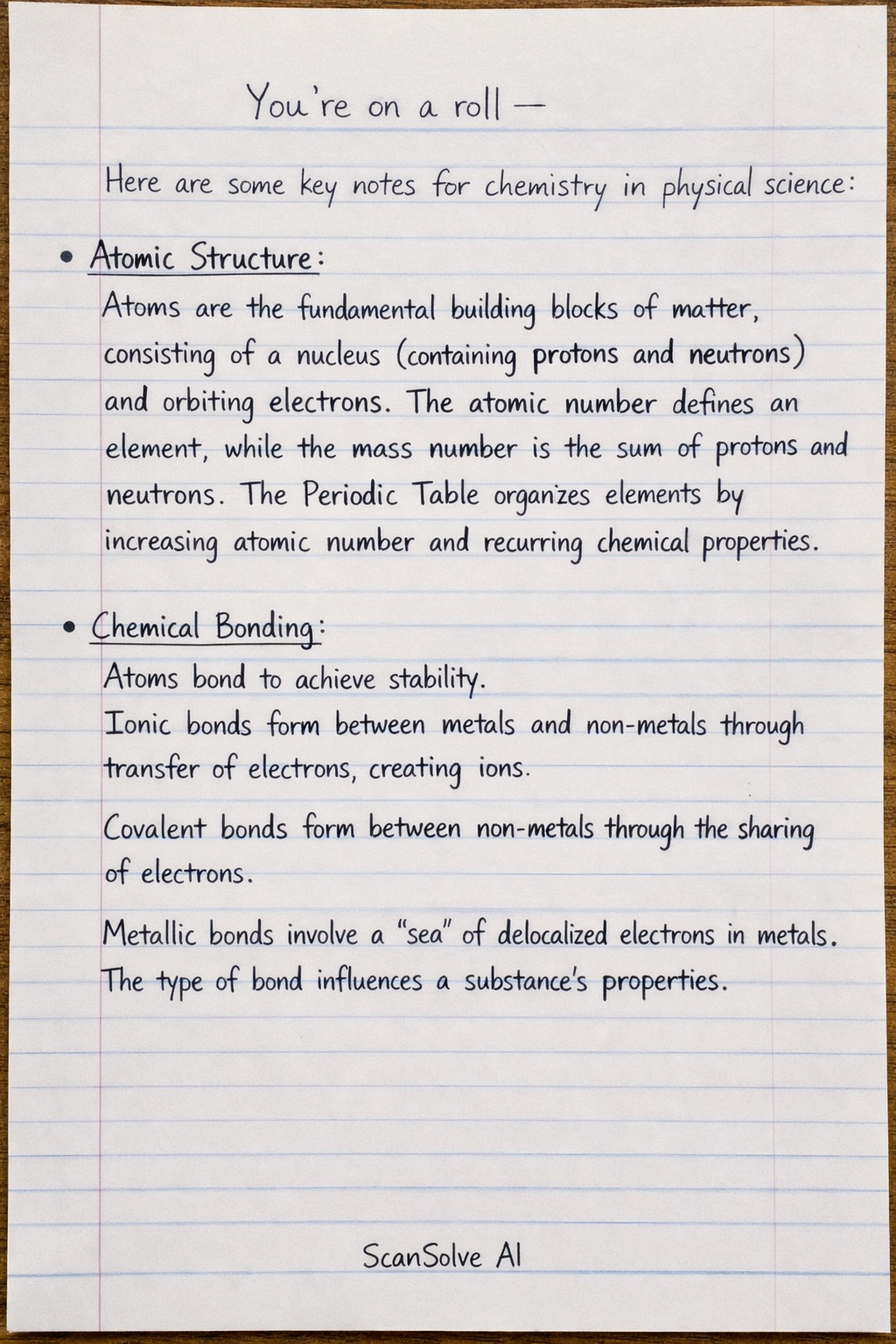
Here are some key notes for chemistry in physical science: Atomic Structure: Atoms are the fundamental building blocks of matter, consisting of a nucleus (containing protons and neutrons) and orbiting electrons. The atomic number defines an element, while the mass number is the sum of protons and neutrons. The Periodic Table* organizes elements by increasing atomic number and recurring chemical properties. Chemical Bonding: Atoms bond to achieve stability. Ionic bonds form between metals and non-metals through the transfer of electrons, creating ions. Covalent bonds form between non-metals through the sharing of electrons. Metallic bonds* involve a "sea" of delocalized electrons in metals. The type of bond influences a substance's properties. Intermolecular Forces (IMFs): These are attractive forces between molecules. They are weaker than chemical bonds but determine physical properties like boiling point and melting point. Common IMFs include London dispersion forces (in all molecules, especially non-polar), dipole-dipole forces (in polar molecules), and hydrogen bonds* (a strong type of dipole-dipole force involving H bonded to N, O, or F). Chemical Reactions: These involve the rearrangement of atoms to form new substances. Reactions are represented by chemical equations, which must be balanced* to obey the law of conservation of mass. Common reaction types include synthesis, decomposition, single displacement, double displacement, and combustion. Acids and Bases: Acids are substances that produce hydrogen ions (H^+) in solution, while bases produce hydroxide ions (OH^-). The pH scale* measures the acidity or alkalinity of a solution, with pH 7 being neutral, below 7 acidic, and above 7 basic. States of Matter: Matter exists primarily as solids, liquids, and gases*. Solids have a fixed shape and volume, liquids have a fixed volume but take the shape of their container, and gases have no fixed shape or volume. Transitions between these states (e.g., melting, boiling, freezing) involve energy changes.