
We read your photo as:
QUESTION 7 (Start on a new page.) Hydrated potassium carbonate, K₂CO₃·xH₂O, is a WEAK BASE. A solution is prepared by dissolving some of this solid in water.
ScanSolve AI Answer
Step-by-step solution
13 stepsHere are the solutions to your questions:
7.1 Define the term weak base.
A weak base is a base that partially ionizes in an aqueous solution, meaning it does not fully dissociate to produce hydroxide ions.
7.2 Write down the formula of the conjugate acid of the carbonate ion, (aq).
When the carbonate ion () accepts a proton (), it forms its conjugate acid.
7.3 Determine the value of:
7.3.1 p
Use the formula
Volume used = Final burette reading - Initial burette reading.
Solve for p.
7.3.2 q
Use the formula
Volume used = Final burette reading - Initial burette reading.
Solve for q.
7.4 METHYL ORANGE is used as the indicator. Explain why methyl orange is the most suitable indicator for this titration by referring to the pH at the equivalence point.
The titration involves a strong acid (HCl) and a weak base (). At the equivalence point of such a titration, the resulting solution will be acidic (pH < 7). Methyl orange changes color in the pH range of 3.1 to 4.4, which is suitable for detecting the equivalence point in an acidic medium.7.5 Calculate the concentration of the solution.
Given:
Concentration of HCl () =
Volume of HCl () =
Balanced equation:
Mole ratio is .Calculate the average volume of () used.
Convert to : .
Use the titration formula to find .
Solve for .
The concentration of the solution is .
7.6 Calculate the value of x in the formula .
The solution from 7.5 was prepared by dissolving of in () water.
Concentration of () = (from 7.5).Calculate the moles of anhydrous in the solution.
Calculate the molar mass of anhydrous .
Calculate the mass of anhydrous in the sample.
Calculate the mass of water in the hydrated sample.
Calculate the moles of water.
Determine the value of x.
Rounding to the nearest whole number, the value of x is .
Still stuck on this one?
Ask a follow-up, and the answer starts from this question.
More Chemistry Questions
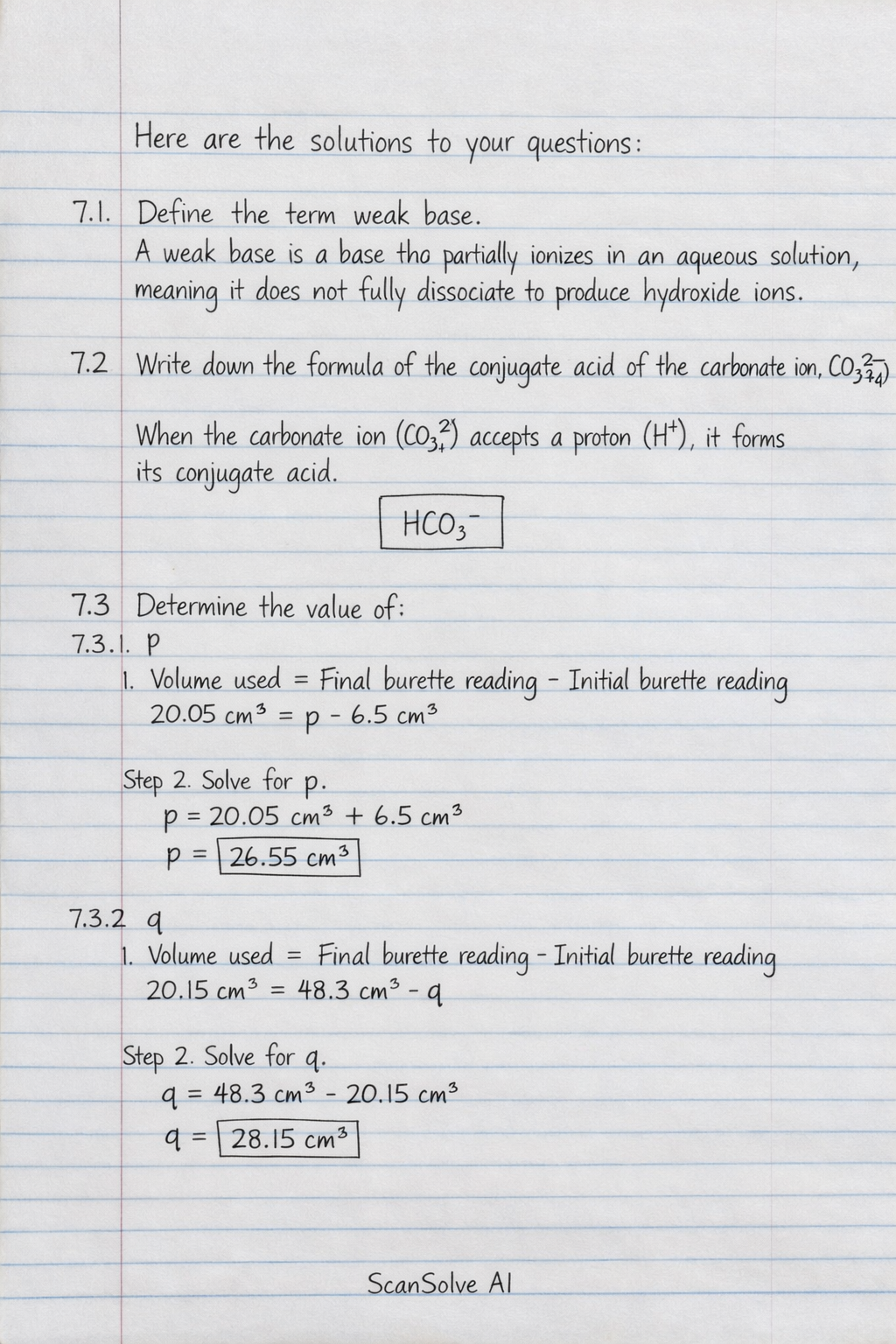
Handwritten Step-by-Step Solution
Get this as a handwritten image on WhatsApp — like a tutor wrote it for you.
Try on WhatsApp