

This chemistry question involves key chemical concepts and calculations. The detailed solution below walks through each step, from identifying the reaction type to computing the final answer.
ScanSolve AI Answer
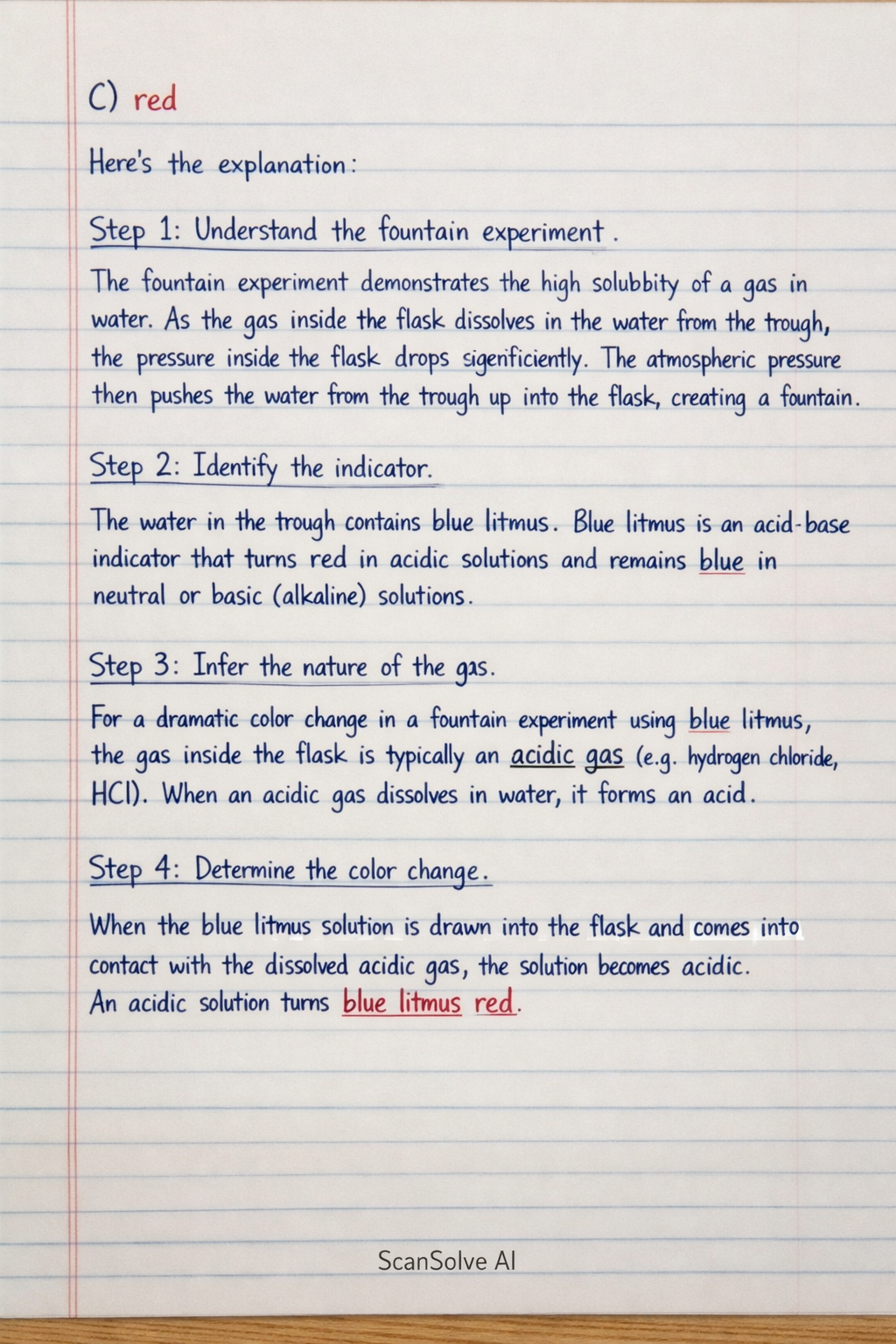
C) red Here's the explanation: Step 1: Understand the fountain experiment. The fountain experiment demonstrates the high solubility of a gas in water. As the gas inside the flask dissolves in the water from the trough, the pressure inside the flask drops significantly. The atmospheric pressure then pushes the water from the trough up into the flask, creating a fountain. Step 2: Identify the indicator. The water in the trough contains blue litmus. Blue litmus is an acid-base indicator that turns red in acidic solutions and remains blue in neutral or basic (alkaline) solutions. Step 3: Infer the nature of the gas. For a dramatic color change in a fountain experiment using blue litmus, the gas inside the flask is typically an acidic gas (e.g., hydrogen chloride, HCl). When an acidic gas dissolves in water, it forms an acid. Step 4: Determine the color change. When the blue litmus solution is drawn into the flask and comes into contact with the dissolved acidic gas, the solution becomes acidic. An acidic solution turns blue litmus red. The final answer is C. Last free one today — make it count tomorrow, or type /upgrade for unlimited.