
We read your photo as:
Inference: Stale milk contains a higher concentration of microorganisms, which produce reductase (dehydrogenase) enzymes. These enzymes are responsible for reducing the redox indicator dye, causing
ScanSolve AI Answer
Here are the answers to your questions:
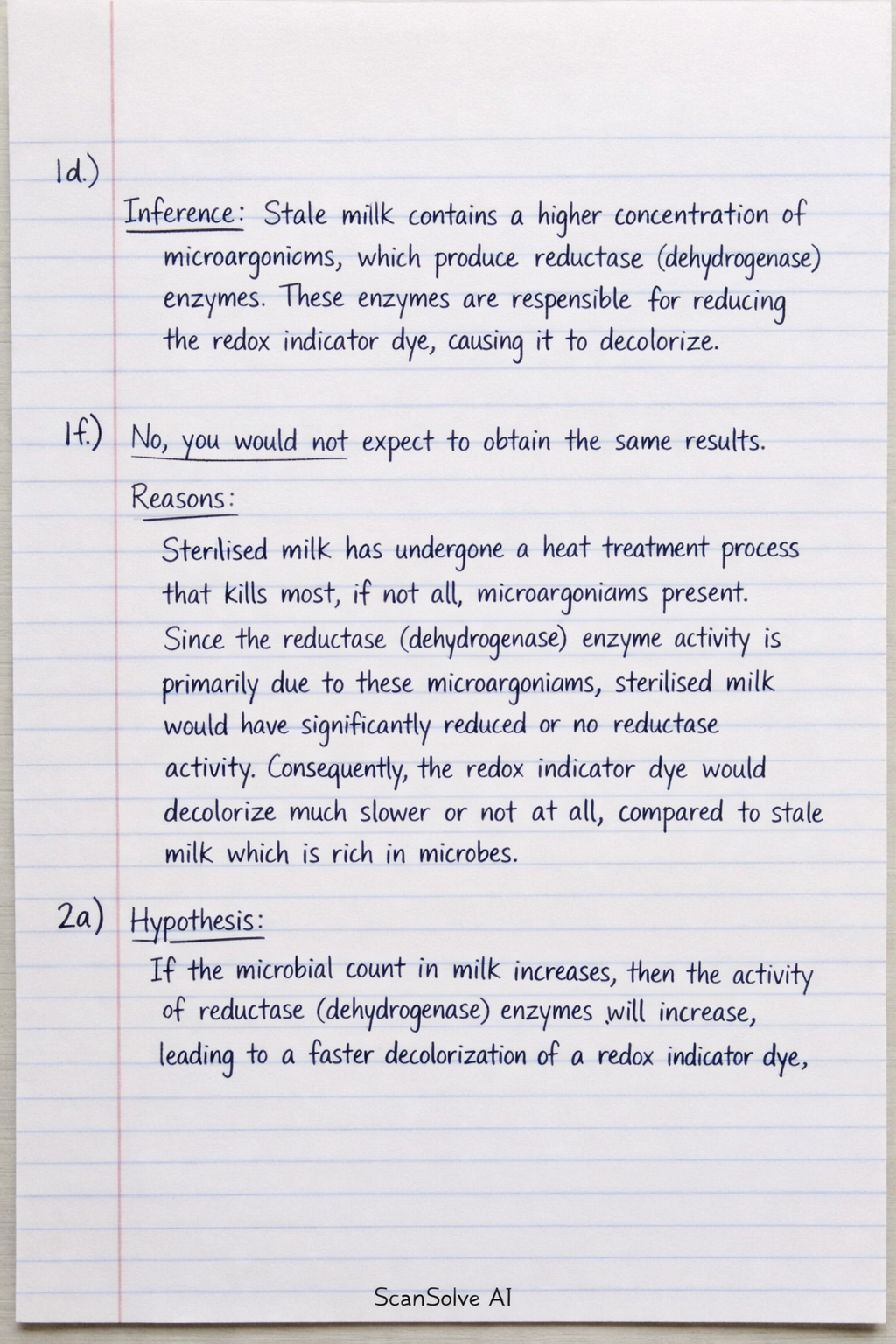
1d)
Inference: Stale milk contains a higher concentration of microorganisms, which produce reductase (dehydrogenase) enzymes. These enzymes are responsible for reducing the redox indicator dye, causing it to decolorize.
1f)
No, you would not expect to obtain the same results.
Reasons: Sterilised milk has undergone a heat treatment process that kills most, if not all, microorganisms present. Since the reductase (dehydrogenase) enzyme activity is primarily due to these microorganisms, sterilised milk would have significantly reduced or no reductase activity. Consequently, the redox indicator dye would decolorize much slower or not at all, compared to stale milk which is rich in microbes.
2a)
Hypothesis: If the microbial count in milk increases, then the activity of reductase (dehydrogenase) enzymes will increase, leading to a faster decolorization of a redox indicator dye.
2b)
Procedure:
- Materials: Fresh milk, stale milk, sterilised milk, methylene blue solution, three test tubes, measuring cylinder/pipette, water bath (e.g., set to ), stopwatch.
- Preparation: Label three test tubes A, B, and C.
- Setup:
- Add of fresh milk to test tube A.
- Add of stale milk to test tube B.
- Add of sterilised milk to test tube C.
- Indicator Addition: Add of methylene blue solution to each test tube.
- Mixing: Gently invert or swirl each test tube to mix the contents.
- Incubation: Place all three test tubes in the water bath at .
- Observation: Start the stopwatch immediately. Observe the test tubes at regular intervals (e.g., every 5 minutes) and record the time it takes for the methylene blue to decolorize (turn from blue to white/colorless) in each test tube.
- Comparison: Compare the decolorization times to assess the reductase activity in each milk sample.
Still stuck on this one?
Ask a follow-up, and the answer starts from this question.
More Chemistry Questions
Handwritten Step-by-Step Solution
Get this as a handwritten image on WhatsApp — like a tutor wrote it for you.
Try on WhatsApp