We read your photo as:

Determine the following integrals: 2.1 ∫ a³ˣ sin2x dx 2.2 ∫ (3 / cot⁴ 2x) dx 2.3 ∫ sin⁵ ax cos³ ax dx 2.4 ∫ (1 / (3x² - 2x + 9)) dx

Mathematics

ScanSolve AI Answer

This answer stops before the end.

It was cut off when it was first written. Ask ScanSolve this question again for the full working.

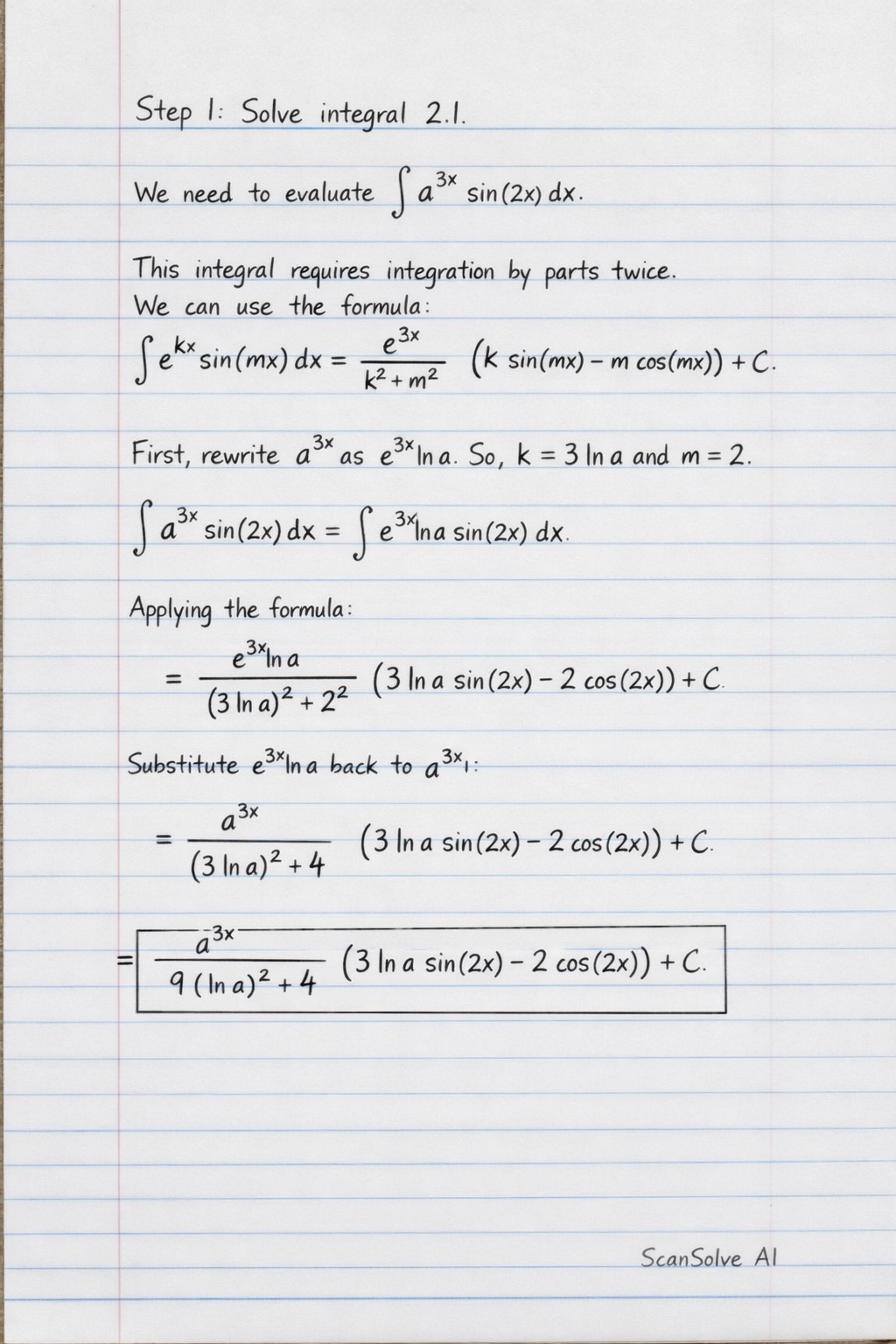
Step 1: Solve integral 2.1.
We need to evaluate ∫a3xsin⁡(2x)dx\int a^{3x} \sin(2x) dx.
This integral requires integration by parts twice. We can use the formula for ∫ekxsin⁡(mx)dx=ekxk2+m2(ksin⁡(mx)−mcos⁡(mx))+C\int e^{kx} \sin(mx) dx = \frac{e^{kx}}{k^2+m^2}(k \sin(mx) - m \cos(mx)) + C.
First, rewrite a3xa^{3x} as e3xln⁡ae^{3x \ln a}. So, k=3ln⁡ak = 3 \ln a and m=2m = 2.

∫a3xsin⁡(2x)dx=∫e3xln⁡asin⁡(2x)dx\int a^{3x} \sin(2x) dx = \int e^{3x \ln a} \sin(2x) dx

Applying the formula:

=e3xln⁡a(3ln⁡a)2+22(3ln⁡asin⁡(2x)−2cos⁡(2x))+C= \frac{e^{3x \ln a}}{(3 \ln a)^2 + 2^2} (3 \ln a \sin(2x) - 2 \cos(2x)) + C

Substitute e3xln⁡ae^{3x \ln a} back to a3xa^{3x}:

=a3x(3ln⁡a)2+4(3ln⁡asin⁡(2x)−2cos⁡(2x))+C= \frac{a^{3x}}{(3 \ln a)^2 + 4} (3 \ln a \sin(2x) - 2 \cos(2x)) + C =a3x9(ln⁡a)2+4(3ln⁡asin⁡(2x)−2cos⁡(2x))+C= \boxed{\frac{a^{3x}}{9 (\ln a)^2 + 4} (3 \ln a \sin(2x) - 2 \cos(2x)) + C}

Step 2: Solve integral 2.2.
We need to evaluate ∫3cot⁡4(2x)dx\int \frac{3}{\cot^4(2x)} dx.
Use the identity 1cot⁡x=tan⁡x\frac{1}{\cot x} = \tan x.

∫3cot⁡4(2x)dx=∫3tan⁡4(2x)dx\int \frac{3}{\cot^4(2x)} dx = \int 3 \tan^4(2x) dx

Let u=2xu = 2x, so du=2dxdu = 2 dx, which means dx=12dudx = \frac{1}{2} du.

=3∫tan⁡4u(12)du=32∫tan⁡4udu= 3 \int \tan^4 u \left(\frac{1}{2}\right) du = \frac{3}{2} \int \tan^4 u du

Use the reduction formula for ∫tan⁡nudu=tan⁡n−1un−1−∫tan⁡n−2udu\int \tan^n u du = \frac{\tan^{n-1} u}{n-1} - \int \tan^{n-2} u du.
For n=4n=4:

∫tan⁡4udu=tan⁡3u3−∫tan⁡2udu\int \tan^4 u du = \frac{\tan^3 u}{3} - \int \tan^2 u du

For ∫tan⁡2udu\int \tan^2 u du, use the identity tan⁡2u=sec⁡2u−1\tan^2 u = \sec^2 u - 1:

∫tan⁡2udu=∫(sec⁡2u−1)du=tan⁡u−u+C1\int \tan^2 u du = \int (\sec^2 u - 1) du = \tan u - u + C_1

Substitute this back:

∫tan⁡4udu=tan⁡3u3−(tan⁡u−u)+C1\int \tan^4 u du = \frac{\tan^3 u}{3} - (\tan u - u) + C_1

Now substitute this back into the main integral:

32(tan⁡3u3−tan⁡u+u)+C\frac{3}{2} \left( \frac{\tan^3 u}{3} - \tan u + u \right) + C

Substitute u=2xu = 2x:

=32(tan⁡3(2x)3−tan⁡(2x)+2x)+C= \frac{3}{2} \left( \frac{\tan^3(2x)}{3} - \tan(2x) + 2x \right) + C =12tan⁡3(2x)−32tan⁡(2x)+3x+C= \frac{1}{2} \tan^3(2x) - \frac{3}{2} \tan(2x) + 3x + C =12tan⁡3(2x)−32tan⁡(2x)+3x+C= \boxed{\frac{1}{2} \tan^3(2x) - \frac{3}{2} \tan(2x) + 3x + C}

Step 3: Solve integral 2.3.
We need to evaluate ∫sin⁡5(ax)cos⁡3(ax)dx\int \sin^5(ax) \cos^3(ax) dx.
Since the power of cos⁡(ax)\cos(ax) is odd, let u=sin⁡(ax)u = \sin(ax).
Then du=acos⁡(ax)dxdu = a \cos(ax) dx, so cos⁡(ax)dx=1adu\cos(ax) dx = \frac{1}{a} du.
Rewrite cos⁡3(ax)\cos^3(ax) as cos⁡2(ax)cos⁡(ax)=(1−sin⁡2(ax))cos⁡(ax)\cos^2(ax) \cos(ax) = (1 - \sin^2(ax)) \cos(ax).

∫sin⁡5(ax)cos⁡3(ax)dx=∫sin⁡5(ax)(1−sin⁡2(ax))cos⁡(ax)dx\int \sin^5(ax) \cos^3(ax) dx = \int \sin^5(ax) (1 - \sin^2(ax)) \cos(ax) dx

Substitute u=sin⁡(ax)u = \sin(ax):

=∫u5(1−u2)1adu= \int u^5 (1 - u^2) \frac{1}{a} du =1a∫(u5−u7)du= \frac{1}{a} \int (u^5 - u^7) du

Integrate term by term:

=1a(u66−u88)+C= \frac{1}{a} \left( \frac{u^6}{6} - \frac{u^8}{8} \right) + C

Substitute back u=sin⁡(ax)u = \sin(ax):

=1a(sin⁡6(ax)6−sin⁡8(ax)8)+C= \frac{1}{a} \left( \frac{\sin^6(ax)}{6} - \frac{\sin^8(ax)}{8} \right) + C =sin⁡6(ax)6a−sin⁡8(ax)8a+C= \boxed{\frac{\sin^6(ax)}{6a} - \frac{\sin^8(ax)}{8a} + C}

Step 4: Solve integral 2.4.
We need to evaluate ∫13x2−2x+9dx\int \frac{1}{3x^2 - 2x + 9} dx.
Complete the square in the denominator.

Was this helpful?

Still stuck on this one?

Ask a follow-up, and the answer starts from this question.

Got a different question?Ask your own question
Handwritten step-by-step solution preview

Handwritten Step-by-Step Solution

Get this as a handwritten image on WhatsApp — like a tutor wrote it for you.

Try on WhatsApp