
We read your photo as:
Write the integrated rate law for a first-order reaction.
ScanSolve AI Answer
Answer
Step-by-step solution
5 stepsWrite the integrated rate law for a first-order reaction.
For a first-order reaction, the integrated rate law is given by:
where is the initial concentration of the reactant, is the concentration at time , and is the rate constant.
This can be rearranged as:Define the half-life ().
The half-life () is the time required for the concentration of a reactant to decrease to half of its initial value.
So, at , the concentration becomes .Substitute the half-life conditions into the integrated rate law.
Substitute and into the integrated rate law:
Simplify the expression.
Solve for .
Since , the expression can also be written as:
The expression for the half-life period of a first-order reaction is:
Try one yourself
A new problem that tests the same skill.
Still stuck on this one?
Ask a follow-up, and the answer starts from this question.
More Chemistry Questions
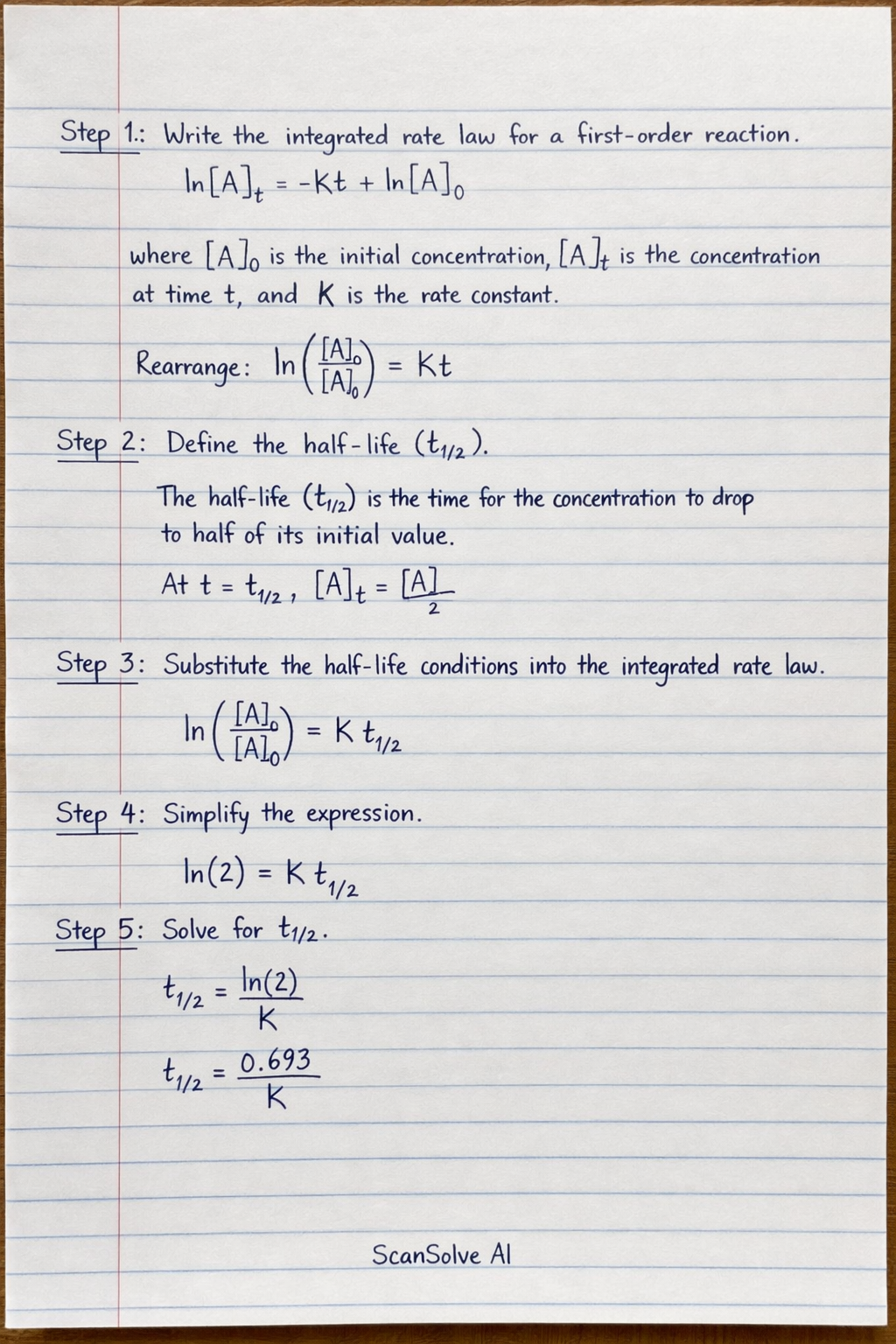
Handwritten Step-by-Step Solution
Get this as a handwritten image on WhatsApp — like a tutor wrote it for you.
Try on WhatsApp