
We read your photo as:
Calculate the mass of aluminium deposited from an aqueous solution of aluminum sulfate when a current of 3.0 A is passed for 2 hours. (Molar mass of Al = 27 g/mol; Faraday constant F = 96500 C/mol)
Chemistry
ScanSolve AI Answer
Step-by-step solution
6 stepsConvert time from hours to seconds.
Calculate the total charge () passed using the formula .
Write the half-reaction for the deposition of aluminium.
Aluminium ions are .
This reaction shows that 3 moles of electrons are required to deposit 1 mole of aluminium.
Calculate the moles of electrons passed.
One Faraday () is the charge of one mole of electrons, given as .
Calculate the moles of aluminium deposited using the stoichiometry from the half-reaction.
Calculate the mass of aluminium deposited using its molar mass ().
The calculated mass is approximately , which is closest to .
The final answer is .
- In electrolytic purification processes, the impure metal to be purified is used as the anode. At the anode, the impure metal is oxidized to form metal ions, which then migrate to the cathode to be deposited as pure metal.
The final answer is .
- One faraday is equal to the charge of one mole of electrons. Numerically, this value is approximately .
The final answer is .
Was this helpful?
Still stuck on this one?
Ask a follow-up, and the answer starts from this question.
Got a different question?Ask your own question
More Chemistry Questions
QCalculate the mass of aluminum deposited from molten aluminum oxide when a current of 40,000 A is…QCalculate the current that must be passed into a solution of aluminum salt for 2hrs in order to…QHow many coulombs of electricity would be needed to deposit 3.6 g of aluminium by the electrolysis…QCalculate the time required to deposit 1.98 g of copper from a solution of copper sulfate with a…QCalculate the relative atomic mass of a divalent metal M if 0.66 g of it is deposited by passing a…
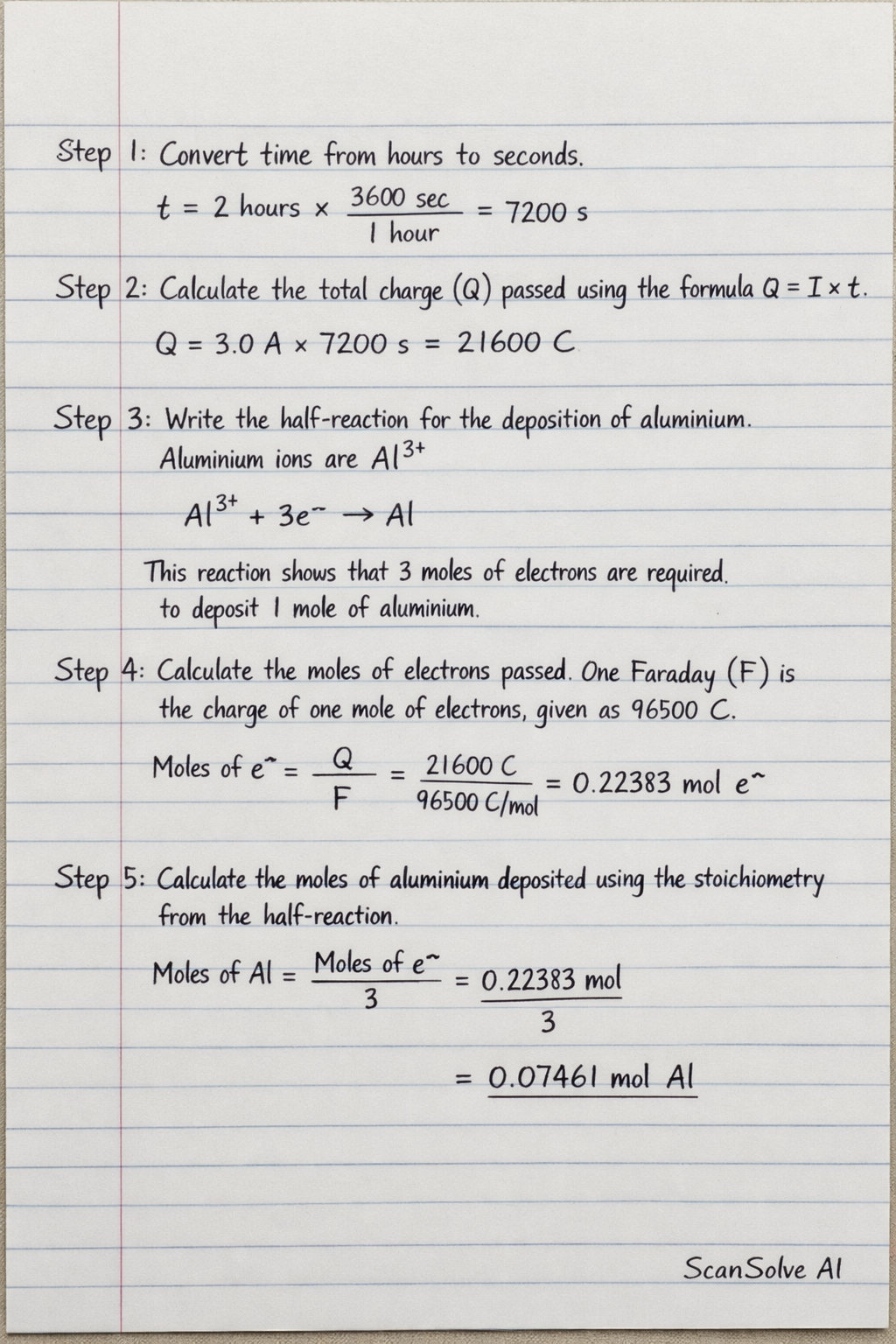
Handwritten Step-by-Step Solution
Get this as a handwritten image on WhatsApp — like a tutor wrote it for you.
Try on WhatsApp