We read your photo as:

Calculate the molar mass, moles, and concentration of NaHCO₃ in solution B, given mass and volume.

Chemistry

ScanSolve AI Answer

Step-by-step solution

6 steps

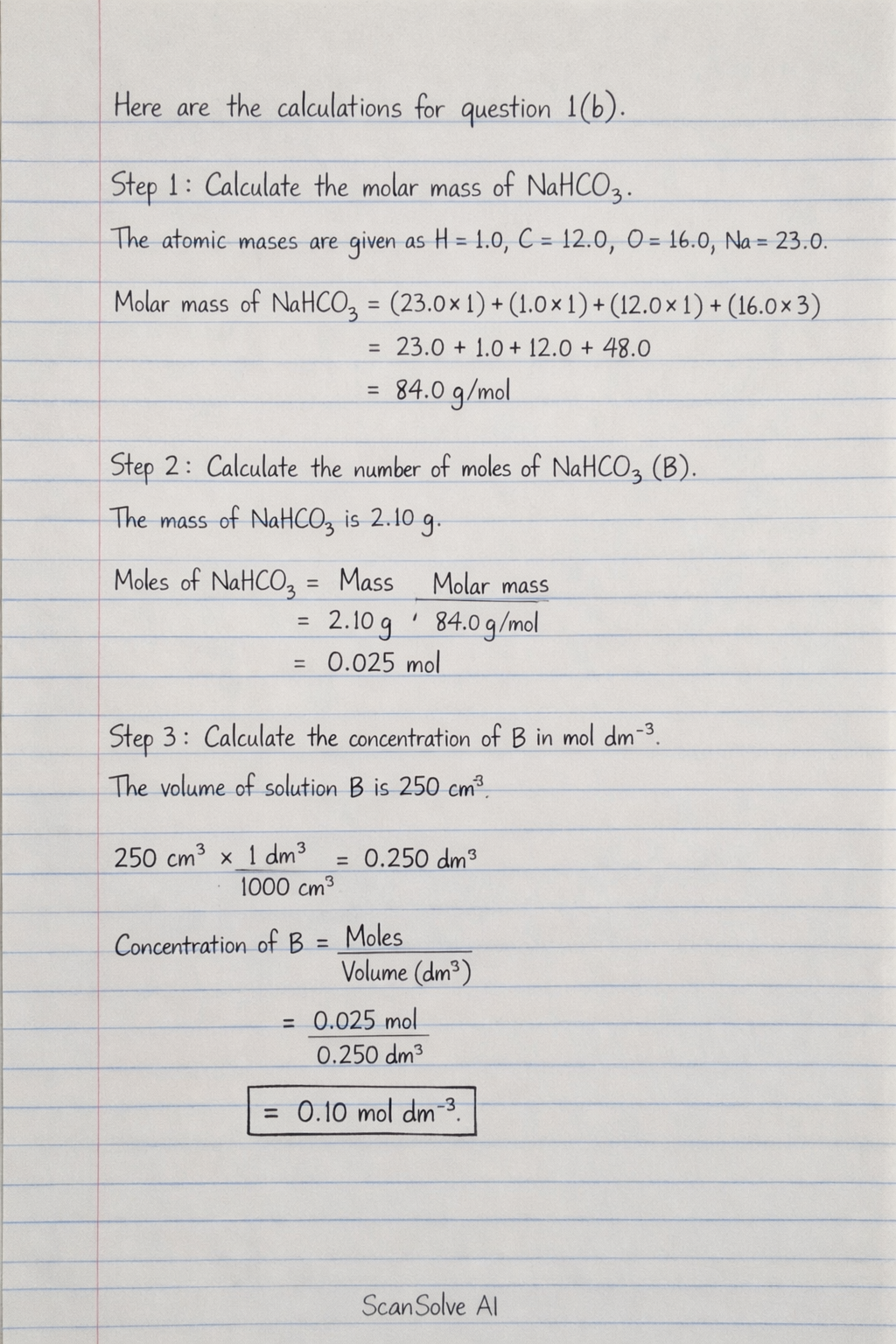
Here are the calculations for question 1(b).

  1. Calculate the molar mass of NaHCO₃.

    The atomic masses are given as H = 1.0, C = 12.0, O = 16.0, Na = 23.0.

    Molar mass of NaHCO3=(23.0×1)+(1.0×1)+(12.0×1)+(16.0×3)\text{Molar mass of NaHCO}_3 = (23.0 \times 1) + (1.0 \times 1) + (12.0 \times 1) + (16.0 \times 3) Molar mass of NaHCO3=23.0+1.0+12.0+48.0=84.0 g/mol\text{Molar mass of NaHCO}_3 = 23.0 + 1.0 + 12.0 + 48.0 = 84.0 \text{ g/mol}
  2. Calculate the number of moles of NaHCO₃ (B).

    The mass of NaHCO₃ is 2.10 g.

    Moles of NaHCO3=MassMolar mass=2.10 g84.0 g/mol=0.025 mol\text{Moles of NaHCO}_3 = \frac{\text{Mass}}{\text{Molar mass}} = \frac{2.10 \text{ g}}{84.0 \text{ g/mol}} = 0.025 \text{ mol}
  3. Calculate the concentration of B in mol dm⁻³.

    The volume of solution B is 250 cm³, which is equal to 250 cm3×1 dm31000 cm3=0.250 dm3250 \text{ cm}^3 \times \frac{1 \text{ dm}^3}{1000 \text{ cm}^3} = 0.250 \text{ dm}^3.

    Concentration of B=MolesVolume (dm3)=0.025 mol0.250 dm3=0.10 mol dm−3\text{Concentration of B} = \frac{\text{Moles}}{\text{Volume (dm}^3)} = \frac{0.025 \text{ mol}}{0.250 \text{ dm}^3} = \boxed{0.10 \text{ mol dm}^{-3}}

    To calculate parts (ii), (iii), and (iv), the average volume of solution A used in the titration (from part 1(a)) is required, as well as the specific volume of solution B used for each titration (either 20.0 cm³ or 25.0 cm³). Since these values are not provided in the question, we will assume the following to demonstrate the calculations:

    • Assume 25.0 cm³ of solution B was used for each titration.
    • Assume the average volume of solution A used was 24.50 cm³.
  4. Calculate the concentration of A in mol dm⁻³ (based on assumptions).

    From the balanced equation: NaHCO3(aq)+HCl(aq)→NaCl(aq)+H2O(l)+CO2(g)\text{NaHCO}_3(\text{aq}) + \text{HCl}(\text{aq}) \rightarrow \text{NaCl}(\text{aq}) + \text{H}_2\text{O}(\text{l}) + \text{CO}_2(\text{g}).
    The mole ratio of NaHCO₃ to HCl is 1:1.

    Moles of NaHCO₃ in 25.0 cm³ of solution B:

    Moles of NaHCO3=Concentration of B×Volume of B\text{Moles of NaHCO}_3 = \text{Concentration of B} \times \text{Volume of B} Moles of NaHCO3=0.10 mol dm−3×25.01000 dm3=0.0025 mol\text{Moles of NaHCO}_3 = 0.10 \text{ mol dm}^{-3} \times \frac{25.0}{1000} \text{ dm}^3 = 0.0025 \text{ mol}

    Since the mole ratio is 1:1, moles of HCl reacted = 0.0025 mol.

    Concentration of A (HCl):

    Concentration of A=Moles of HClAverage volume of A (dm3)\text{Concentration of A} = \frac{\text{Moles of HCl}}{\text{Average volume of A (dm}^3)} Concentration of A=0.0025 mol24.501000 dm3=0.00250.0245 mol dm−3≈0.102 mol dm−3\text{Concentration of A} = \frac{0.0025 \text{ mol}}{\frac{24.50}{1000} \text{ dm}^3} = \frac{0.0025}{0.0245} \text{ mol dm}^{-3} \approx \boxed{0.102 \text{ mol dm}^{-3}}
  5. Calculate the concentration of A in g dm⁻³ (based on assumptions).

    Molar mass of HCl = H + Cl = 1.0 + 35.5 = 36.5 g/mol.

    Concentration of A in g dm−3=Concentration of A in mol dm−3×Molar mass of HCl\text{Concentration of A in g dm}^{-3} = \text{Concentration of A in mol dm}^{-3} \times \text{Molar mass of HCl} Concentration of A in g dm−3=0.102 mol dm−3×36.5 g/mol≈3.72 g dm−3\text{Concentration of A in g dm}^{-3} = 0.102 \text{ mol dm}^{-3} \times 36.5 \text{ g/mol} \approx \boxed{3.72 \text{ g dm}^{-3}}
  6. Calculate the volume, V, of hydrogen chloride gas dissolved in 1 dm³ of the solution (based on assumptions).

    The concentration of A in mol dm⁻³ represents the moles of HCl in 1 dm³ of solution.
    Moles of HCl in 1 dm³ of solution A = 0.102 mol.
    Molar volume of gas at s.t.p. = 22.4 dm³/mol.

    Volume of HCl gas=Moles of HCl×Molar volume of gas at s.t.p.\text{Volume of HCl gas} = \text{Moles of HCl} \times \text{Molar volume of gas at s.t.p.} Volume of HCl gas=0.102 mol×22.4 dm3/mol≈2.28 dm3\text{Volume of HCl gas} = 0.102 \text{ mol} \times 22.4 \text{ dm}^3/\text{mol} \approx \boxed{2.28 \text{ dm}^3}
Was this helpful?

Still stuck on this one?

Ask a follow-up, and the answer starts from this question.

Got a different question?Ask your own question
Handwritten step-by-step solution preview

Handwritten Step-by-Step Solution

Get this as a handwritten image on WhatsApp — like a tutor wrote it for you.

Try on WhatsApp