
We read your photo as:
The concentration of NaOH in solution B is 2.00 g/dm³. Calculate the concentration of solution B in mol/dm³. If a titration used 25.00 cm³ of NaOH and 18.50 cm³ of H₂SO₄, what is the concentration of
ScanSolve AI Answer
Answer
Step-by-step solution
3 stepsCalculate the molar mass of sodium hydroxide (NaOH).
The atomic masses are: Na = , O = , H = .
Calculate the concentration of solution B (NaOH) in .
The mass concentration of NaOH is given as .
The concentration of B is .
Address parts (ii) and (iii).
To calculate the pH of solution A and the amount of ions that react, the concentration of solution A () is required. The concentration of A is determined from the titration data (specifically, the average volume of solution A used from the burette). Since no burette readings or average volume of A are provided in the problem description, parts (ii) and (iii) cannot be calculated.
If the average volume of A () and the pipetted volume of B () were known, the calculations would proceed as follows:
-
For (ii) pH of solution A:
- Write the balanced chemical equation: .
- Use the titration formula: , where and .
- Calculate the concentration of A () using the known (from part i), (pipette volume, e.g., ), and the experimental .
- Since is a diprotic acid, .
- Calculate .
-
For (iii) amount of ions that react:
- In an acid-base neutralization reaction, ions are spectator ions and do not chemically react (i.e., their chemical form does not change).
- If the question implies the amount of ions present in the volume of acid that reacted, then: Moles of = Moles of reacted. Moles of reacted = (where is the average volume of A used, in ). This calculation also requires the concentration of A () and the average volume of A used (), which are not provided.
-
Try one yourself
A new problem that tests the same skill.
Still stuck on this one?
Ask a follow-up, and the answer starts from this question.
More Chemistry Questions
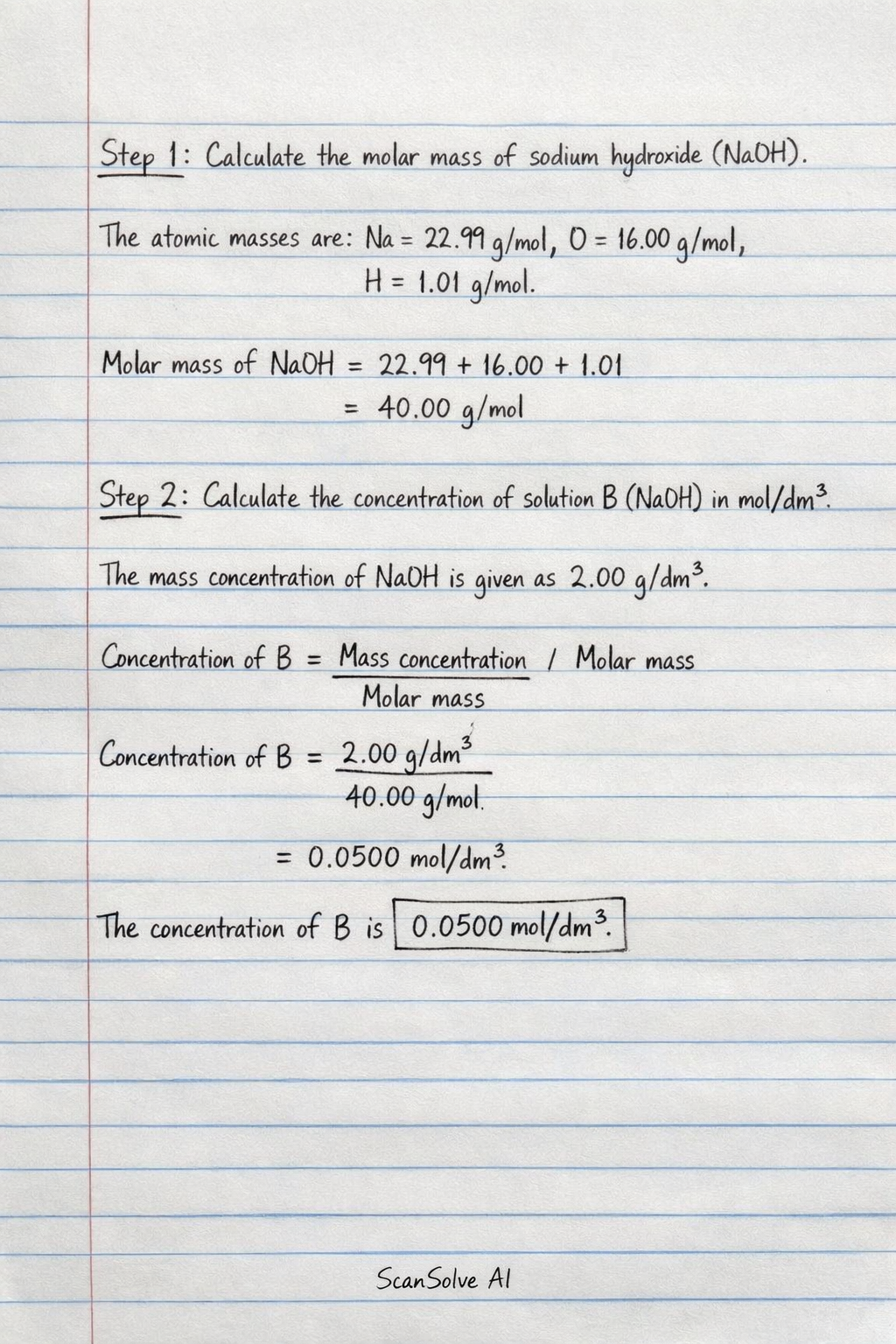
Handwritten Step-by-Step Solution
Get this as a handwritten image on WhatsApp — like a tutor wrote it for you.
Try on WhatsApp