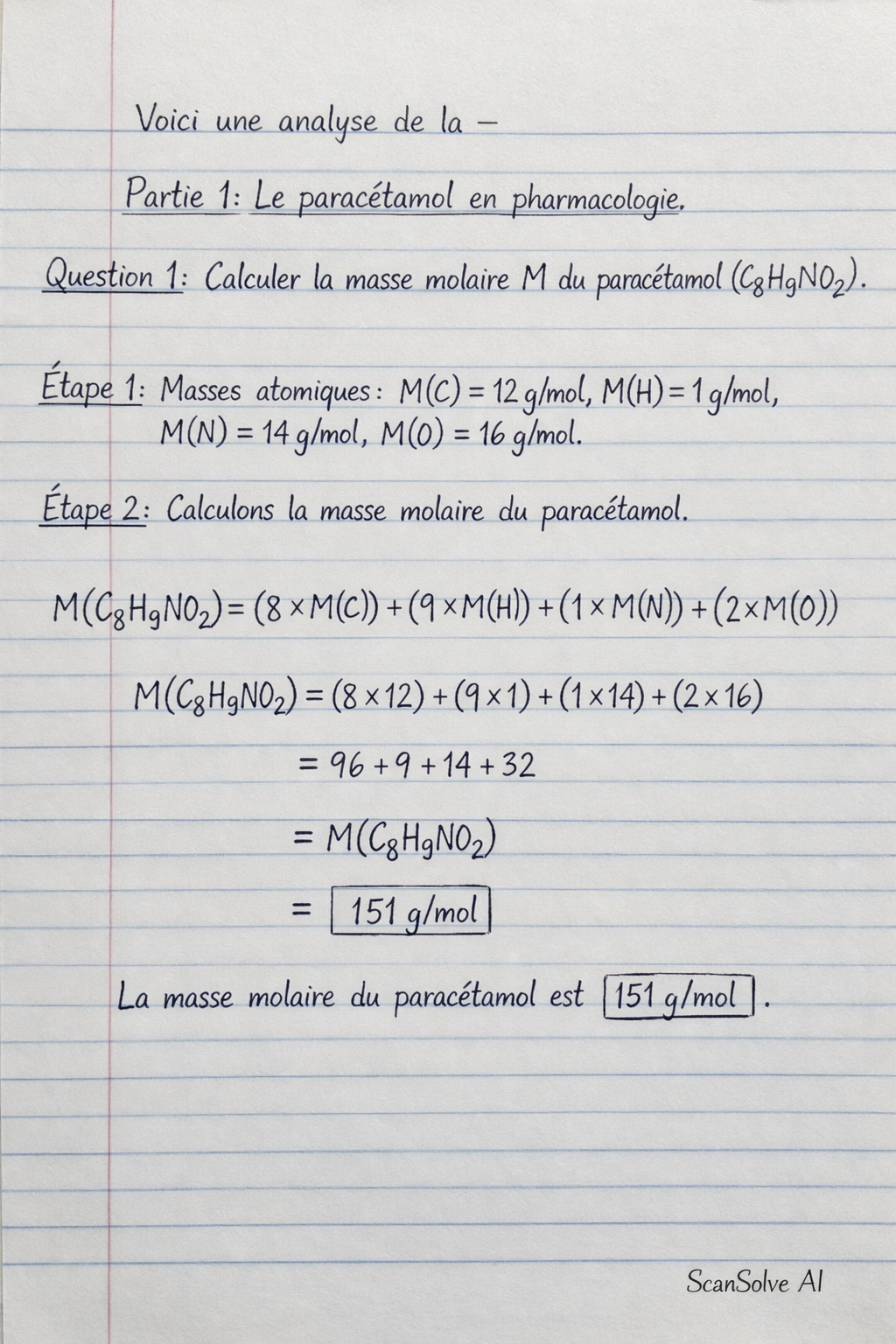
We read your photo as:

Calculate the molar mass of paracetamol (C8H9NO2), the amount of substance (in moles) of paracetamol in a tablet, and the number of paracetamol molecules in a tablet.

Chemistry

ScanSolve AI Answer

Step-by-step solution

16 steps

Partie 1: Le paracétamol en pharmacologie

Question 1: Calculer la masse molaire M du paracétamol (C8H9NO2\text{C}_8\text{H}_9\text{NO}_2).

  1. Use the atomic masses provided

    M(C) = 12 g/mol, M(H) = 1 g/mol, M(N) = 14 g/mol, M(O) = 16 g/mol.

  2. Calculate the molar mass of paracetamol.

    M(C8H9NO2)=(8×M(C))+(9×M(H))+(1×M(N))+(2×M(O))M(\text{C}_8\text{H}_9\text{NO}_2) = (8 \times M(\text{C})) + (9 \times M(\text{H})) + (1 \times M(\text{N})) + (2 \times M(\text{O})) M(C8H9NO2)=(8×12)+(9×1)+(1×14)+(2×16)M(\text{C}_8\text{H}_9\text{NO}_2) = (8 \times 12) + (9 \times 1) + (1 \times 14) + (2 \times 16) M(C8H9NO2)=96+9+14+32M(\text{C}_8\text{H}_9\text{NO}_2) = 96 + 9 + 14 + 32 M(C8H9NO2)=151 g/molM(\text{C}_8\text{H}_9\text{NO}_2) = 151 \text{ g/mol}

    The molar mass of paracetamol is 151 g/mol\boxed{151 \text{ g/mol}}.

    Question 2: Calculer la quantité de matière n (en moles) de paracétamol dans un comprimé.

  3. Use the mass of paracetamol in one tablet m=0.5m = 0.5 g and the molar mass M=151M = 151 g/mol.

  4. Calculate the quantity of matter.

    n=mMn = \frac{m}{M} n=0.5 g151 g/moln = \frac{0.5 \text{ g}}{151 \text{ g/mol}} n≈0.00331 moln \approx 0.00331 \text{ mol}

    The quantity of matter is 0.00331 mol\boxed{0.00331 \text{ mol}}.

    Question 3: Combien y a-t-il de molécules de paracétamol dans un comprimé?

  5. Use the quantity of matter n≈0.00331n \approx 0.00331 mol and Avogadro's number NA=6.02×10²³N_A = 6.02 \times 10^{23} mol−1^{-1}.

  6. Calculate the number of molecules.

    Nombre de moleˊcules=n×NA\text{Nombre de molécules} = n \times N_A Nombre de moleˊcules=0.00331 mol×(6.02×1023 moleˊcules/mol)\text{Nombre de molécules} = 0.00331 \text{ mol} \times (6.02 \times 10^{23} \text{ molécules/mol}) Nombre de moleˊcules≈1.99×10²¹ moleˊcules\text{Nombre de molécules} \approx 1.99 \times 10^{21} \text{ molécules}

    The number of paracetamol molecules is 1.99×10²¹ moleˊcules\boxed{1.99 \times 10^{21} \text{ molécules}}.

    Partie 2: Le butane dans une bouteille de gaz

    Question 1: Déterminer la masse molaire du butane M(C4H10\text{C}_4\text{H}_{10}).

  7. Use the atomic masses

    M(C) = 12 g/mol, M(H) = 1 g/mol.

  8. Calculate the molar mass of butane.

    M(C4H10)=(4×M(C))+(10×M(H))M(\text{C}_4\text{H}_{10}) = (4 \times M(\text{C})) + (10 \times M(\text{H})) M(C4H10)=(4×12)+(10×1)M(\text{C}_4\text{H}_{10}) = (4 \times 12) + (10 \times 1) M(C4H10)=48+10M(\text{C}_4\text{H}_{10}) = 48 + 10 M(C4H10)=58 g/molM(\text{C}_4\text{H}_{10}) = 58 \text{ g/mol}

    The molar mass of butane is 58 g/mol\boxed{58 \text{ g/mol}}.

    Question 2: Calculer la quantité de matière n du butane dans la bouteille.

  9. Use the volume of the bottle V=25V = 25 L and the molar volume of gas Vm=24V_m = 24 L/mol.

  10. Calculate the quantity of matter.

    n=VVmn = \frac{V}{V_m} n=25 L24 L/moln = \frac{25 \text{ L}}{24 \text{ L/mol}} n≈1.04 moln \approx 1.04 \text{ mol}

    The quantity of matter of butane is 1.04 mol\boxed{1.04 \text{ mol}}.

    Question 3: Quelle est la masse m du gaz contenu dans la bouteille?

  11. Use the quantity of matter n≈1.04n \approx 1.04 mol and the molar mass M=58M = 58 g/mol.

  12. Calculate the mass of the gas.

    m=n×Mm = n \times M m=1.04 mol×58 g/molm = 1.04 \text{ mol} \times 58 \text{ g/mol} m≈60.32 gm \approx 60.32 \text{ g}

    The mass of the butane gas is 60.32 g\boxed{60.32 \text{ g}}.

    Question 4: En déduire la masse volumique ρ\rho du butane dans ces conditions.

  13. Use the mass of the gas m≈60.32m \approx 60.32 g and the volume of the bottle V=25V = 25 L.

  14. Calculate the volumetric mass (density).

    ρ=mV\rho = \frac{m}{V} ρ=60.32 g25 L\rho = \frac{60.32 \text{ g}}{25 \text{ L}} ρ≈2.41 g/L\rho \approx 2.41 \text{ g/L}

    The volumetric mass of butane is 2.41 g/L\boxed{2.41 \text{ g/L}}.

    Question 5: Calculer la densité d du butane par rapport à l'air.

  15. The density of a gas relative to air can be calculated using the ratio of their molar masses, assuming ideal gas behavior at the same temperature and pressure.

    The average molar mass of air is approximately Mair≈29M_{air} \approx 29 g/mol.

  16. Calculate the density relative to air.

    d=M(butane)M(air)d = \frac{M(\text{butane})}{M(\text{air})} d=58 g/mol29 g/mold = \frac{58 \text{ g/mol}}{29 \text{ g/mol}} d=2d = 2

    The density of butane relative to air is 2\boxed{2}.

Was this helpful?

Still stuck on this one?

Ask a follow-up, and the answer starts from this question.

Got a different question?Ask your own question
Handwritten step-by-step solution preview

Handwritten Step-by-Step Solution

Get this as a handwritten image on WhatsApp — like a tutor wrote it for you.

Try on WhatsApp