We read your photo as:

Calculate the molarity of solution A using the provided redox titration equations.

Chemistry

ScanSolve AI Answer

Step-by-step solution

4 steps

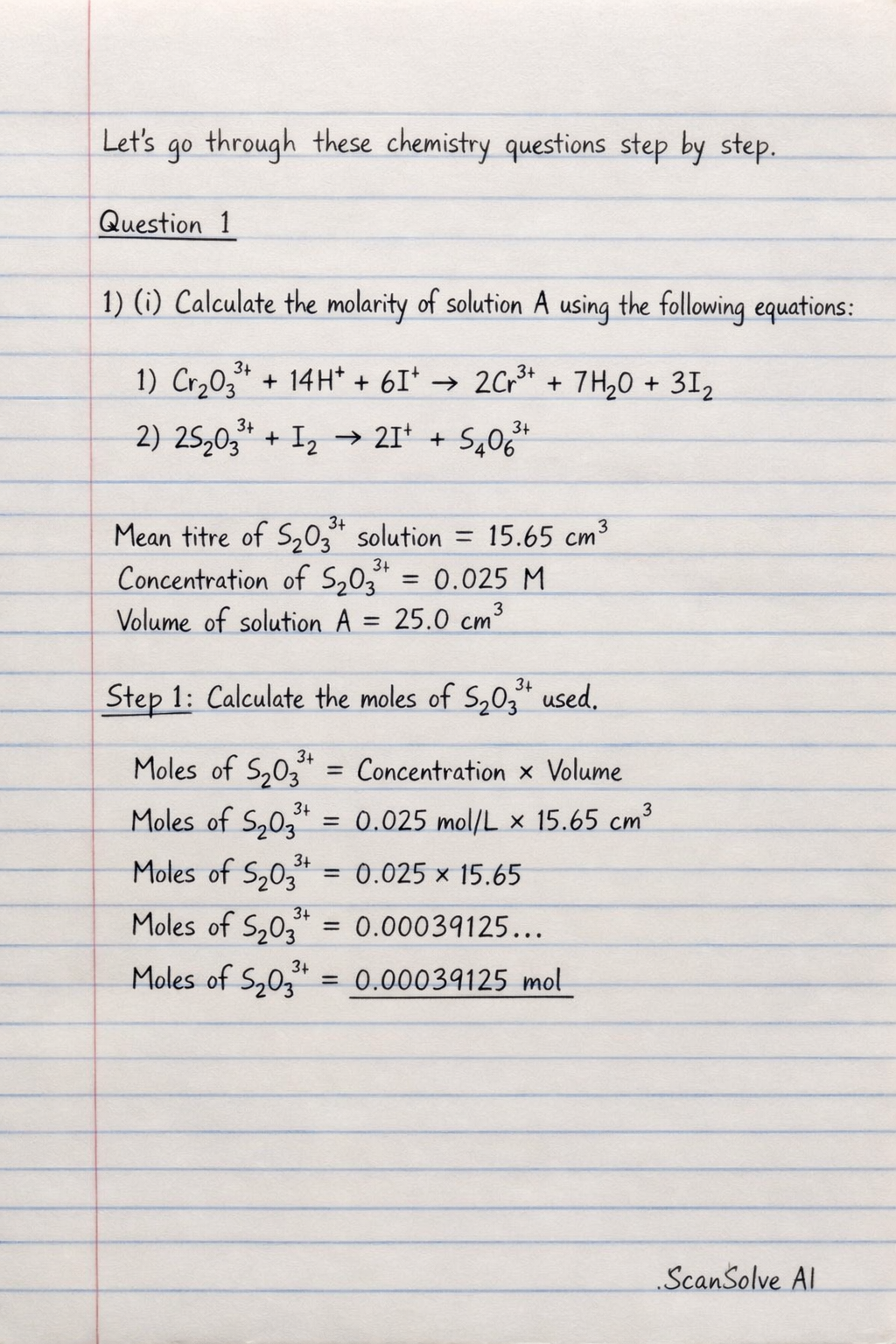
Let's go through these chemistry questions step by step.

Question 1

1) (i) Calculate the molarity of solution A using the following equations:
Given equations:

  1. Cr2O72−+14H++6I−→2Cr3++7H2O+3I2\text{Cr}_2\text{O}_7^{2-} + 14\text{H}^+ + 6\text{I}^- \to 2\text{Cr}^{3+} + 7\text{H}_2\text{O} + 3\text{I}_2
  2. 2S2O32−+I2→2I−+S4O62−2\text{S}_2\text{O}_3^{2-} + \text{I}_2 \to 2\text{I}^- + \text{S}_4\text{O}_6^{2-}

From your previous work, the mean titre (volume of S2O32−\text{S}_2\text{O}_3^{2-} solution) is 15.65 cm315.65 \text{ cm}^3.
We will assume the concentration of the S2O32−\text{S}_2\text{O}_3^{2-} solution is 0.025 M0.025 \text{ M}, as implied by your partial calculation. The volume of solution A used for titration is typically 25.0 cm325.0 \text{ cm}^3.

  1. Calculate the moles of S2O32−\text{S}_2\text{O}_3^{2-} used.

    Moles of S2O32−=Concentration×Volume\text{Moles of S}_2\text{O}_3^{2-} = \text{Concentration} \times \text{Volume} Moles of S2O32−=0.025 mol dm−3×15.651000 dm3\text{Moles of S}_2\text{O}_3^{2-} = 0.025 \text{ mol dm}^{-3} \times \frac{15.65}{1000} \text{ dm}^3 Moles of S2O32−=0.00039125 mol\text{Moles of S}_2\text{O}_3^{2-} = 0.00039125 \text{ mol}
  2. Calculate the moles of I2\text{I}_2 produced.

    From equation (2), the mole ratio of S2O32−\text{S}_2\text{O}_3^{2-} to I2\text{I}_2 is 2:12:1.

    Moles of I2=Moles of S2O32−2\text{Moles of I}_2 = \frac{\text{Moles of S}_2\text{O}_3^{2-}}{2} Moles of I2=0.00039125 mol2\text{Moles of I}_2 = \frac{0.00039125 \text{ mol}}{2} Moles of I2=0.000195625 mol\text{Moles of I}_2 = 0.000195625 \text{ mol}
  3. Calculate the moles of Cr2O72−\text{Cr}_2\text{O}_7^{2-} (solution A) reacted.

    From equation (1), the mole ratio of Cr2O72−\text{Cr}_2\text{O}_7^{2-} to I2\text{I}_2 is 1:31:3.

    Moles of Cr2O72−=Moles of I23\text{Moles of Cr}_2\text{O}_7^{2-} = \frac{\text{Moles of I}_2}{3} Moles of Cr2O72−=0.000195625 mol3\text{Moles of Cr}_2\text{O}_7^{2-} = \frac{0.000195625 \text{ mol}}{3} Moles of Cr2O72−=0.0000652083 mol\text{Moles of Cr}_2\text{O}_7^{2-} = 0.0000652083 \text{ mol}
  4. Calculate the molarity of solution A.

    The volume of solution A used was 25.0 cm325.0 \text{ cm}^3 (0.025 dm30.025 \text{ dm}^3).

    Molarity of A=Moles of Cr2O72−Volume of A\text{Molarity of A} = \frac{\text{Moles of Cr}_2\text{O}_7^{2-}}{\text{Volume of A}} Molarity of A=0.0000652083 mol0.025 dm3\text{Molarity of A} = \frac{0.0000652083 \text{ mol}}{0.025 \text{ dm}^3} Molarity of A=0.00260833 mol dm−3\text{Molarity of A} = 0.00260833 \text{ mol dm}^{-3}

    The molarity of solution A is 0.00261 M\boxed{0.00261 \text{ M}} (to 3 significant figures).

    1) (ii) Is the reaction occurring in table 2 exothermic or endothermic? Explain.
    The reaction is endothermic.
    The temperature of the water decreased from 27.0∘C27.0^\circ\text{C} to 21.5∘C21.5^\circ\text{C}. This indicates that the reaction absorbed heat from the surroundings (the water), causing the temperature of the water to drop.

    Question 2

    a) (i) Carry out a flame test on a solid sample of E.

    • Observations: Lilac flame
    • Inferences: The presence of potassium ions (K+\text{K}^+). (A lilac flame is characteristic of potassium.)

    a) (ii) To a solid portion of E in a dry test tube, add 1 cm31 \text{ cm}^3 of conc. H2SO4\text{H}_2\text{SO}_4, test for any gas evolved with red and blue litmus paper.

    • Observations: Gas turns blue litmus paper red; red litmus paper shows no observable change. This indicates an acidic gas is evolved.
    • Inferences: The evolution of an acidic gas (likely brown fumes of NO2\text{NO}_2) when a solid reacts with concentrated sulfuric acid suggests the presence of nitrite ions (NO2−\text{NO}_2^-). (Nitrites react with conc. H2SO4\text{H}_2\text{SO}_4 to produce acidic brown fumes of nitrogen dioxide.)
Was this helpful?

Still stuck on this one?

Ask a follow-up, and the answer starts from this question.

Got a different question?Ask your own question
Handwritten step-by-step solution preview

Handwritten Step-by-Step Solution

Get this as a handwritten image on WhatsApp — like a tutor wrote it for you.

Try on WhatsApp