
We read your photo as:
Describe an experiment to determine the heat of combustion of methanol.
ScanSolve AI Answer
Answer
Step-by-step solution
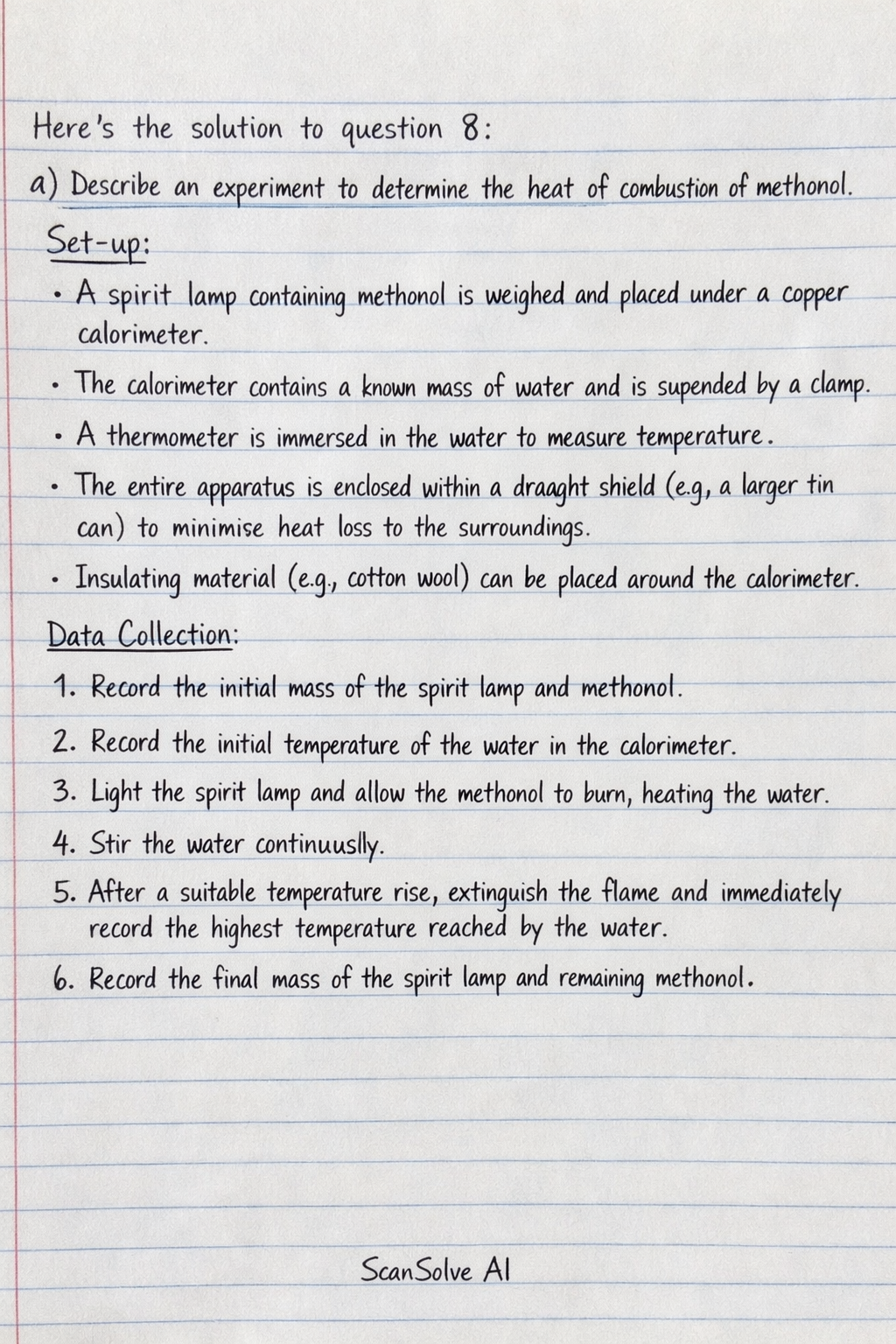
5 stepsHere's the solution to question 8:
Part a
Describe an experiment to determine the heat of combustion of methanol.
-
Set-up:
- A spirit lamp containing methanol is weighed and placed under a copper calorimeter.
- The calorimeter contains a known mass of water and is suspended by a clamp.
- A thermometer is immersed in the water to measure temperature.
- The entire apparatus is enclosed within a draught shield (e.g., a larger tin can) to minimize heat loss to the surroundings.
- Insulating material (e.g., cotton wool) can be placed around the calorimeter.
-
Data Collection:
- Record the initial mass of the spirit lamp and methanol.
- Record the initial temperature of the water in the calorimeter.
- Light the spirit lamp and allow the methanol to burn, heating the water.
- Stir the water continuously.
- After a suitable temperature rise, extinguish the flame and immediately record the highest temperature reached by the water.
- Record the final mass of the spirit lamp and remaining methanol.
-
Precautions:
- Use a draught shield to prevent heat loss due to convection currents and ensure complete combustion.
- Insulate the calorimeter to minimize heat loss to the surroundings.
- Stir the water constantly to ensure uniform temperature distribution and accurate readings.
- Ensure the flame is directly under the calorimeter for efficient heat transfer.
-
Assumptions:
- All heat released by the combustion of methanol is absorbed by the water and the calorimeter.
- The specific heat capacity of water is constant ().
- The density of water is .
- Complete combustion of methanol occurs.
- The heat capacity of the calorimeter is negligible or accounted for.
Part b
Calculate the molar heat of combustion of methanol.
Calculate the mass of water.
Given the volume of water is and assuming the density of water is .
Calculate the temperature change of the water.
Calculate the heat absorbed by the water.
Using the formula , where for water is .
Calculate the moles of methanol burned.
Given the mass of methanol is and RMM is .
Calculate the molar heat of combustion.
The molar heat of combustion is the heat released per mole of methanol. Since heat was absorbed by the water, the combustion is exothermic, so the value will be negative.
The molar heat of combustion of methanol is .
Try one yourself
A new problem that tests the same skill.
Still stuck on this one?
Ask a follow-up, and the answer starts from this question.
More Chemistry Questions
Handwritten Step-by-Step Solution
Get this as a handwritten image on WhatsApp — like a tutor wrote it for you.
Try on WhatsApp