

This chemistry question involves key chemical concepts and calculations. The detailed solution below walks through each step, from identifying the reaction type to computing the final answer.
ScanSolve AI Answer
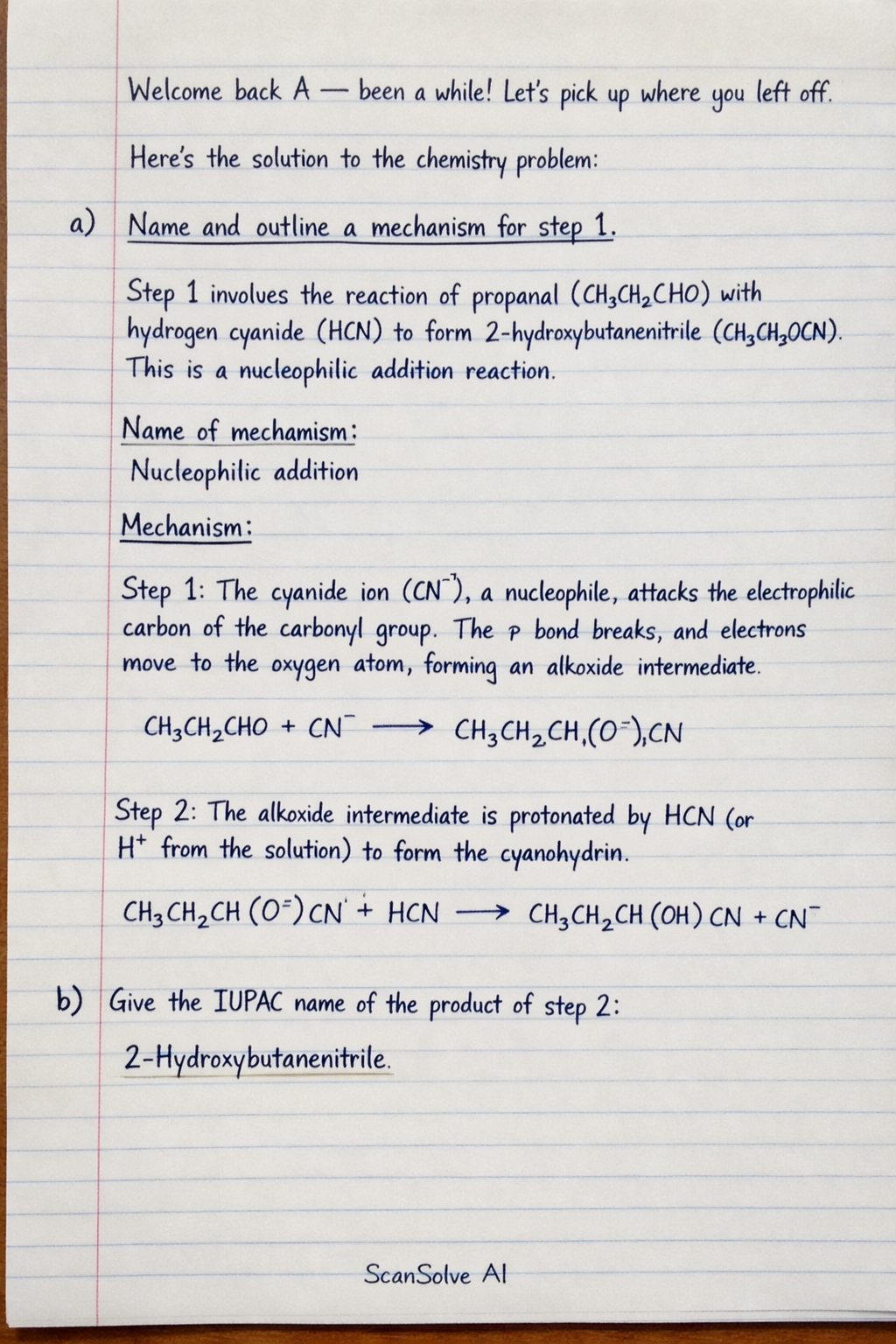
Here's the solution to the chemistry problem: a) Name and outline a mechanism for step 1 Step 1 involves the reaction of propanal (CH_3CH_2CHO) with hydrogen cyanide (HCN) to form 2-hydroxybutanenitrile (CH_3CH_2CH(OH)CN). This is a nucleophilic addition reaction. Name of mechanism: Nucleophilic addition Mechanism: Step 1: The cyanide ion (CN^-), a nucleophile, attacks the electrophilic carbon of the carbonyl group. The bond breaks, and electrons move to the oxygen atom, forming an alkoxide intermediate. CH_3CH_2CHO + CN^- CH_3CH_2CH(O^-)CN Step 2: The alkoxide intermediate is protonated by HCN (or H^+ from the solution) to form the cyanohydrin. CH_3CH_2CH(O^-)CN + HCN CH_3CH_2CH(OH)CN + CN^- b) Give the IUPAC name of the product of step 2. The product of step 2 is CH_3CH_2CH(OH)CN. This is 2-hydroxybutanenitrile. IUPAC name: 2-hydroxybutanenitrile c) For step 3, give the reagent, give a necessary condition and name the mechanism. Step 3 involves the conversion of 2-hydroxybutanenitrile (CH_3CH_2CH(OH)CN) to 2-aminobutanoic acid (CH_3CH_2CH(NH_2)COOH), which is amino acid X. This is a two-step process: hydrolysis of the nitrile to a carboxylic acid and reduction of the hydroxyl group to an amino group. However, the diagram shows the conversion of the nitrile to an amine, then to a carboxylic acid. Let's re-evaluate based on the provided diagram. The diagram shows: Step 1: CH_3CH_2CHO HCN CH_3CH_2CH(OH)CN Step 2: CH_3CH_2CH(OH)CN HBr CH_3CH_2CH(Br)CN Step 3: CH_3CH_2CH(Br)CN NH_3 CH_3CH_2CH(NH_2)CN Step 4: CH_3CH_2CH(NH_2)CN H_2O/H^+ CH_3CH_2CH(NH_2)COOH (Amino acid X) For step 3: Reagent: NH_3 (ammonia) Conditions: Reflux Name of mechanism: Nucleophilic substitution (specifically, S_N2, where ammonia acts as a nucleophile replacing the bromine atom). d) At room temperature, the amino acid X exist as a solid (Zwitterion). i) Draw the structure of the species present in the solid amino acid. Amino acid X is 2-aminobutanoic acid. In its zwitterionic form, the amino group is protonated (-NH_3^+) and the carboxylic acid group is deprotonated (-COO^-). A Zwitterion form: CH_3CH_2CH(NH_3^+)COO^- ii) With reference to your answer to part (d) (i), explain why the melting point of the amino acid X is higher than the melting point of CH_3CH_2CH(OH)COOH. Amino acid X (2-aminobutanoic acid) exists as a zwitterion, which is an ionic species. The zwitterions are held together by strong electrostatic forces of attraction between the positively charged ammonium group and the negatively charged carboxylate group. These strong ionic bonds require a significant amount of energy to overcome, leading to a high melting point. In contrast, CH_3CH_2CH(OH)COOH (2-hydroxybutanoic acid) is a neutral molecule. While it can form hydrogen bonds due to the -OH and -COOH groups, these intermolecular forces are much weaker than the ionic bonds present in the zwitterionic form of the amino acid. Therefore, less energy is required to overcome these forces, resulting in a lower melting point. Reasons: 1. Amino acid X exists as a zwitterion, which is an ionic compound. 2. Zwitterions form strong electrostatic forces of attraction (ionic bonds) between the positive and negative charges, requiring more energy to break compared to the weaker intermolecular forces (like hydrogen bonds) in 2-hydroxybutanoic acid. Drop the next question! 📸