
We read your photo as:
Name the separation technique. How many components are resolved in the separation? What material is used in the laboratory as the absorbent medium? Which of the labels above indicates the point of application?
ScanSolve AI Answer
Step-by-step solution
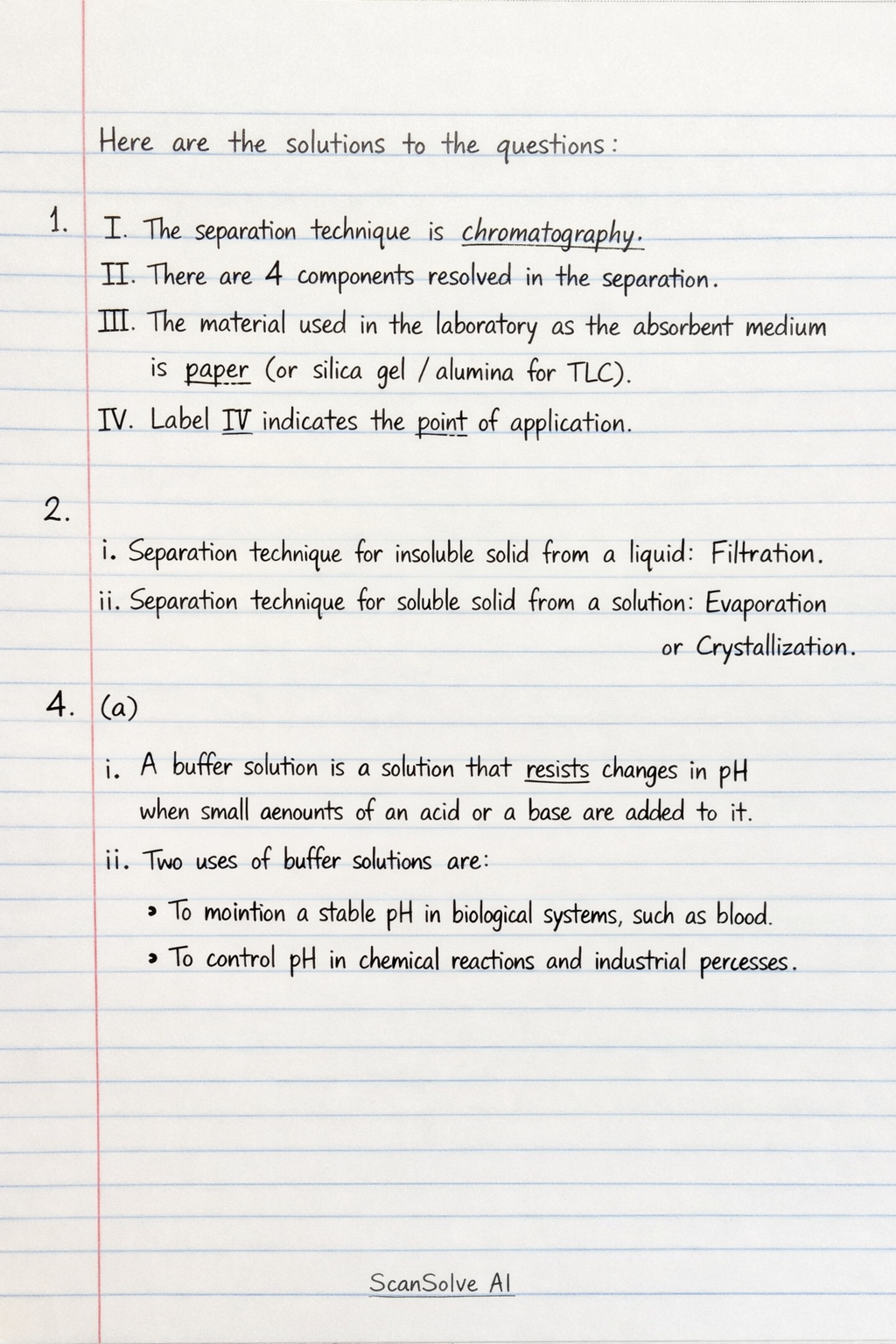
4 stepsHere are the solutions to the questions:
1.
I. The separation technique is chromatography.
II. There are 4 components resolved in the separation.
III. The material used in the laboratory as the absorbent medium is paper (or silica gel/alumina for TLC).
IV. Label IV indicates the point of application.
2.
i. Separation technique for insoluble solid from a liquid: Filtration.
ii. Separation technique for soluble solid from a solution: Evaporation or Crystallization.
4. (a)
i. A buffer solution is a solution that resists changes in pH when small amounts of an acid or a base are added to it.
ii. Two uses of buffer solutions are:
- To maintain a stable pH in biological systems, such as blood.
- To control pH in chemical reactions and industrial processes.
4. (b)
i. The process used in the production of ammonia is the Haber process.
ii. Two physical properties of nitrogen are:
- It is a colorless and odorless gas.
- It has a very low boiling point (approximately ). iii. The two allotropes of carbon are diamond and graphite. iv. The structure of each allotrope:
- Diamond: Each carbon atom is tetrahedrally bonded to four other carbon atoms, forming a rigid 3D network.
- Graphite: Carbon atoms are arranged in hexagonal layers, with each carbon atom bonded to three others within the layer. The layers are held together by weak intermolecular forces. v. One use of charcoal is as a fuel. (Other uses include adsorbent in purification or gas masks, and as a drawing material).
4. (c)
i. General molecular formula for:
I. Alkenes:
II. Alkynes:
ii. The possible structural isomers of are:
- (straight chain)
- (branched chain)
iii. The IUPAC names of the isomers in (c)ii are:
- : Butane
- : 2-Methylpropane
iv. Calculate the molecular formula of a compound with the following composition by mass; 60% carbon, 13.3% hydrogen and 20.7% oxygen with a molar mass of 60.
Calculate the mass of each element in 60 g of the compound.
Given percentages: C = 60%, H = 13.3%, O = 20.7%.
Note: The sum of percentages () is not . We will assume the given percentages are correct for the respective elements within the 60 g molar mass.Convert the mass of each element to moles.
(Atomic masses: C = 12.01 g/mol, H = 1.008 g/mol, O = 16.00 g/mol)
Determine the molecular formula from the mole ratios.
The approximate mole ratio C:H:O is 3:8:1. Since the total molar mass is given as 60 g/mol, these mole numbers directly give the molecular formula.
Verify the molar mass of the determined formula.
For :
This value is consistent with the given molar mass of 60 g/mol.
The molecular formula is .
Still stuck on this one?
Ask a follow-up, and the answer starts from this question.
More Chemistry Questions
Handwritten Step-by-Step Solution
Get this as a handwritten image on WhatsApp — like a tutor wrote it for you.
Try on WhatsApp