
We read your photo as:
NORTH WEST MOCK CHEMISTRY ADVANCED LEVEL PRACTICAL GROUP 2 BY MR PHILIP 672912469
ScanSolve AI Answer
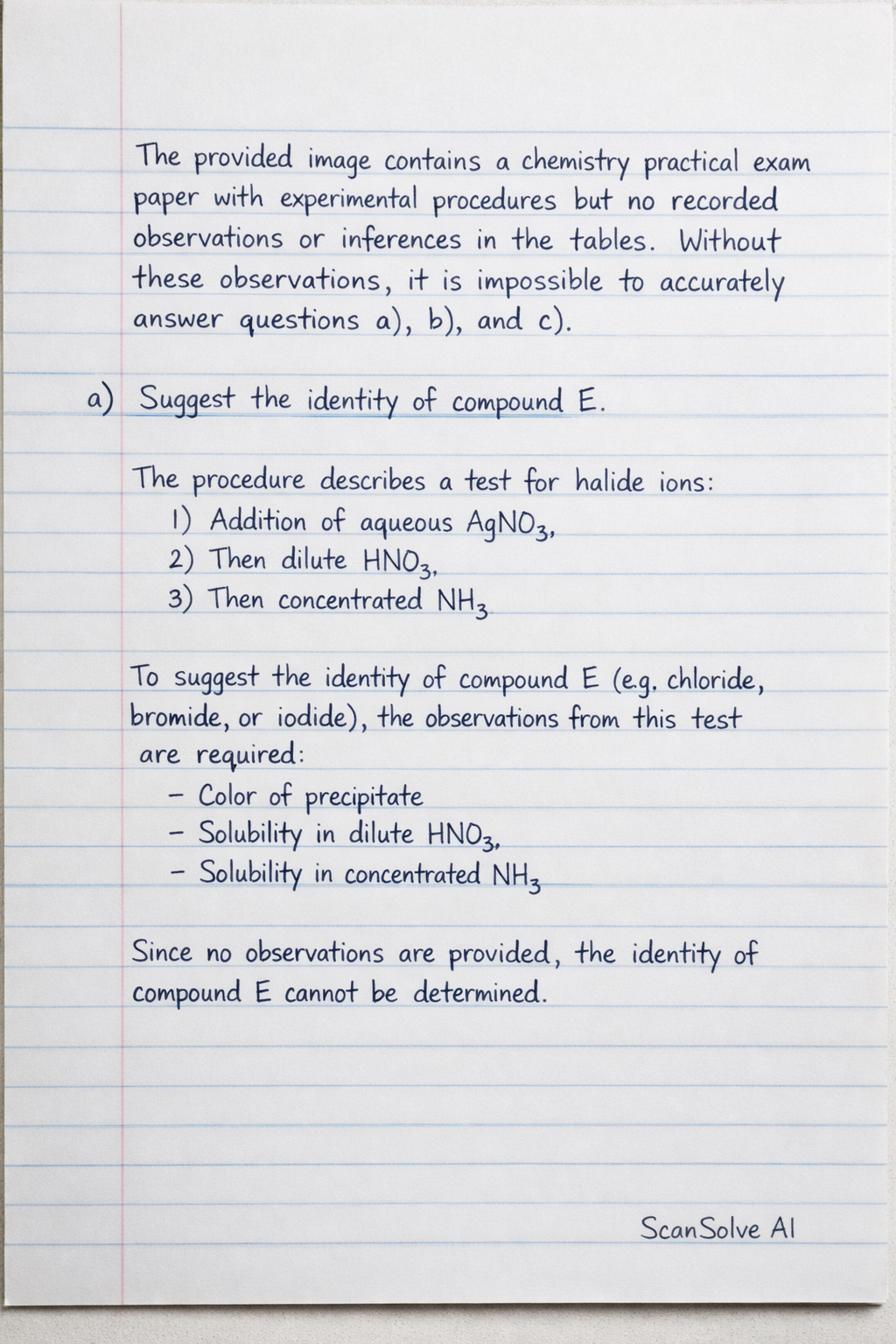
The provided image contains a chemistry practical exam paper with experimental procedures but no recorded observations or inferences in the tables. Without these observations, it is impossible to accurately answer questions a), b), and c).
a) Suggest the identity of compound E.
The procedure describes a test for halide ions (addition of aqueous AgNO₃, then dilute HNO₃, then concentrated NH₃). To suggest the identity of compound E (e.g., chloride, bromide, or iodide), the observations from this test (color of precipitate, solubility in dilute HNO₃, and solubility in concentrated NH₃) are required. Since no observations are provided, the identity of compound E cannot be determined.
b) Identify the cation(s) and anion(s) of compound F.
The procedures describe tests for various cations (addition of NaOH dropwise and in excess, addition of aqueous sodium carbonate) and anions (addition of aqueous barium chloride followed by dilute hydrochloric acid for sulfate/sulfite/carbonate). To identify the cation(s) and anion(s) of compound F, the observations from these tests (e.g., precipitate formation, color, solubility) are required. Since no observations are provided, the cation(s) and anion(s) of compound F cannot be determined.
c) Suggest the functional group(s) present in G.
The procedures describe tests for the pH of solution G (litmus paper), presence of acidic groups (reaction with solid sodium hydrogen carbonate), and reaction with concentrated H₂SO₄ upon warming. To suggest the functional group(s) present in G, the observations from these tests (e.g., litmus color change, effervescence, gas evolved) are required. Since no observations are provided, the functional group(s) present in G cannot be determined.
Still stuck on this one?
Ask a follow-up, and the answer starts from this question.
More Chemistry Questions
Handwritten Step-by-Step Solution
Get this as a handwritten image on WhatsApp — like a tutor wrote it for you.
Try on WhatsApp