ScanSolve logoScanSolve
Toggle sidebar
  • Homework
  • Tutor
  • Humanizer
  • AI Detector
  • Questions
  • Blog
  • History
  • Mobile App

  • Homework
  • Tutor
  • Humanizer
  • AI Detector

  • Questions
  • Math homework helpMath
    Physics homework helpPhysics
    Chemistry homework helpChemistry
    Biology homework helpBiology
    Computer Science homework helpComputer Science
    History homework helpHistory
    More homework helpMore
  • Blog
  • History

  • Mobile App
ScanSolvePLUS
  • Unlimited answers
  • ScanSolve AI Pro
Start Free Trial →
Try on WhatsApp
Home > Chemistry Homework Help > Solution

NW chemistry p2

Asked on March 27, 2026|Chemistry

This chemistry question involves key chemical concepts and calculations. The detailed solution below walks through each step, from identifying the reaction type to computing the final answer.

ScanSolve AI AnswerAnswered on March 27, 2026
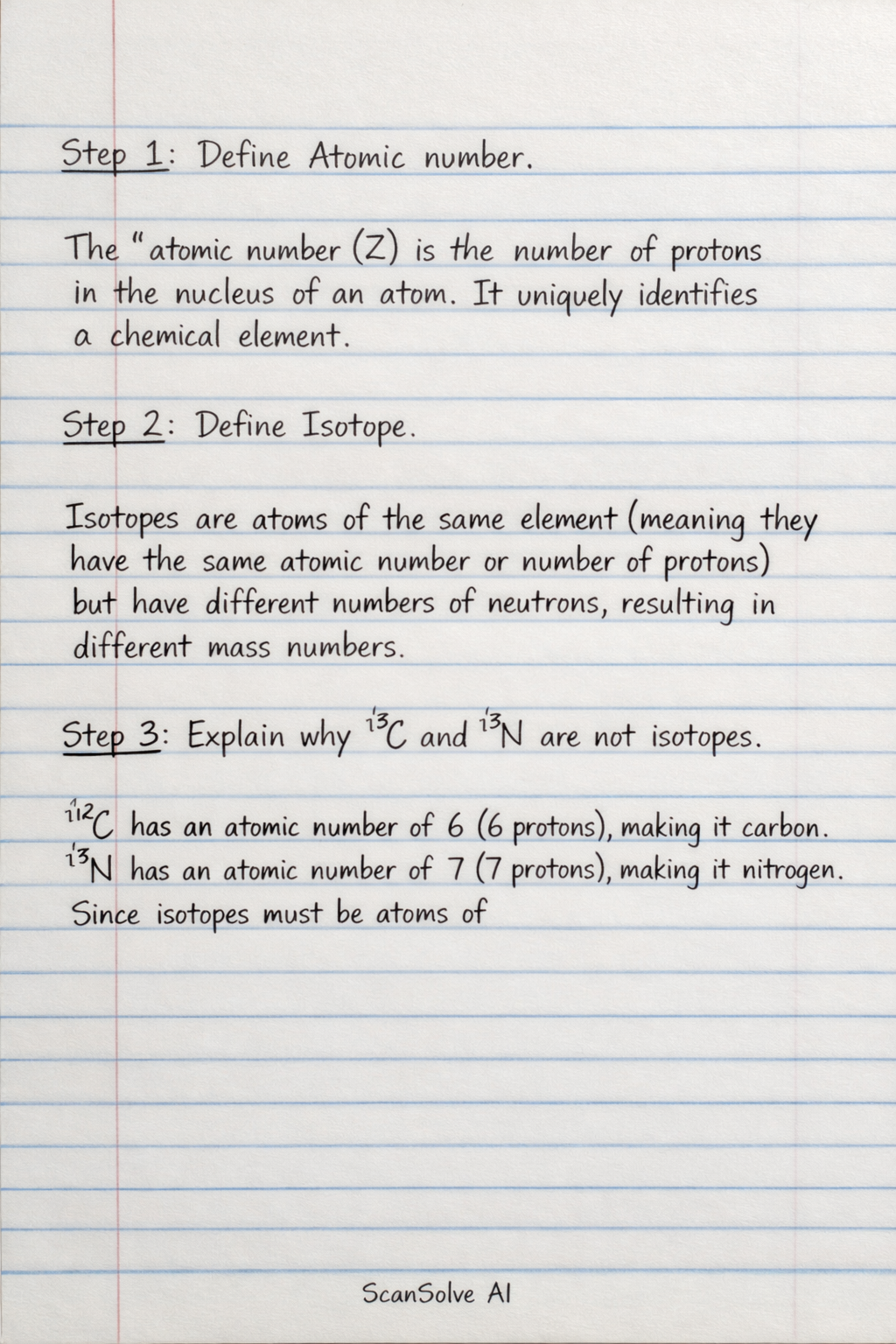
Step 1: Define Atomic number. The atomic number ($Z$) is the number of protons in the nucleus of an atom. It uniquely identifies a chemical element. Step 2: Define Isotope. Isotopes are atoms of the same element (meaning they have the same atomic number or number of protons) but have different numbers of neutrons, resulting in different mass numbers. Step 3: Explain why $^{12}\text{C}$ and $^{13}\text{N}$ are not isotopes. $^{12}\text{C}$ has an atomic number of 6 (6 protons), making it carbon. $^{13}\text{N}$ has an atomic number of 7 (7 protons), making it nitrogen. Since isotopes must be atoms of

Related Chemistry Questions

  • Identify the base and exponents.
  • Identify the atomic number.
  • Acid, bases and salt
  • SECTION A: PHYSICAL CHEMISTRY
  • The image provided is the cover page of a chemistry examination paper. It contains general instructions and information...
  • I) Compound Words
See all Chemistry questions

This step-by-step solution was generated by ScanSolve AI. Need help with more chemistry problems? Browse Chemistry solutions or ask your own question.

Home›Chemistry Homework Help›NW chemistry p2
Q

NW chemistry p2

March 27, 2026|Chemistry
NW chemistry p2

NW chemistry p2

ScanSolve AI

ScanSolve AI Answer

Answered on March 27, 2026

Step 1: Define Atomic number. The atomic number (ZZZ) is the number of protons in the nucleus of an atom. It uniquely identifies a chemical element.

Step 2: Define Isotope. Isotopes are atoms of the same element (meaning they have the same atomic number or number of protons) but have different numbers of neutrons, resulting in different mass numbers.

Step 3: Explain why 12C^{12}\text{C}12C and 13N^{13}\text{N}13N are not isotopes. 12C^{12}\text{C}12C has an atomic number of 6 (6 protons), making it carbon. 13N^{13}\text{N}13N has an atomic number of 7 (7 protons), making it nitrogen. Since isotopes must be atoms of

Need help with your own homework?

Get instant step-by-step solutions to any question. Free to start.

Ask Your Question
Handwritten step-by-step solution

Handwritten Step-by-Step Solution

Get this solution as a handwritten image on WhatsApp — just like a tutor wrote it for you.

Try on WhatsApp

More Chemistry Questions

Identify the base and exponents.Identify the atomic number.Acid, bases and saltSECTION A: PHYSICAL CHEMISTRYThe image provided is the cover page of a chemistry examination paper. It contains general instructi…I) Compound Words
See all Chemistryquestions →