

This chemistry question involves key chemical concepts and calculations. The detailed solution below walks through each step, from identifying the reaction type to computing the final answer.
ScanSolve AI Answer
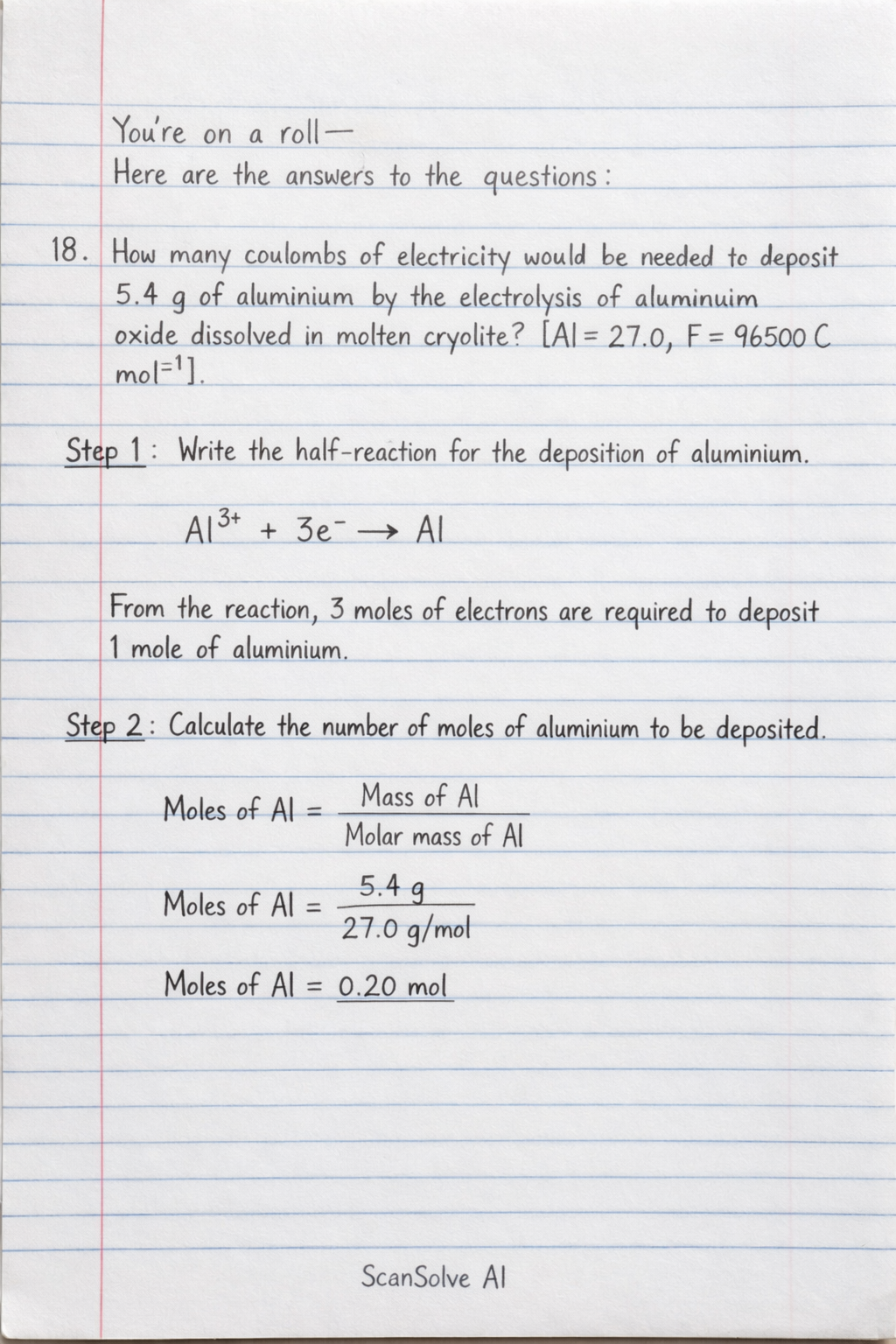
Here are the answers to the questions: 18. How many coulombs of electricity would be needed to deposit 5.4 g of aluminium by the electrolysis of aluminium oxide dissolved in molten cryolite? [Al = 27.0, F = 96500 C mol⁻¹] Step 1: Write the half-reaction for the deposition of aluminium. Al^3+ + 3e^- Al From the reaction, 3 moles of electrons are required to deposit 1 mole of aluminium. Step 2: Calculate the number of moles of aluminium to be deposited. Moles of Al = Mass of AlMolar mass of Al Moles of Al = 5.4 g27.0 g/mol Moles of Al = 0.20 mol Step 3: Calculate the total charge (coulombs) required. Since 1 mole of Al requires 3 moles of electrons, and 1 mole of electrons carries 96500 C (Faraday's constant): Charge = Moles of Al × Moles of e^- per mole of Al × Faraday's constant Charge = 0.20 mol Al × 3 mol e^-/mol Al × 96500 C/mol e^- Charge = 0.60 × 96500 C Charge = 57900 C The correct answer is D. 57900 C. 19. Which of the following allotropes of carbon is used in the rubber industry? Carbon black is a form of amorphous carbon that is widely used as a reinforcing filler in rubber products, such as tires, to improve their strength, durability, and wear resistance. The correct answer is D. Carbon black. 20. The two rows of elements placed below the main body of the periodic table show the I. lanthanides II. actinides III. f-block elements The two rows of elements placed below the main body of the periodic table are the lanthanides and the actinides. These elements are also collectively known as the f-block elements because their valence electrons occupy the f-orbitals. The correct answer is D. I, II and III. 21. The process of converting glucose to ethanol by the use of yeast is known as Fermentation is a metabolic process that converts sugar (like glucose) into acids, gases, or alcohol (like ethanol). Yeast is commonly used to carry out this process. The correct answer is D. fermentation. 22. The loss of some or all of water of crystallization when a hydrated compound is exposed to air is called Efflorescence is the process by which a hydrated salt loses its water of crystallization when exposed to dry air, often resulting in a powdery coating. The correct answer is D. efflorescence. 23. The measure of the tendency of an atom or molecule to attract shared electrons to itself is Electronegativity is a chemical property that describes the tendency of an atom or a functional group to attract electrons (or electron density) towards itself from a shared covalent bond. The correct answer is A. electronegativity. 24. What is the molecular mass for CuSO_4 · 5H_2O? [Cu = 63.5, S = 32.0, O = 16.0, H = 1.0] Step 1: Calculate the molar mass of CuSO_4. Molar mass of Cu = 1 × 63.5 = 63.5 Molar mass of S = 1 × 32.0 = 32.0 Molar mass of O = 4 × 16.0 = 64.0 Molar mass of CuSO_4 = 63.5 + 32.0 + 64.0 = 159.5 g/mol Step 2: Calculate the molar mass of 5H_2O. Molar mass of H_2O = (2 × 1.0) + (1 × 16.0) = 2.0 + 16.0 = 18.0 g/mol Molar mass of 5H_2O = 5 × 18.0 = 90.0 g/mol Step 3: Add the molar masses to find the total molecular mass of CuSO_4 · 5H_2O. Total molecular mass = Molar mass of CuSO_4 + Molar mass of 5H_2O Total molecular mass = 159.5 g/mol + 90.0 g/mol Total molecular mass = 249.5 g/mol The correct answer is A. 249.5 g. 25. All pure substances which are not elements are Pure substances are classified into two categories: elements (which cannot be broken down into simpler substances by chemical means) and compounds (which are formed when two or more elements are chemically combined in fixed proportions). Therefore, any pure substance that is not an element must be a compound. The correct answer is A. compounds. 26. A neutron striking an unstable nucleus may split it, causing the process known as Nuclear fission is a nuclear reaction in which the nucleus of an atom splits into two or more smaller, lighter nuclei, often producing gamma photons, free neutrons, and a large amount of energy. This process is typically initiated by bombarding a heavy, unstable nucleus with a neutron. The correct answer is A. nuclear fission. 27. The valence electrons in magnesium are in the Magnesium (Mg) has an atomic number of 12. Its electron configuration is 1s^2 2s^2 2p^6 3s^2. The valence electrons are the electrons in the outermost shell, which is the third shell in this case. These electrons are in the 3s orbital. The correct answer is D. 3s orbital. Drop the next question.