

This chemistry question involves key chemical concepts and calculations. The detailed solution below walks through each step, from identifying the reaction type to computing the final answer.
ScanSolve AI Answer
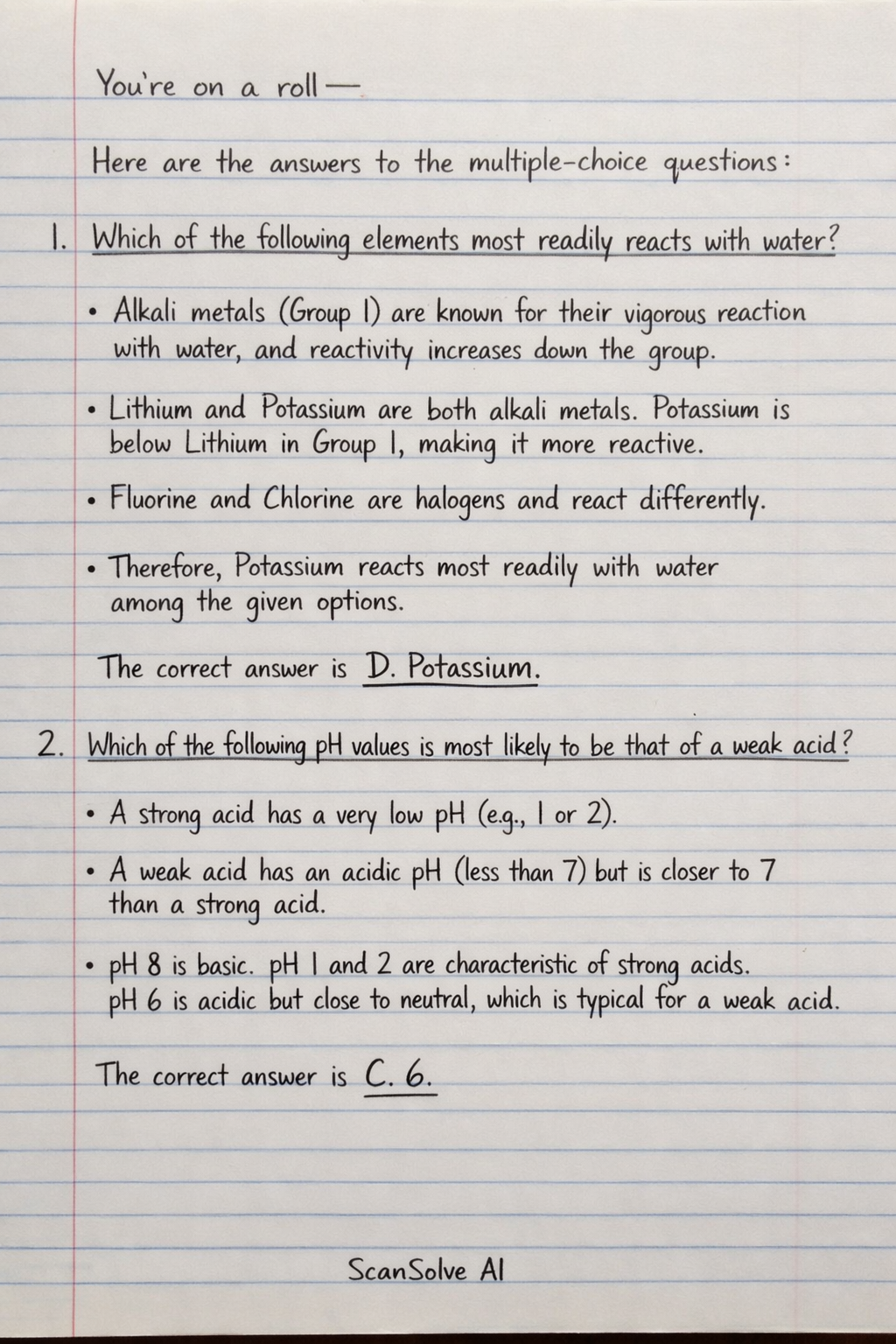
Here are the answers to the multiple-choice questions: 1. Which of the following elements most readily reacts with water? Alkali metals (Group 1) are known for their vigorous reaction with water, and reactivity increases down the group. Lithium and Potassium are both alkali metals. Potassium is below Lithium in Group 1, making it more reactive. Fluorine and Chlorine are halogens and react differently. Therefore, Potassium reacts most readily with water among the given options. The correct answer is D. Potassium. 2. Which of the following pH values is most likely to be that of a weak acid? A strong acid has a very low pH (e.g., 1 or 2). A weak acid has an acidic pH (less than 7) but is closer to 7 than a strong acid. pH 8 is basic. pH 1 and 2 are characteristic of strong acids. pH 6 is acidic but close to neutral, which is typical for a weak acid. The correct answer is C. 6. 3. Of the first 18 elements in the periodic table, how many are gases at 25 °C and 100 kPa? The first 18 elements are: H, He, Li, Be, B, C, N, O, F, Ne, Na, Mg, Al, Si, P, S, Cl, Ar. At 25 °C and 100 kPa (standard conditions), the elements that are gases are: Hydrogen (H_2) Helium (He) Nitrogen (N_2) Oxygen (O_2) Fluorine (F_2) Neon (Ne) Chlorine (Cl_2) Argon (Ar) Counting these, there are 8 gases. The correct answer is C. Eight. 4. The following reaction produces a precipitate: 2AgNO_3 + Na_2CO_3 Ag_2CO_3 + 2NaNO_3. Which of the compounds is the precipitate? A precipitate is an insoluble solid formed during a chemical reaction in solution. We need to identify which product is insoluble. According to solubility rules: Nitrates (NO_3^-) are generally soluble. Thus, NaNO_3 is soluble. Carbonates (CO_3^2-) are generally insoluble, with exceptions for Group 1 metals and ammonium. Silver (Ag^+) is not a Group 1 metal. Therefore, Ag_2CO_3 is the insoluble precipitate. The correct answer is C. Ag_2CO_3. 5. Which of the properties of pure liquid varies with the amount of matter? Properties can be intensive (independent of amount) or extensive (dependent on amount). Boiling point, melting point, and density are intensive properties; they do not change with the amount of substance. Volume is an extensive property; it changes with the amount of substance. For example, 10 mL of water has a different volume than 100 mL of water. The correct answer is D. Volume. 6. How many unpaired electrons are in a Mn^2+ ion in the ground electron state? [Mn = 25] First, write the electron configuration for neutral Manganese (Mn), which has 25 electrons: Mn: [Ar] 3d^5 4s^2 To form the Mn^2+ ion, two electrons are removed. These are removed from the outermost shell first, which is the 4s orbital: Mn^2+: [Ar] 3d^5 Now, consider the 3d subshell. It has 5 orbitals. According to Hund's rule, electrons will occupy each orbital singly before pairing up. 3d^5: All 5 electrons in the 3d subshell are unpaired. The correct answer is D. 5. What's next?