
We read your photo as:
Which of the following ions will interact with water to give a solution of pH < 7? A.Na+ B.NH4+ C.CN- D.HCOO-
ScanSolve AI Answer
Answer
Step-by-step solution
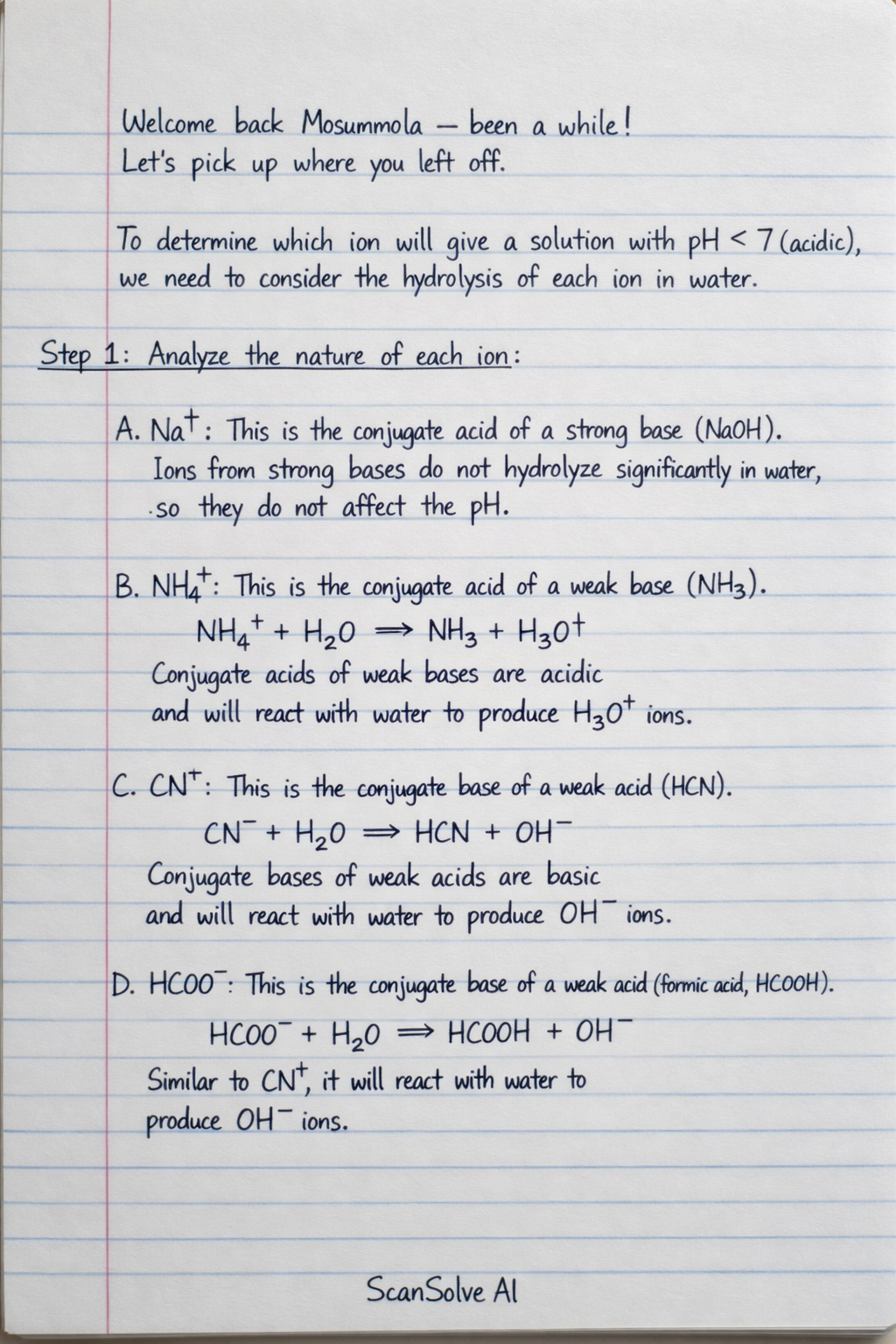
2 stepsTo determine which ion will give a solution with pH < 7 (acidic), we need to consider the hydrolysis of each ion in water.
Analyze the nature of each ion.
- A. Na: This is the conjugate acid of a strong base (NaOH). Ions from strong bases do not hydrolyze significantly in water, so they do not affect the pH.
- B. NH: This is the conjugate acid of a weak base (NH). Conjugate acids of weak bases are acidic and will react with water to produce HO ions.
- C. CN: This is the conjugate base of a weak acid (HCN). Conjugate bases of weak acids are basic and will react with water to produce OH ions.
- D. HCOO: This is the conjugate base of a weak acid (formic acid, HCOOH). Similar to CN, it will react with water to produce OH ions.
Write the hydrolysis reaction for the ion that would produce an acidic solution.
An acidic solution has a pH less than 7, meaning it has an excess of HO ions. From Step 1, NH is the only ion that is an acidic conjugate.
The hydrolysis reaction for NH is:This reaction produces hydronium ions (), which makes the solution acidic, resulting in a pH less than 7.
The other ions would either not affect the pH (Na) or make the solution basic (CN and HCOO).
The correct option is B.
Try one yourself
A new problem that tests the same skill.
Still stuck on this one?
Ask a follow-up, and the answer starts from this question.
More Chemistry Questions
Handwritten Step-by-Step Solution
Get this as a handwritten image on WhatsApp — like a tutor wrote it for you.
Try on WhatsApp