
We read your photo as:
Which of the following is a chemical change? How can a mixture of iodine and sodium chloride be separated most effectively?
ScanSolve AI Answer
Step-by-step solution
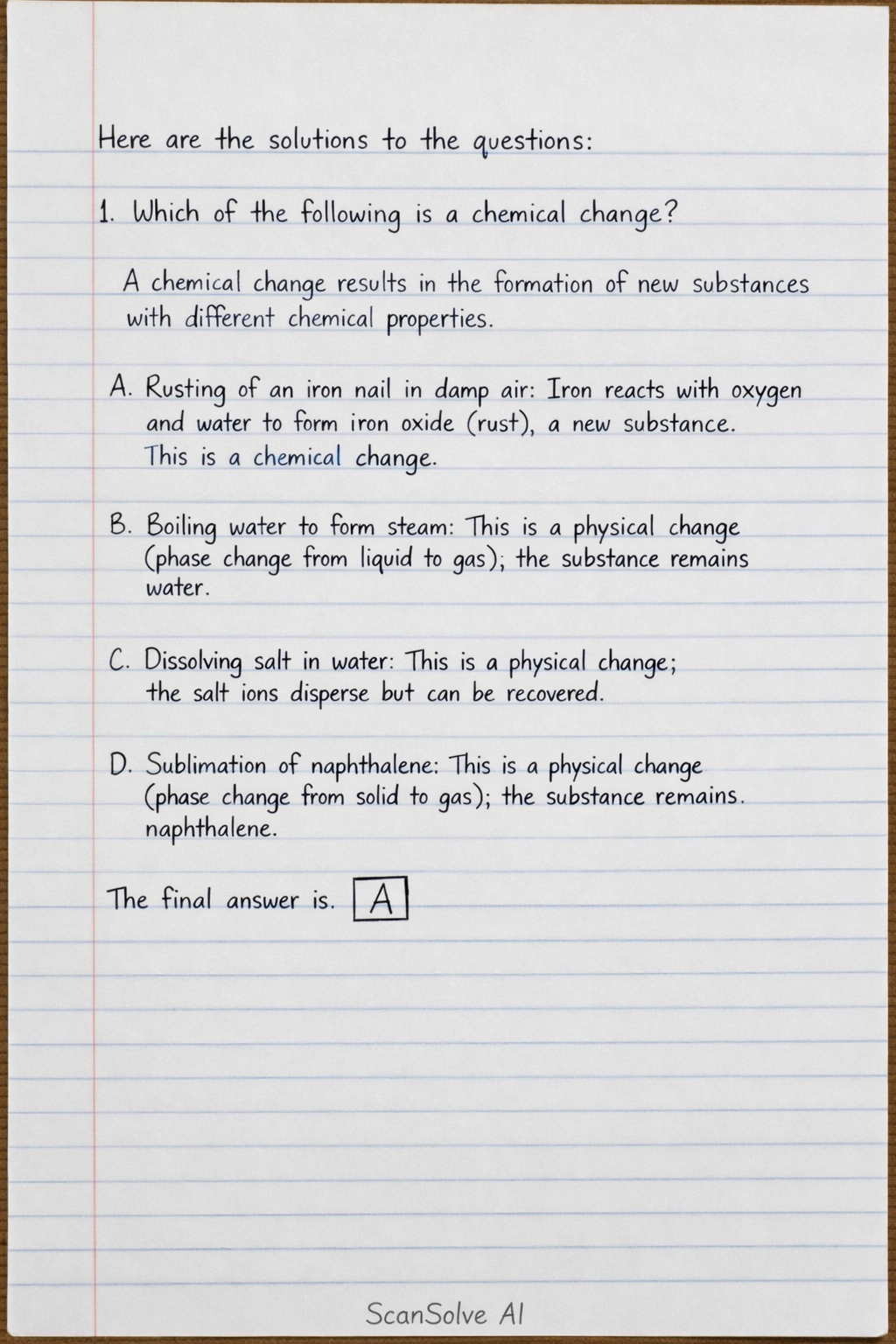
3 stepsHere are the solutions to the questions:
1. Which of the following is a chemical change?
A chemical change results in the formation of new substances with different chemical properties.
- A. Rusting of an iron nail in damp air: Iron reacts with oxygen and water to form iron oxide (rust), a new substance. This is a chemical change.
- B. Boiling water to form steam: This is a physical change (phase change from liquid to gas); the substance remains water.
- C. Dissolving salt in water: This is a physical change; the salt ions disperse but can be recovered.
- D. Sublimation of naphthalene: This is a physical change (phase change from solid to gas); the substance remains naphthalene.
The final answer is
2. How can a mixture of iodine and sodium chloride be separated most effectively?
Iodine is known to sublime, meaning it changes directly from a solid to a gas upon heating, and then back to a solid upon cooling. Sodium chloride does not sublime. This difference in physical properties allows for separation.
- A. Chromatography: Used for separating components of a mixture based on differential partitioning.
- B. Fractional distillation: Used for separating liquids with different boiling points.
- C. Filtration: Used for separating insoluble solids from liquids.
- D. Sublimation: Heating the mixture will cause iodine to sublime, leaving the sodium chloride behind. The iodine can then be collected by condensation.
The final answer is
3. Which pair of compounds illustrates the Law of Multiple Proportions?
The Law of Multiple Proportions states that when two elements combine to form more than one compound, the masses of one element that combine with a fixed mass of the other element are in ratios of small whole numbers. This requires the compounds to be formed from the same two elements.
- A. CO and CO₂: Both compounds are formed from carbon (C) and oxygen (O). This pair illustrates the law.
- B. NH₃ and HCl: These compounds involve different sets of elements (N, H and H, Cl).
- C. H₂O and D₂O: Deuterium (D) is an isotope of hydrogen (H). These are essentially the same compound with isotopic substitution, not different compounds formed from the same two elements in varying proportions.
- D. NaCl and NaBr: These compounds involve different halogens (Cl and Br).
The final answer is
4. What volume of oxygen at STP is required to completely burn 5.0 dm³ of butane (C₄H₁₀)? (Molar volume at STP = 22.4 dm³)
Write the balanced chemical equation for the complete combustion of butane.
Use the mole ratio from the balanced equation.
According to Avogadro's Law, at constant temperature and pressure (like STP), the ratio of volumes of reacting gases is the same as their mole ratio.
From the balanced equation, 2 moles (or volumes) of C₄H₁₀ react with 13 moles (or volumes) of O₂.Calculate the volume of oxygen required.
Given volume of C₄H₁₀ = 5.0 dm³.
The final answer is
5. Which phenomenon best supports that matter consists of tiny particles in constant random motion?
The kinetic theory of matter states that all matter is composed of tiny particles (atoms, molecules, or ions) that are in constant, random motion.- A. Diffusion: The net movement of particles from an area of higher concentration to an area of lower concentration due to their random motion.
- B. Brownian motion: The erratic, random movement of microscopic particles suspended in a fluid (a liquid or a gas) as a result of their collision with the fast-moving atoms or molecules in the fluid. This is direct visual evidence of the constant random motion of the fluid particles.
- C. Evaporation: The process by which a liquid changes into a gas. While it involves particle motion, Brownian motion is a more direct observation of random motion.
- D. Filtration: A separation technique based on particle size, not directly related to random motion.
Brownian motion is considered the most direct observational evidence for the constant random motion of particles.
The final answer is
6. According to Boyle's Law, if the pressure of a gas is doubled at constant temperature, its volume is:
Boyle's Law states that for a fixed amount of gas at constant temperature, the pressure () and volume () are inversely proportional. This can be expressed as .
If the pressure is doubled, .Divide both sides by :
Solve for :
The new volume is half of the original volume.
The final answer is
7. In Charles's Law (V/T = k), which variable must remain constant?
Charles's Law states that for a fixed amount of gas at constant pressure, the volume () is directly proportional to its absolute temperature (). The constant in the equation holds true only if the pressure and the amount of gas are kept constant.The final answer is
Still stuck on this one?
Ask a follow-up, and the answer starts from this question.
More Chemistry Questions
Handwritten Step-by-Step Solution
Get this as a handwritten image on WhatsApp — like a tutor wrote it for you.
Try on WhatsApp