
We read your photo as:
What are the best methods of physical separation for mixtures of salt and sand, sugar and tea leaves, peanuts and dried beans, coins, sweets, sand and water, and chalk and water?
ScanSolve AI Answer
Here are the best methods of physical separation for each mixture:
-
Salt and sand: To separate salt and sand, you would typically add water to dissolve the salt. The sand would then settle. You could then use Decanting to separate the salt solution from the sand, or Filtering to remove the sand.
- Methods: Settling, Decanting, Filtering
-
Sugar and tea leaves: If the sugar and tea leaves are dry, Sieving can separate them if their particle sizes are different. If the tea leaves are in a liquid (like brewed tea), Filtering is used.
- Method: Sieving (if dry), Filtering (if in liquid)
-
Peanuts and dried beans: These are large, distinct solid particles.
- Method: Hand sorting
-
50c and 10c coins: These are distinct solid objects.
- Method: Hand sorting
-
Jelly Tots and Smarties: These are distinct solid objects.
- Method: Hand sorting
-
Sand and water: Sand is an insoluble solid that is denser than water.
- Methods: Settling (sand sinks), followed by Decanting (pouring off water) or Filtering (to separate sand from water).
-
Chalk and water: Chalk is an insoluble solid that forms a suspension in water and will settle over time.
- Methods: Settling (chalk sinks), followed by Decanting (pouring off water) or Filtering (to separate chalk from water).
-
Curry powder and water: Curry powder is a fine, mostly insoluble solid that forms a suspension in water and will settle.
- Methods: Settling (powder sinks), followed by Decanting (pouring off water) or Filtering (to separate powder from water).
-
Grated cheese and milk: Grated cheese is a solid that can be separated from liquid milk.
- Method: Filtering
-
Oil and water: Oil and water are immiscible liquids with different densities.
- Methods: Settling (layers separate), followed by Decanting (pouring off the top layer).
Still stuck on this one?
Ask a follow-up, and the answer starts from this question.
More Chemistry Questions
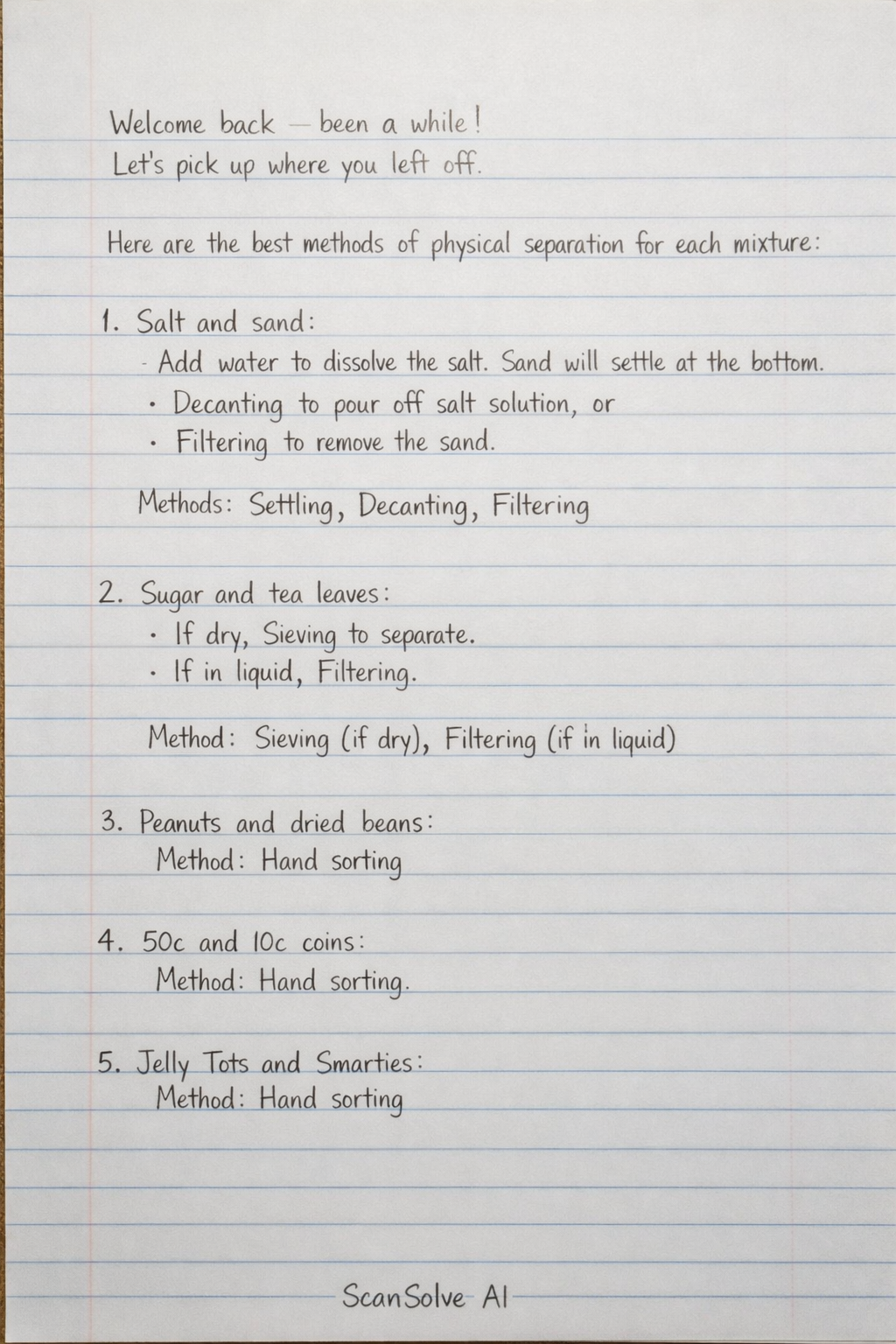
Handwritten Step-by-Step Solution
Get this as a handwritten image on WhatsApp — like a tutor wrote it for you.
Try on WhatsApp