
We read your photo as:
What are the units for mass and length, and what are methods to separate mixtures like salt from water, sand from water, and oil from water? What tool separates a magnetic substance from non-magnetic
ScanSolve AI Answer
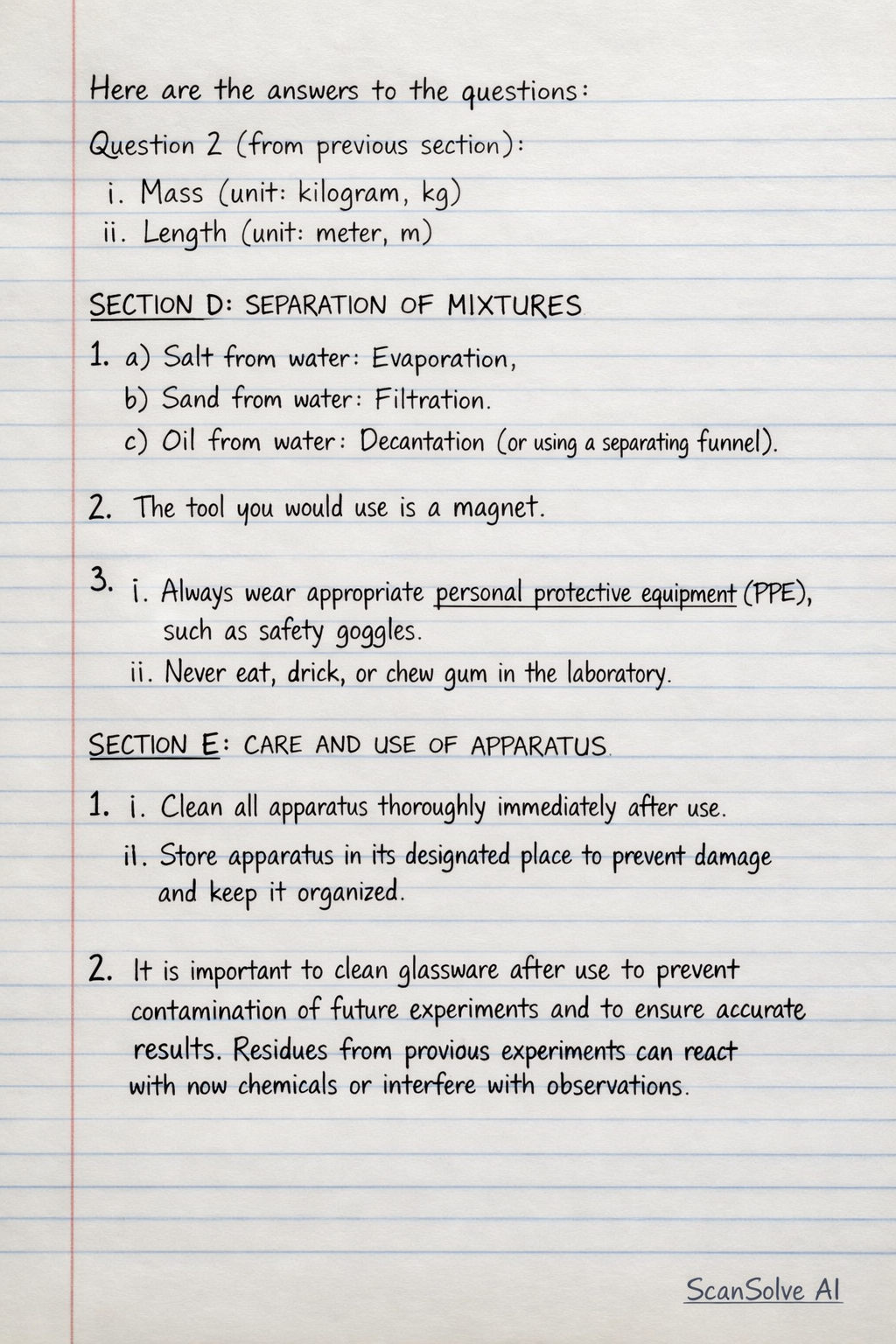
Here are the answers to the questions:
Question 2 (from previous section):
i. Mass (unit: kilogram, kg)
ii. Length (unit: meter, m)
SECTION D: SEPARATION OF MIXTURES
1.
a) Salt from water: Evaporation
b) Sand from water: Filtration
c) Oil from water: Decantation (or using a separating funnel)
2. The tool you would use is a magnet.
3.
i. Always wear appropriate personal protective equipment (PPE), such as safety goggles.
ii. Never eat, drink, or chew gum in the laboratory.
SECTION E: CARE AND USE OF APPARATUS
1.
i. Clean all apparatus thoroughly immediately after use.
ii. Store apparatus in its designated place to prevent damage and keep it organized.
2. It is important to clean glassware after use to prevent contamination of future experiments and to ensure accurate results. Residues from previous experiments can react with new chemicals or interfere with observations.
3.
i. Always carry a microscope with two hands: one hand supporting the base and the other holding the arm.
ii. Always place the microscope gently on a stable, flat surface away from the edge of the bench.
Still stuck on this one?
Ask a follow-up, and the answer starts from this question.
More Chemistry Questions
Handwritten Step-by-Step Solution
Get this as a handwritten image on WhatsApp — like a tutor wrote it for you.
Try on WhatsApp