Which of the following metals can be prepared in samples by the thermal decomposition of their trioxonitrate(v) salts?
|Chemistry
Which of the following metals can be prepared in samples by the thermal decomposition of their trioxonitrate(v) salts?
ScanSolve AI Answer
Answer
sodium amalgam is an alloy of sodium and mercury
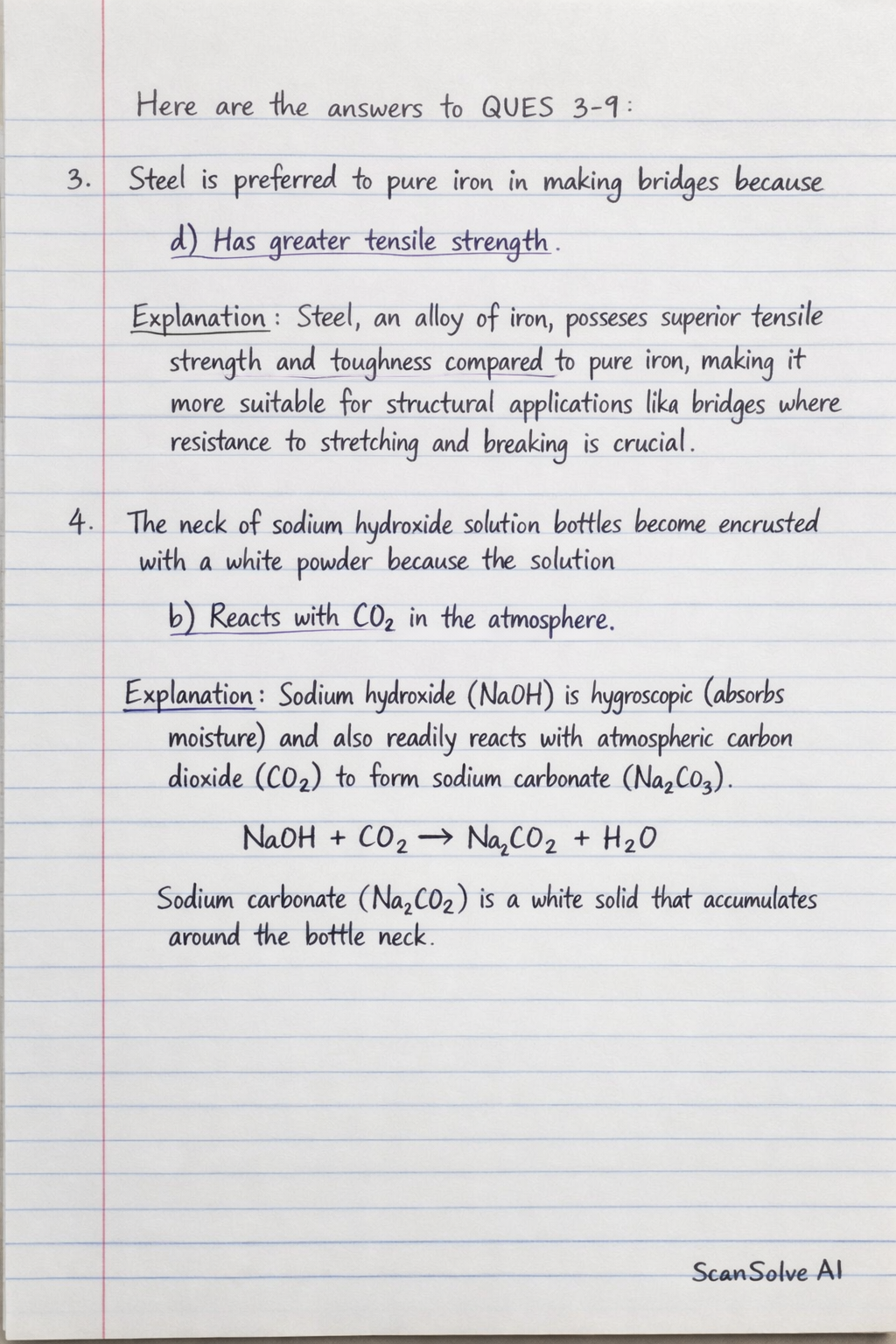
Here are the answers to QUES 3-9:
3. Steel is preferred to pure iron in making bridges because steel
d) Has greater tensile strength
Explanation: Steel, an alloy of iron, possesses superior tensile strength and toughness compared to pure iron, making it more suitable for structural applications like bridges where resistance to stretching and breaking is crucial.
4. The neck of sodium hydroxide solution bottles become encrusted with a white powder because the solution
b) Reacts with CO2 in the atmosphere
Explanation: Sodium hydroxide (NaOH) is hygroscopic (absorbs moisture) and also readily reacts with atmospheric carbon dioxide (CO2) to form sodium carbonate (Na2CO3), which is a white solid that accumulates around the bottle neck.
5. When iron is finely divided, it will burn in oxygen to form the magnetic oxide with formula:
c) Fe3O4
Explanation: When iron burns in oxygen, especially in a finely divided state, it forms iron(II,III) oxide, also known as magnetite, which is a magnetic oxide with the formula Fe3O4.
6. Which of the following metals can be prepared in samples by the thermal decomposition of their trioxonitrate(V) salts
c) Mercury and silver
Explanation: Nitrates of less reactive metals like mercury and silver decompose directly to the metal, nitrogen dioxide, and oxygen upon heating. For example, 2AgNO3(s)Δ2Ag(s)+2NO2(g)+O2(g). More reactive metals like copper and magnesium form their respective metal oxides.
7. Which of the following does not decompose when heated?
b) K2CO3
Explanation: Potassium carbonate (K2CO3) is an alkali metal carbonate (except lithium carbonate) and is very thermally stable, not decomposing even at high temperatures. Ammonium chloride, lead(II) nitrate, and calcium carbonate all decompose upon heating.
8. Sodium amalgam can be described as an alloy of sodium and
b) Mercury
Explanation: An amalgam is an alloy where one of the metals is mercury. Therefore, sodium amalgam is an alloy of sodium and mercury.
9. In which of the following are the substances arranged in the correct order of increasing melting point?
a) Sulphur, Sodium chloride, Diamond
Explanation:
Sulphur (S8) is a molecular solid with weak intermolecular forces, giving it a relatively low melting point (approx. 115∘C).
Sodium chloride (NaCl) is an ionic compound with strong electrostatic forces, resulting in a high melting point (approx. 801∘C).
Diamond (C) is a covalent network solid with extremely strong covalent bonds throughout its structure, giving it an exceptionally high melting point (sublimes above 3500∘C).
Thus, the order of increasing melting point is Sulphur < Sodium chloride < Diamond.
That's 2 down. 3 left today — send the next one.
Was this helpful?
Need help with your own homework?
Get instant step-by-step solutions to any question. Free to start.
This chemistry question involves key chemical concepts and calculations. The detailed solution below walks through each step, from identifying the reaction type to computing the final answer.
ScanSolve AI Answer
Here are the answers to QUES 3-9: 3. Steel is preferred to pure iron in making bridges because steel d) Has greater tensile strength Explanation:* Steel, an alloy of iron, possesses superior tensile strength and toughness compared to pure iron, making it more suitable for structural applications like bridges where resistance to stretching and breaking is crucial. 4. The neck of sodium hydroxide solution bottles become encrusted with a white powder because the solution b) Reacts with CO_2 in the atmosphere Explanation:* Sodium hydroxide (NaOH) is hygroscopic (absorbs moisture) and also readily reacts with atmospheric carbon dioxide (CO_2) to form sodium carbonate (Na_2CO_3), which is a white solid that accumulates around the bottle neck. 5. When iron is finely divided, it will burn in oxygen to form the magnetic oxide with formula: c) Fe_3O_4 Explanation:* When iron burns in oxygen, especially in a finely divided state, it forms iron(II,III) oxide, also known as magnetite, which is a magnetic oxide with the formula Fe_3O_4. 6. Which of the following metals can be prepared in samples by the thermal decomposition of their trioxonitrate(V) salts c) Mercury and silver Explanation:* Nitrates of less reactive metals like mercury and silver decompose directly to the metal, nitrogen dioxide, and oxygen upon heating. For example, 2AgNO_3(s) 2Ag(s) + 2NO_2(g) + O_2(g). More reactive metals like copper and magnesium form their respective metal oxides. 7. Which of the following does not decompose when heated? b) K_2CO_3 Explanation:* Potassium carbonate (K_2CO_3) is an alkali metal carbonate (except lithium carbonate) and is very thermally stable, not decomposing even at high temperatures. Ammonium chloride, lead(II) nitrate, and calcium carbonate all decompose upon heating. 8. Sodium amalgam can be described as an alloy of sodium and b) Mercury Explanation:* An amalgam is an alloy where one of the metals is mercury. Therefore, sodium amalgam is an alloy of sodium and mercury. 9. In which of the following are the substances arranged in the correct order of increasing melting point? a) Sulphur, Sodium chloride, Diamond Explanation:* Sulphur (S_8) is a molecular solid with weak intermolecular forces, giving it a relatively low melting point (approx. 115^). Sodium chloride (NaCl) is an ionic compound with strong electrostatic forces, resulting in a high melting point (approx. 801^). Diamond (C) is a covalent network solid with extremely strong covalent bonds throughout its structure, giving it an exceptionally high melting point (sublimes above 3500^). Thus, the order of increasing melting point is Sulphur < Sodium chloride < Diamond. That's 2 down. 3 left today — send the next one.