

This chemistry question involves key chemical concepts and calculations. The detailed solution below walks through each step, from identifying the reaction type to computing the final answer.
ScanSolve AI Answer
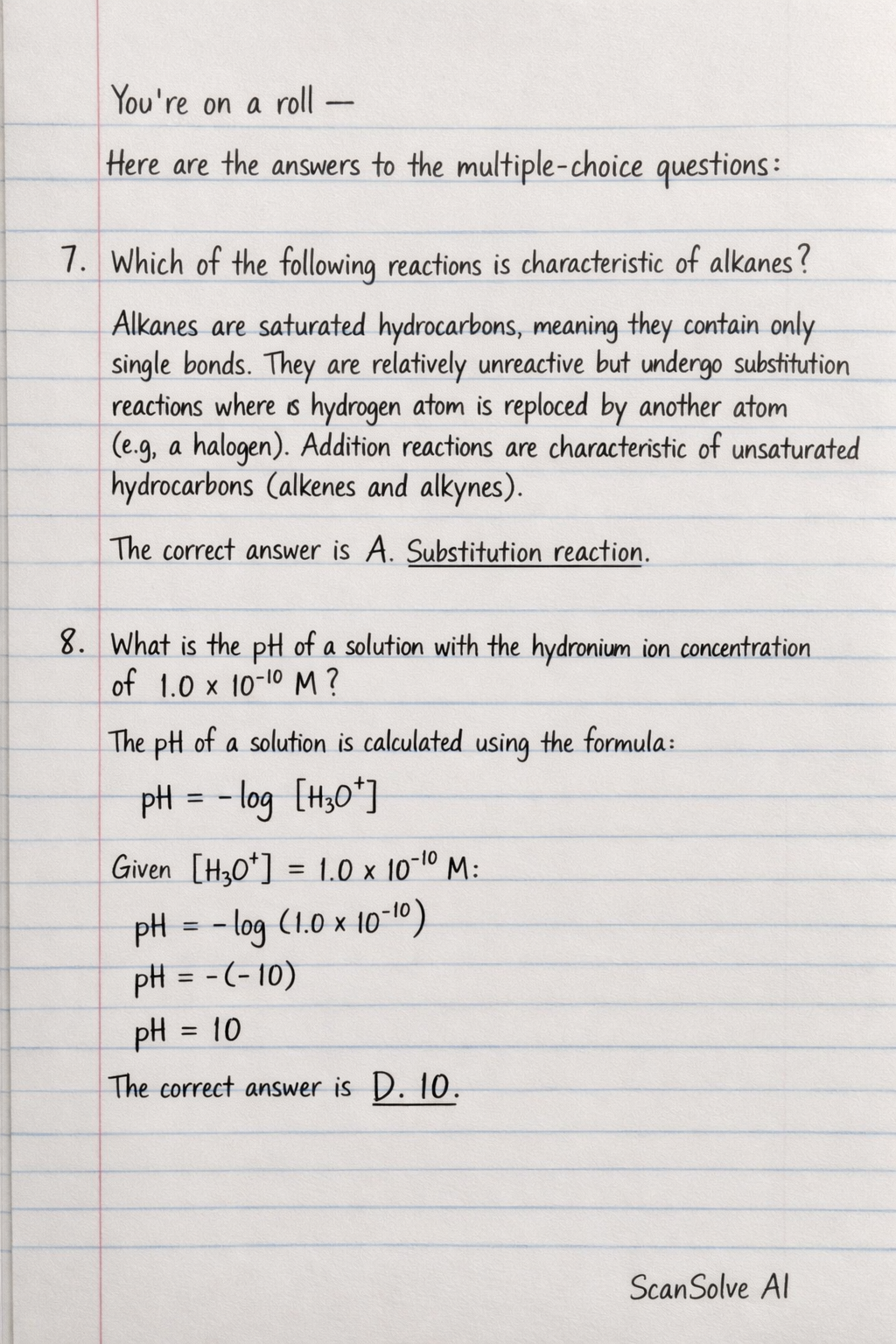
Here are the answers to the multiple-choice questions: 7. Which of the following reactions is characteristic of alkanes? Alkanes are saturated hydrocarbons, meaning they contain only single bonds. They are relatively unreactive but undergo substitution reactions where a hydrogen atom is replaced by another atom (e.g., a halogen). Addition reactions are characteristic of unsaturated hydrocarbons (alkenes and alkynes). The correct answer is A. Substitution reaction. 8. What is the pH of a solution with the hydronium ion concentration of 1.0 × 10^-10 M? The pH of a solution is calculated using the formula: pH = -[H_3O^+] Given [H_3O^+] = 1.0 × 10^-10 M: pH = -(1.0 × 10^-10) pH = -(-10) pH = 10 The correct answer is D. 10. 9. Which of the following factors does not influence the rate of a chemical reaction involving aqueous solutions? • Pressure changes: Pressure significantly affects the rate of reactions involving gases because it changes their concentration. For reactions in aqueous solutions, changes in external pressure have a negligible effect on the concentration of reactants and thus on the reaction rate. • Temperature changes: Increasing temperature generally increases the kinetic energy of molecules, leading to more frequent and energetic collisions, thus increasing the reaction rate. • Nature of reactants: Different reactants have different chemical structures and bond strengths, which inherently affect how quickly they react. • Concentration: Higher concentrations of reactants lead to more frequent collisions between reactant particles, increasing the reaction rate. The correct answer is A. Pressure changes. 10. The maximum number of electrons that can occupy the p-subshell is A p-subshell consists of three orbitals (p_x, p_y, p_z). According to the Pauli exclusion principle, each orbital can hold a maximum of two electrons. Therefore, the maximum number of electrons in a p-subshell is 3 orbitals × 2 electrons/orbital = 6 electrons. The correct answer is C. 6. 11. What is the oxidation state of Fe in FeSO_4? In the compound FeSO_4, the sulfate ion (SO_4) has a charge of -2. Since the compound is neutral, the sum of the oxidation states must be zero. Let the oxidation state of Fe be x. x + (-2) = 0 x = +2 The oxidation state of Fe in FeSO_4 is +2. The correct answer is B. +2. 12. Which of the following elements is not an inert gas? Inert gases are also known as noble gases, which are elements in Group 18 of the periodic table. These include Helium (He), Neon (Ne), Argon (Ar), Krypton (Kr), Xenon (Xe), and Radon (Rn). • A. Argon is an inert gas. • B. Neon is an inert gas. • C. Oxygen (O) is in Group 16 and is not an inert gas. • D. Helium is an inert gas. The correct answer is C. Oxygen. 13. The correct chemical formula for calcium tetroxophosphate(V) is • Calcium is in Group 2, so its ion is Ca^2+. • Tetroxophosphate(V) refers to the phosphate ion, PO_4^3-. The (V) indicates that phosphorus has an oxidation state of +5. To form a neutral compound, the charges must balance. We need three Ca^2+ ions (3 × +2 = +6) and two PO_4^3- ions (2 × -3 = -6). The chemical formula is Ca_3(PO_4)_2. The correct answer is C. Ca_3(PO_4)_2. 14. Alpha particles are represented by Alpha particles are positively charged particles emitted by some radioactive nuclei. They consist of two protons and two neutrons, which is identical to the nucleus of a helium atom. The correct answer is C. helium nuclei. 15. The acid which is found in butter is Butyric acid (also known as butanoic acid) is a carboxylic acid found in butter, especially rancid butter, and is responsible for its characteristic odor. The correct answer is C. butyric acid. 16. How many moles are contained in 1.20 × 10^23 molecules of NH_3? To find the number of moles, we divide the number of molecules by Avogadro's number (N_A = 6.022 × 10^23 molecules/mol). Number of moles = Number of moleculesAvogadro's number Number of moles = 1.20 × 10^23 molecules6.022 × 10^23 molecules/mol Number of moles ≈ 0.199 mol Given the options, it appears there might be a typo in the question, and the number of molecules was intended to be 1.20 × 10^24. If so: Number of moles = 1.20 × 10^24 molecules6.022 × 10^23 molecules/mol Number of moles ≈ 1.99 mol Assuming the intended value was 1.20 × 10^24 molecules to match the options. The correct answer is B. 1.99 moles. 17. In the electrolysis of aqueous common salt solution, the substance produced at the cathode is Aqueous common salt solution contains Na^+, Cl^-, H^+, and OH^- ions (from water). At the cathode (negative electrode), reduction occurs. We compare the reduction potentials of Na^+ and H_2O: • Na^+(aq) + e^- Na(s) (E^ = -2.71 V) • 2H_2O(l) + 2e^- H_2(g) + 2OH^-(aq) (E^ = -0.83 V at pH 7) Since water has a less negative (more positive) reduction potential, it is more easily reduced than Na^+. Therefore, hydrogen gas is produced at the cathode. The correct answer is D. hydrogen gas. What's next?