
We read your photo as:
Which of the following statements about acids are true? a) Reaction with metals produce Hydrogen gas. b) Reaction with metal Carbonates produce Carbon dioxide gas.
ScanSolve AI Answer
-
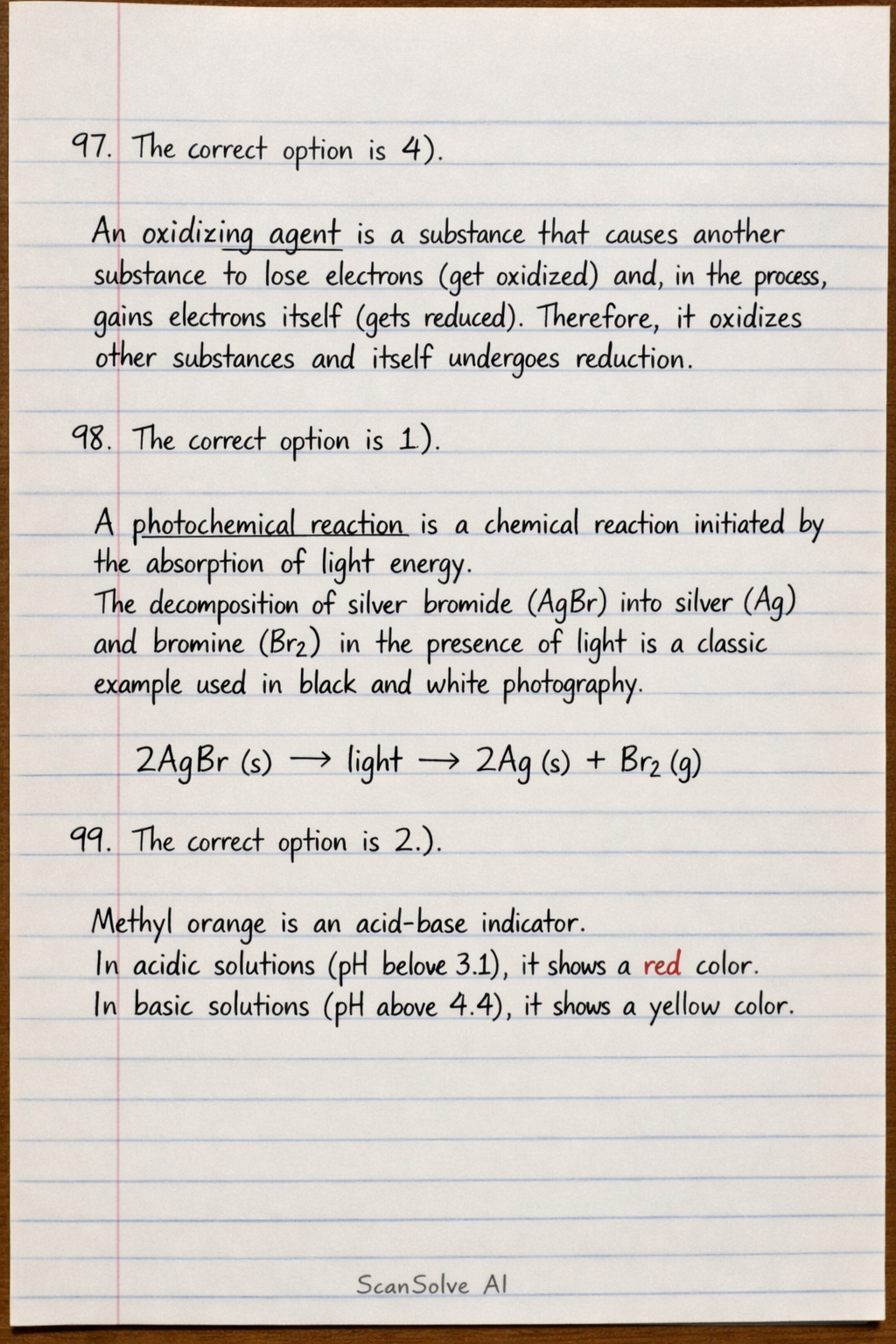
The correct option is 4). An oxidizing agent is a substance that causes another substance to lose electrons (get oxidized) and, in the process, gains electrons itself (gets reduced). Therefore, it oxidizes other substances and itself undergoes reduction.
-
The correct option is 1). A photochemical reaction is a chemical reaction initiated by the absorption of light energy. The decomposition of silver bromide () into silver () and bromine () in the presence of light is a classic example used in black and white photography.
-
The correct option is 2). Methyl orange is an acid-base indicator. In acidic solutions (pH below 3.1), it shows a red color. In basic solutions (pH above 4.4), it shows a yellow color.
-
The correct option is 3). Let's evaluate each statement:
- a) Reaction with metals produce Hydrogen gas. Acids react with active metals (e.g., ). Some strong bases also react with certain amphoteric metals (e.g., ). Thus, this is a common property for both.
- b) Reaction with metal Carbonates produce Carbon dioxide gas. Acids react with metal carbonates to produce carbon dioxide gas (e.g., ). Bases generally do not react with metal carbonates to produce carbon dioxide. Thus, this is not a common property.
- c) Conduct electricity in aqueous state. Both acids and bases dissociate into ions in aqueous solutions, making them electrolytes that can conduct electricity. Thus, this is a common property for both.
- d) Colour will change with phenolphthalein indicator. Phenolphthalein is colorless in acidic solutions and pink in basic solutions. While it shows different colors, it only changes color (from colorless to pink) when added to a base. It remains colorless when added to an acid. Therefore, it's not a change that occurs with both. Thus, this is not a common property in the sense of a visible change occurring in both.
Based on the analysis, statements (a) and (c) are correct.
- The correct option is 4). A universal indicator shows different colors at different pH values:
- Red indicates a strong acid (low pH).
- Green indicates a neutral solution (pH around 7).
- Blue indicates a base (high pH).
Given:
- Solution (X) is green pH is approximately 7 (neutral).
- Solution (Y) is red pH is low (strong acid).
- Solution (Z) is blue pH is high (base).
Therefore, the order of pH from lowest to highest is Y < X < Z.
The decreasing order of pH (highest to lowest) is Z > X > Y.
- The correct option is 2). Let's examine each statement:
-
- Universal indicator is used to know the strength of acid or base. (Correct, as it shows a range of colors corresponding to different pH values, indicating strength).
-
- As the pH value increases from 7 to 14, concentration of ions in the solution increases. (Incorrect. As pH increases from 7 to 14, the solution becomes more basic, meaning the concentration of ions decreases, and the concentration of ions increases).
-
- Higher the hydronium ion concentration lower the pH value. (Correct, because ).
-
- pH value of a solution is less than 7, it is acidic in nature. (Correct, this is the definition of an acidic solution).
The incorrect statement is 2).
- The correct option is 2). The given reaction is:
Here, is calcium hydroxide, which is a metallic hydroxide (a base). is carbon dioxide, which is a non-metallic oxide (an acidic oxide). The products are calcium carbonate (a salt) and water.
Let's evaluate the statements:
- *A) A metallic oxide reacts with a non-metallic oxide to produce salt and
Still stuck on this one?
Ask a follow-up, and the answer starts from this question.
More Chemistry Questions
Handwritten Step-by-Step Solution
Get this as a handwritten image on WhatsApp — like a tutor wrote it for you.
Try on WhatsApp