
We read your photo as:
Give one difference between endothermic and exothermic reactions. State Le Chatelier's principle. Mention three factors that affect the equilibrium position of a chemical reaction.
ScanSolve AI Answer
Step-by-step solution
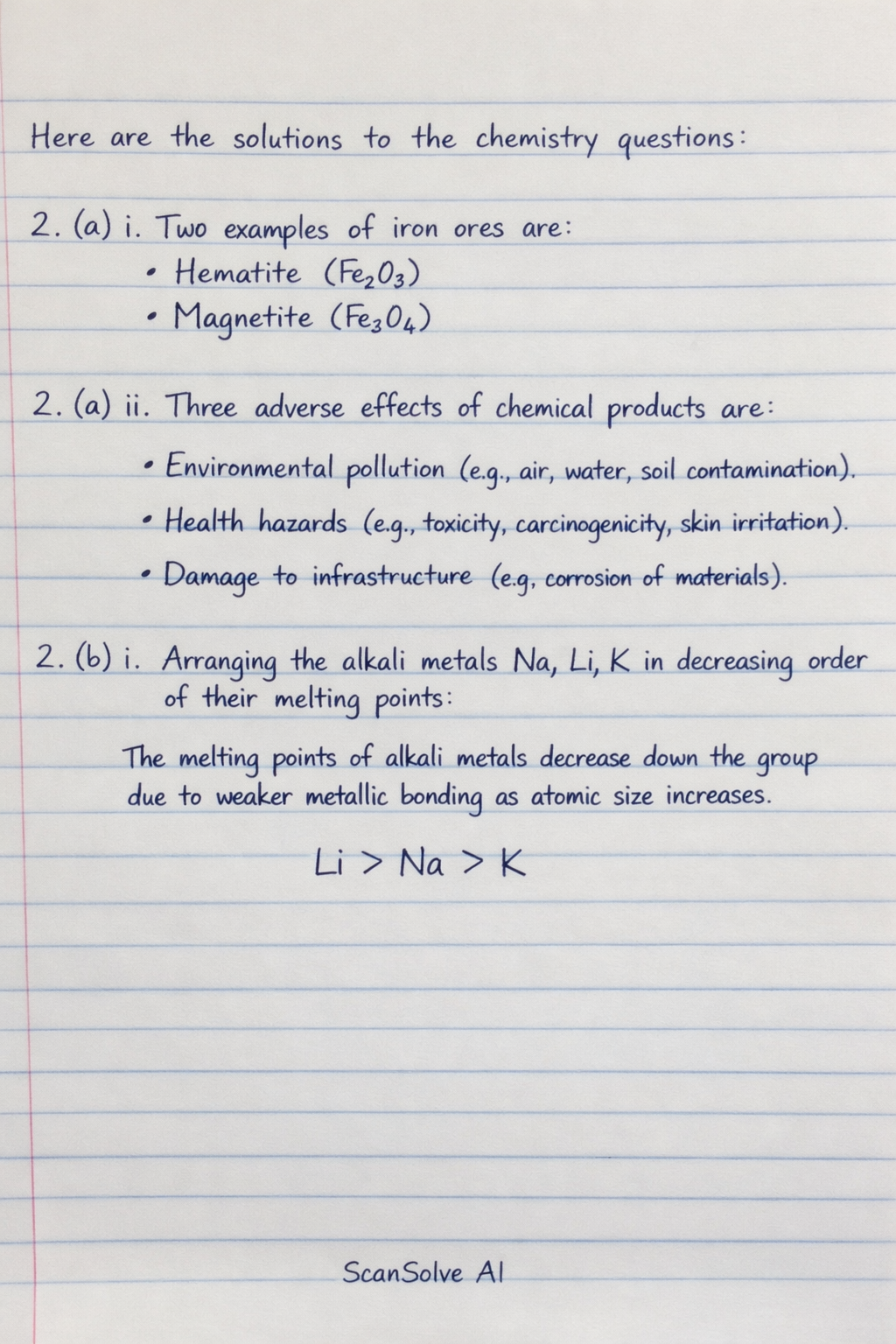
9 stepsHere are the solutions to the chemistry questions:
2. (a) i. Two examples of iron ores are:
- Hematite ()
- Magnetite ()
2. (a) ii. Three adverse effects of chemical products are:
- Environmental pollution (e.g., air, water, soil contamination).
- Health hazards (e.g., toxicity, carcinogenicity, skin irritation).
- Damage to infrastructure (e.g., corrosion of materials).
2. (b) i. Arranging the alkali metals Na, Li, K in decreasing order of their melting points:
The melting points of alkali metals decrease down the group due to weaker metallic bonding as atomic size increases.
- Li > Na > K
2. (b) ii. The three rules/principles of electron distribution in an atom are:
- Aufbau principle: Electrons fill atomic orbitals of the lowest available energy levels before occupying higher energy levels.
- Pauli exclusion principle: No two electrons in the same atom can have identical values for all four quantum numbers; an atomic orbital can hold a maximum of two electrons, and they must have opposite spins.
- Hund's rule of maximum multiplicity: Every orbital in a subshell is singly occupied with one electron before any one orbital is doubly occupied, and all electrons in singly occupied orbitals have the same spin.
2. (c) i. Differentiation between oxidizing agent and reducing agent in terms of electron transfer:
- An oxidizing agent is a substance that gains electrons and is itself reduced in a chemical reaction.
- A reducing agent is a substance that loses electrons and is itself oxidized in a chemical reaction.
2. (c) ii. The ions formed when the following compounds dissociate:
I. KOH:
II. Pb(NO₃)₂:
III. Na₂CO₃:
2. (d) i. Definitions of the following terms:
I. Anode: The electrode where oxidation (loss of electrons) occurs. In an electrolytic cell, it is the positive electrode.
II. Cathode: The electrode where reduction (gain of electrons) occurs. In an electrolytic cell, it is the negative electrode.
2. (d) ii. Calculate the volume in dm³ of hydrogen produced at s.t.p. during the electrolysis of dilute tetraoxosulphate (VI) acid, if 1.0 A was used for 15 minutes.
Given: , , , Molar volume at s.t.p. .
Calculate the total charge (Q).
Calculate the moles of electrons ().
Write the half-reaction for hydrogen production at the cathode.
From the equation, 2 moles of electrons produce 1 mole of gas.
Calculate the moles of produced.
Calculate the volume of at s.t.p.
The volume of hydrogen produced is .
3. (a) With the aid of an energy profile diagram, illustrate the effect of a catalyst on an exothermic reaction.
An energy profile diagram for an exothermic reaction shows the reactants at a higher energy level than the products. The reaction proceeds through a transition state, requiring a certain amount of activation energy (). A catalyst provides an alternative reaction pathway with a lower activation energy (), thereby increasing the reaction rate. However, the catalyst does not change the overall enthalpy change () of the reaction, meaning the energy difference between reactants and products remains the same.3. (b) i. One difference between endothermic and exothermic reactions:
- Endothermic reactions absorb heat from their surroundings, causing the surroundings to cool down, and have a positive enthalpy change ().
- Exothermic reactions release heat to their surroundings, causing the surroundings to warm up, and have a negative enthalpy change ().
3. (b) ii. State Le Chatelier's principle.
Le Chatelier's principle states that if a change of condition (such as temperature, pressure, or concentration) is applied to a system in equilibrium, the system will shift in a direction that relieves the stress.3. (b) iii. Three factors that affect the equilibrium position of a chemical reaction are:
- Concentration of reactants or products.
- Temperature of the system.
- Pressure (for reactions involving gases).
3. (c) i. Define the following:
I. Saturated solution: A solution that contains the maximum amount of solute that can be dissolved in a given amount of solvent at a specific temperature, such that any additional solute added will not dissolve and will remain as a solid.
II. Molar solution: A solution that contains one mole of solute per liter (or cubic decimeter) of solution. Its concentration is expressed in moles per cubic decimeter () or Molarity (M).3. (c) ii. What mass in grams of sodium trioxocarbonate (IV) is needed to prepare 250 cm³ of 0.2 moldm⁻³ solution?
Given: Volume , Concentration .
Atomic masses: , , .
The compound is sodium trioxocarbonate (IV), which is .Calculate the molar mass of .
Convert the volume from to .
Calculate the moles of needed.
Calculate the mass of needed.
The mass of sodium trioxocarbonate (IV) needed is .
Still stuck on this one?
Ask a follow-up, and the answer starts from this question.
More Chemistry Questions
Handwritten Step-by-Step Solution
Get this as a handwritten image on WhatsApp — like a tutor wrote it for you.
Try on WhatsApp