

This chemistry question involves key chemical concepts and calculations. The detailed solution below walks through each step, from identifying the reaction type to computing the final answer.
ScanSolve AI Answer
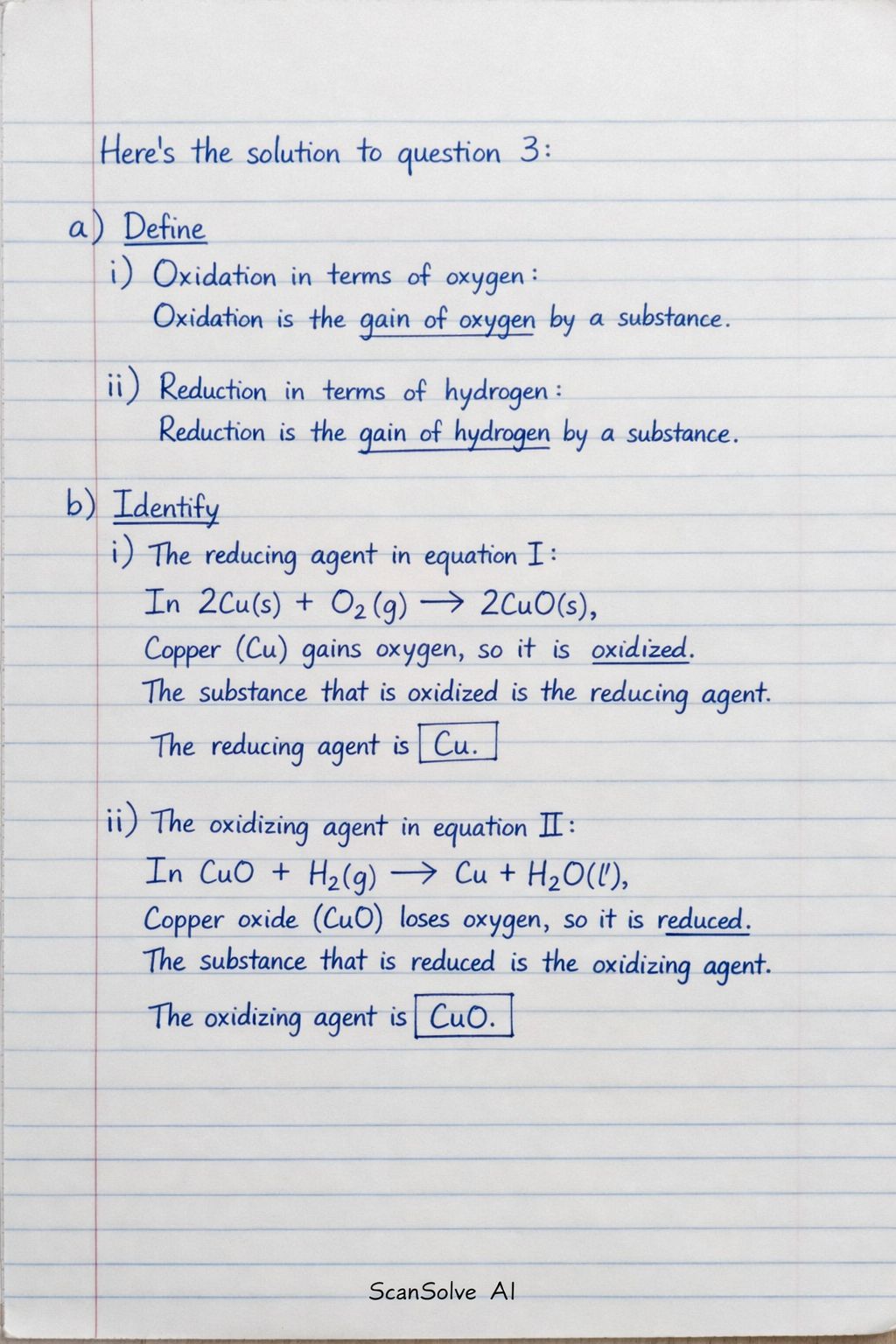
Here's the solution to question 3: a) Define i) Oxidation in terms of oxygen: Oxidation is the gain of oxygen* by a substance. ii) Reduction in term of Hydrogen: Reduction is the gain of hydrogen* by a substance. b) Identify i) The reducing agent in equation I: In 2Cu(s) + O_2(g) → 2CuO(s), Copper (Cu) gains oxygen, so it is oxidized. The substance that is oxidized is the reducing agent. The reducing agent is Cu. ii) The oxidizing agent in equation II: In CuO + H_2(g) → Cu + H_2O(l), Copper oxide (CuO) loses oxygen, so it is reduced. The substance that is reduced is the oxidizing agent. The oxidizing agent is CuO. c) Determine the oxidation state of i) Copper in Cu: Copper in its elemental form has an oxidation state of 0. The oxidation state is 0. ii) Oxygen in H_2O: In water, hydrogen has an oxidation state of +1. Since there are two hydrogen atoms and the molecule is neutral, the oxygen atom must balance the charge. 2(+1) + x = 0 2 + x = 0 x = -2 The oxidation state is -2. d) State whether each of these reactions involves oxidation or reduction or both. i) Al^3+ + 3e^- → Al: Aluminum ion gains electrons to become neutral aluminum. The gain of electrons is reduction. This reaction involves reduction. ii) 2O^2- → O_2 + 4e^-: Oxide ions lose electrons to form oxygen gas. The loss of electrons is oxidation. This reaction involves oxidation. iii) 2H_2 + O_2 → 2H_2O: Hydrogen goes from an oxidation state of 0 to +1 (oxidation), and oxygen goes from an oxidation state of 0 to -2 (reduction). Since both processes occur, it is a redox reaction. This reaction involves both. That's 2 down. 3 left today — send the next one.