
We read your photo as:
Which pair of species has the same percentage composition of carbon, hydrogen, and oxygen?
ScanSolve AI Answer
Answers
2 partsStep-by-step solution
6 stepsHere are the solutions to your questions:
Part 1· 2 steps
The pair of species having same percentage composition of carbon, hydrogen, and oxygen.
To have the same percentage composition, the compounds must have the same empirical formula.
Determine the molecular formula and then the empirical formula for each compound in the options.
-
Option (1): and
- For : Molecular formula is .
- Empirical formula: Divide subscripts by 2, which gives .
- For : Molecular formula is .
- Empirical formula: Divide subscripts by 6, which gives .
- Both compounds have the same empirical formula ().
- For : Molecular formula is .
-
Option (2): and
- For : Empirical formula is .
- For : Molecular formula is .
- Empirical formula: Cannot be simplified, so .
- The empirical formulas are different.
-
Option (3): and
- For : Molecular formula is .
- Empirical formula: .
- For : Molecular formula is .
- Empirical formula: Cannot be simplified, so .
- The empirical formulas are different.
- For : Molecular formula is .
-
Option (4): and
- For : Empirical formula is .
- For : Empirical formula is .
- The empirical formulas are different.
-
Identify the option where both compounds have the same empirical formula.
Option (1) is the only pair where both compounds have the same empirical formula (). Therefore, they will have the same percentage composition of carbon, hydrogen, and oxygen.
The final answer is .
Part 2
A compound prepared as a model of had 4.6% iron by mass if the compound is known to contain a single iron atom, which of these values would be closest to its molar mass?
Identify the given information.
- Percentage of iron () by mass =
- Number of iron atoms per molecule = 1
- Atomic mass of iron () (we can use for approximation as it's a multiple choice question).
Use the formula for percentage by mass.
The percentage by mass of an element in a compound is given by:
Since there is one iron atom per molecule, the mass of iron in one mole of the compound is the atomic mass of iron. Let be the molar mass of the compound.
Substitute the values and solve for .
Using the atomic mass of :
Compare the calculated molar mass with the given options.
The calculated molar mass is approximately .
The options are:
(1)
(2)
(3)
(4)The closest value to is .
The final answer is .
Try one yourself
A new problem that tests the same skill.
Still stuck on this one?
Ask a follow-up, and the answer starts from this question.
More Chemistry Questions
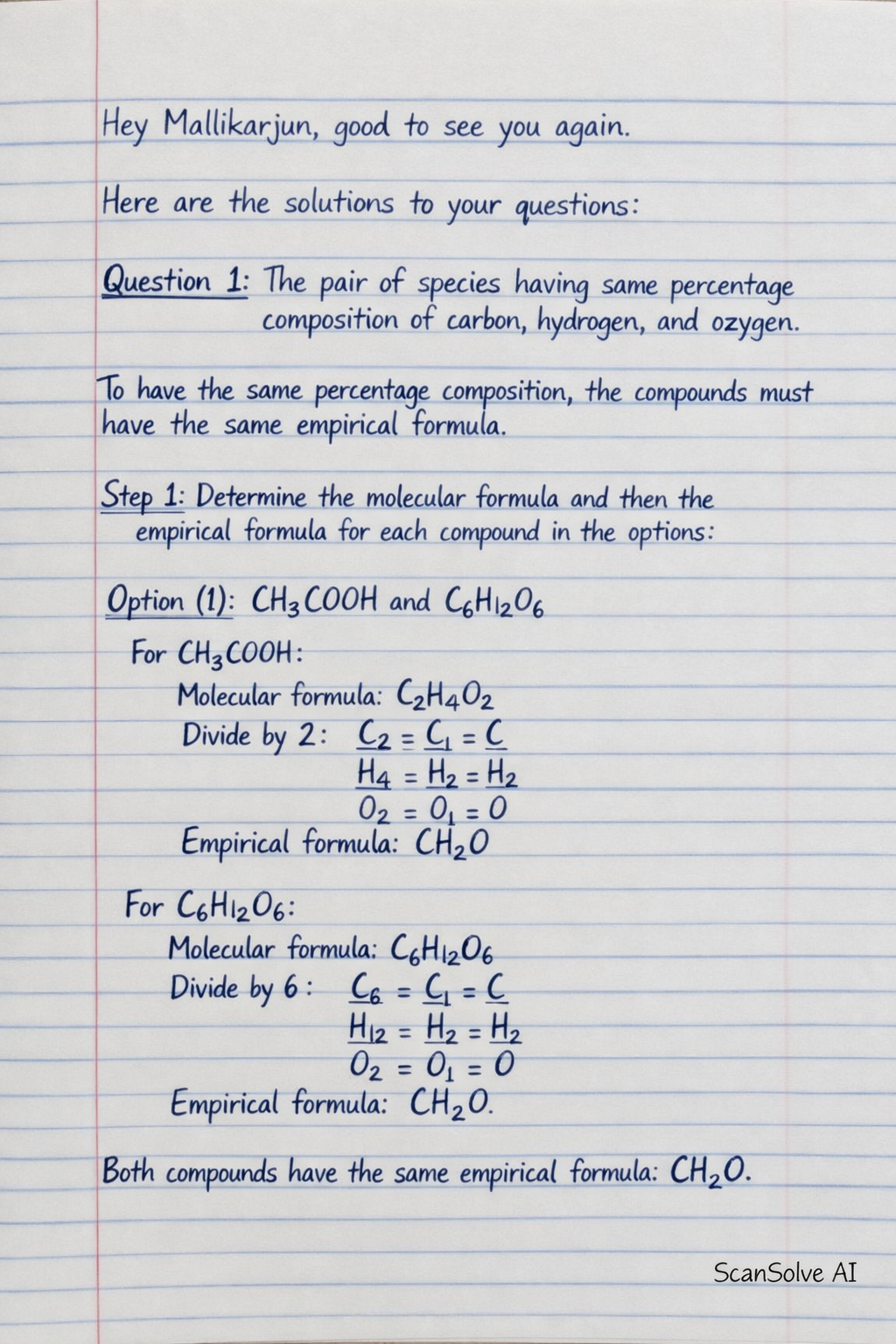
Handwritten Step-by-Step Solution
Get this as a handwritten image on WhatsApp — like a tutor wrote it for you.
Try on WhatsApp