
We read your photo as:
Calculate the percentage of water in the soil sample given initial mass and final dry mass.
ScanSolve AI Answer
Step-by-step solution
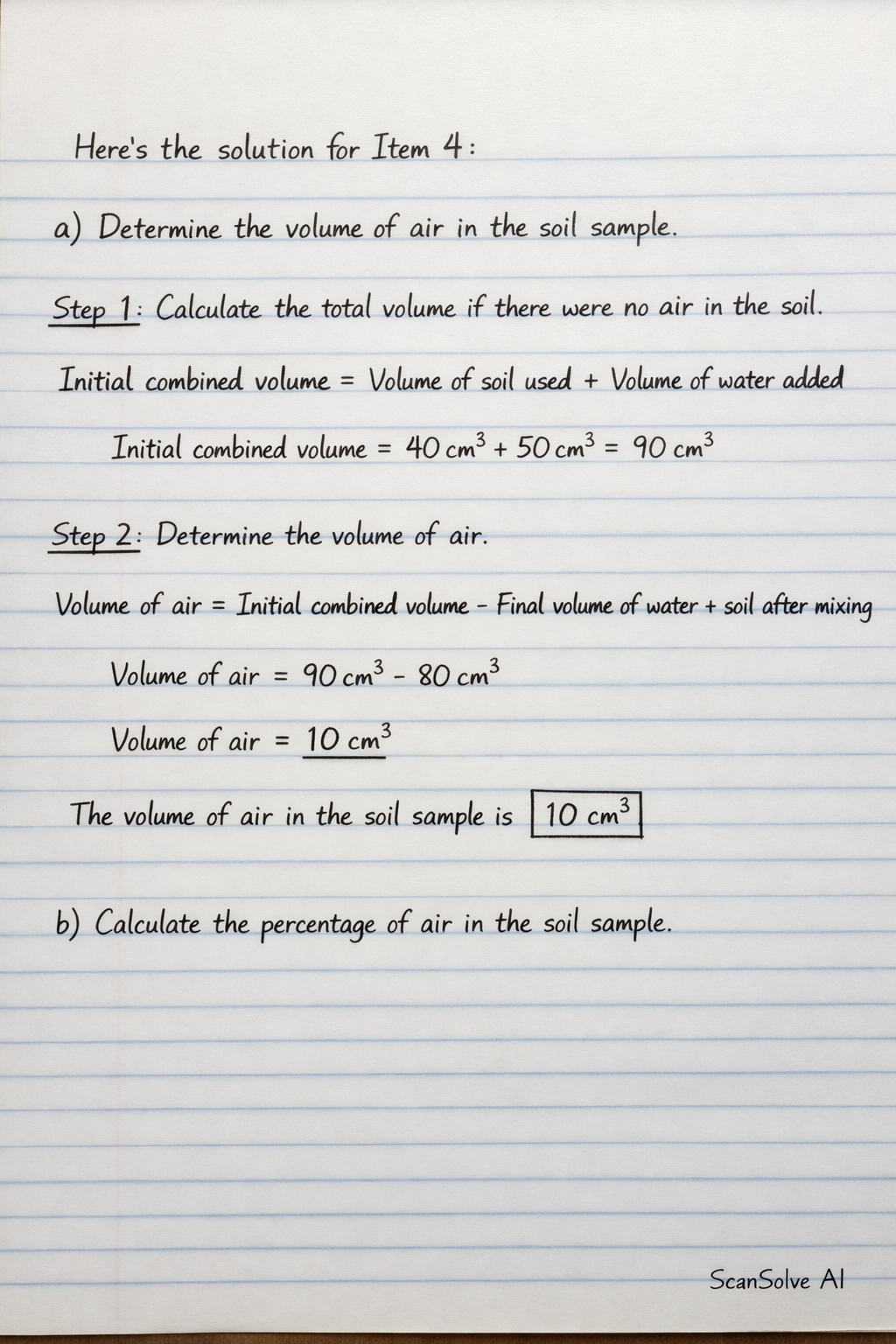
5 stepsHere's the solution for Item 4:
Part a· 2 steps
Determine the volume of air in the soil sample.
Calculate the total volume if there were no air in the soil.
Determine the volume of air.
The difference between the initial combined volume and the final volume represents the volume of air displaced by water.
The volume of air in the soil sample is .
Part b· 3 steps
Calculate the percentage of air in the soil sample.
Use the formula for percentage of air.
The percentage of air in the soil sample is .
In another investigation, 80g of a fresh soil sample was heated in a crucible. After repeated heating and cooling, the constant mass of the soil was found to be 65g. Calculate the percentage of water in the soil sample and explain the factors that affect the water content of a given soil.
Calculate the mass of water in the soil sample.
Calculate the percentage of water in the soil sample.
The percentage of water in the soil sample is .
Factors that affect the water content of a given soil:
- Soil texture: The proportion of sand, silt, and clay particles determines pore size and surface area, influencing how much water the soil can hold and how quickly it drains. Clay soils generally retain more water than sandy soils.
- Organic matter content: Organic matter acts like a sponge, significantly increasing the soil's water-holding capacity.
- Soil structure: The arrangement of soil particles into aggregates affects pore space distribution, influencing water infiltration and retention.
- Climate: Factors like rainfall, temperature (affecting evaporation), and humidity directly impact the amount of water present in the soil.
Still stuck on this one?
Ask a follow-up, and the answer starts from this question.
More Chemistry Questions
Handwritten Step-by-Step Solution
Get this as a handwritten image on WhatsApp — like a tutor wrote it for you.
Try on WhatsApp