
We read your photo as:
Calculate the percentage of oxygen.
ScanSolve AI Answer
Answers
2 partsStep-by-step solution
6 stepsPart a· 3 steps
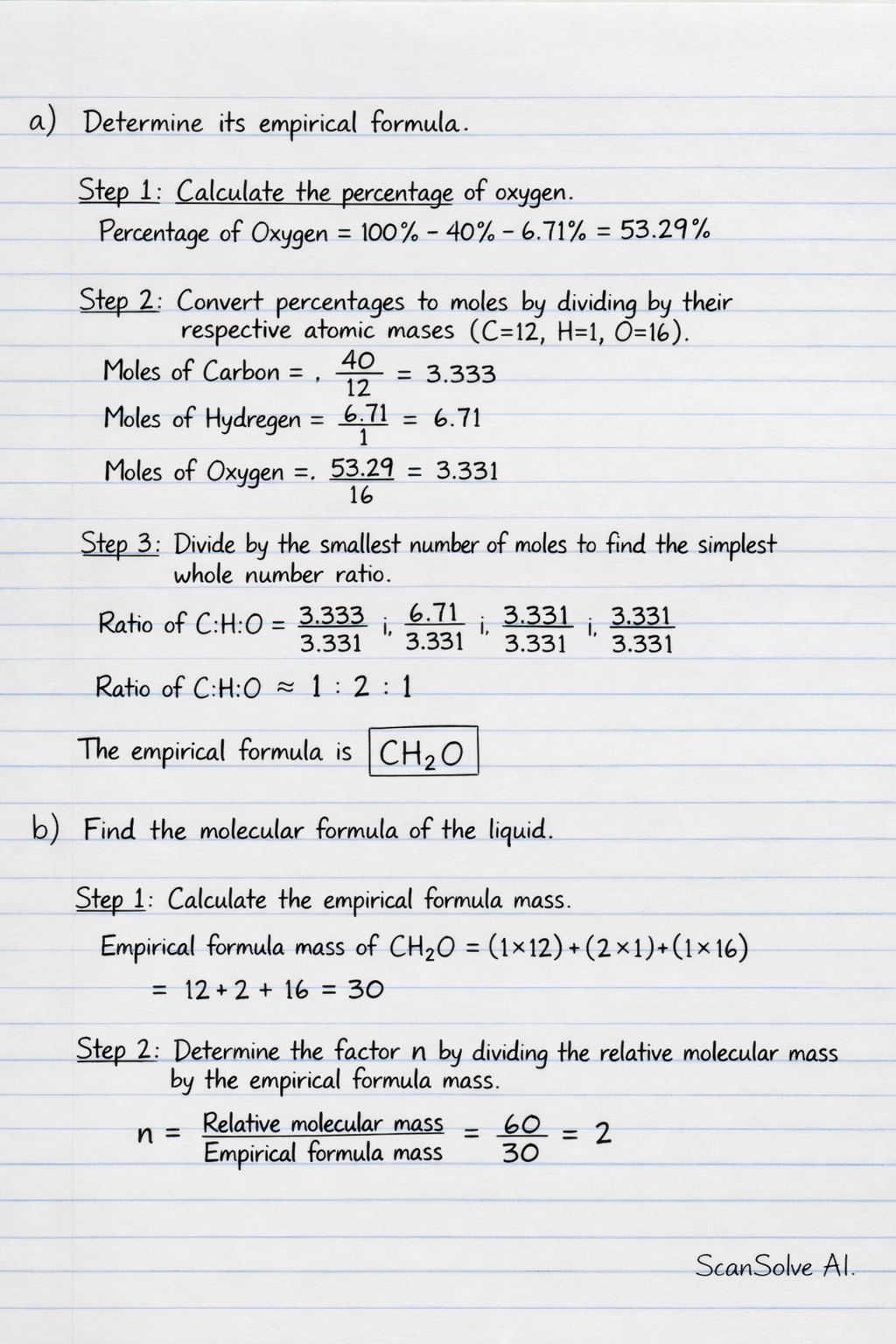
Determine its empirical formula.
Calculate the percentage of oxygen.
Percentage of Oxygen .
Convert percentages to moles by dividing by their respective atomic masses (C=12, H=1, O=16).
Moles of Carbon
Moles of Hydrogen
Moles of OxygenDivide by the smallest number of moles to find the simplest whole number ratio.
Ratio of C:H:O
Ratio of C:H:OThe empirical formula is .
Part b
Find the molecular formula of the liquid.
Calculate the empirical formula mass.
Empirical formula mass of .
Determine the factor by dividing the relative molecular mass by the empirical formula mass.
Multiply the empirical formula by .
Molecular formula .
18. State with a reason which of the above is:
Part b(i)
An ionic compound.
Substance D. It has high melting and boiling points (993 °C and 1695 °C) and conducts electricity when liquid but not when solid. This is characteristic of ionic compounds where ions are mobile in the molten state but fixed in the solid lattice.
Part b(ii)
A metallic structure.
Substance A. It has high melting and boiling points (1083 °C and 2567 °C) and conducts electricity well in both solid and liquid states. This is characteristic of metals due to delocalized electrons.
Part b(iii)
A giant atomic structure.
Substance C. It has very high melting and boiling points (1723 °C and 2230 °C) and is a poor conductor of electricity in both solid and liquid states. This is characteristic of giant covalent structures where strong covalent bonds must be broken to melt or boil, and there are no free mobile charge carriers.
19.
Still stuck on this one?
Ask a follow-up, and the answer starts from this question.
More Mathematics Questions
Handwritten Step-by-Step Solution
Get this as a handwritten image on WhatsApp — like a tutor wrote it for you.
Try on WhatsApp