
This chemistry question involves key chemical concepts and calculations. The detailed solution below walks through each step, from identifying the reaction type to computing the final answer.
ScanSolve AI Answer
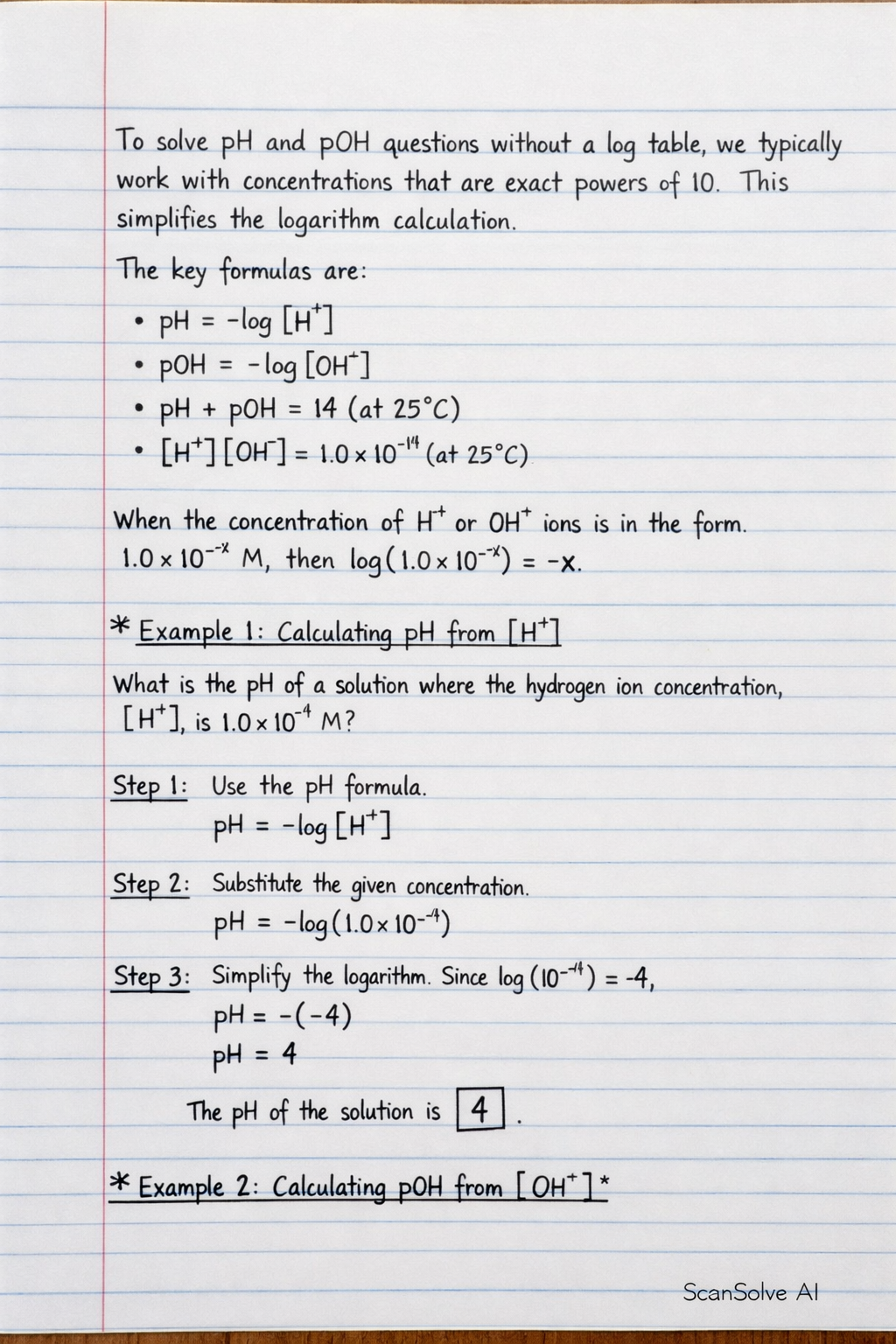
To solve pH and pOH questions without a log table, we typically work with concentrations that are exact powers of 10. This simplifies the logarithm calculation. The key formulas are: • pH = -[H^+] • pOH = -[OH^-] • pH + pOH = 14 (at 25^) • [H^+][OH^-] = 1.0 × 10^-14 (at 25^) When the concentration of H^+ or OH^- ions is in the form 1.0 × 10^-x M, then (1.0 × 10^-x) = -x. Example 1: Calculating pH from [H^+] What is the pH of a solution where the hydrogen ion concentration, [H^+], is 1.0 × 10^-4 M? Step 1: Use the pH formula. pH = -[H^+] Step 2: Substitute the given concentration. pH = -(1.0 × 10^-4) Step 3: Simplify the logarithm. Since (10^-4) = -4. pH = -(-4) pH = 4 The pH of the solution is 4. Example 2: Calculating pOH from [OH^-] What is the pOH of a solution where the hydroxide ion concentration, [OH^-], is 1.0 × 10^-2 M? Step 1: Use the pOH formula. pOH = -[OH^-] Step 2: Substitute the given concentration. pOH = -(1.0 × 10^-2) Step 3: Simplify the logarithm. Since (10^-2) = -2. pOH = -(-2) pOH = 2 The pOH of the solution is 2. Example 3: Calculating pH from pOH (or vice versa) If the pOH of a solution is 3, what is its pH? Step 1: Use the relationship between pH and pOH. pH + pOH = 14 Step 2: Substitute the given pOH value. pH + 3 = 14 Step 3: Solve for pH. pH = 14 - 3 pH = 11 The pH of the solution is 11.