

This chemistry question involves key chemical concepts and calculations. The detailed solution below walks through each step, from identifying the reaction type to computing the final answer.
ScanSolve AI Answer
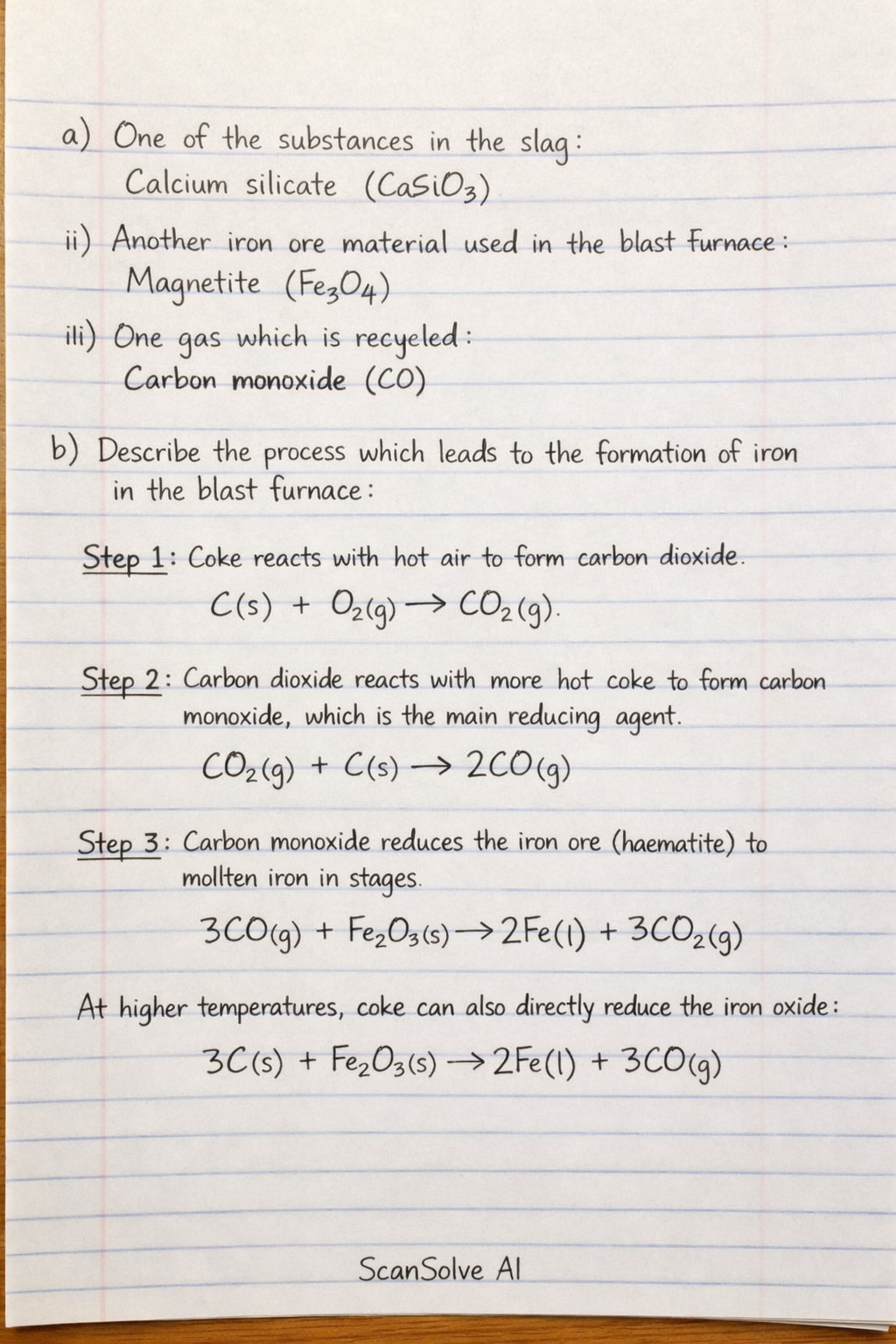
You're on a roll — a) i) One of the substances in the slag Calcium silicate (CaSiO_3) ii) Another iron ore material used in the blast furnace Magnetite (Fe_3O_4) iii) One gas which is recycled Carbon monoxide (CO) b) Describe the process which leads to the formation of iron in the blast furnace Step 1: Coke reacts with hot air to form carbon dioxide. C(s) + O_2(g) CO_2(g) Step 2: Carbon dioxide reacts with more hot coke to form carbon monoxide, which is the main reducing agent. CO_2(g) + C(s) 2CO(g) Step 3: Carbon monoxide reduces the iron ore (haematite) to molten iron in stages. 3CO(g) + Fe_2O_3(s) 2Fe(l) + 3CO_2(g) At higher temperatures, coke can also directly reduce the iron oxide. 3C(s) + Fe_2O_3(s) 2Fe(l) + 3CO(g) c) State the purpose of limestone in the blast furnace Limestone (CaCO_3) decomposes to form calcium oxide (CaO), which acts as a flux. It reacts with acidic impurities like silicon dioxide (SiO_2) to form molten slag (calcium silicate, CaSiO_3), which can be easily removed. CaCO_3(s) CaO(s) + CO_2(g) CaO(s) + SiO_2(s) CaSiO_3(l) d) Give a reason why the melting point of iron obtained from the blast furnace is 1200^ while that of pure iron is 1535^ The iron obtained from the blast furnace (pig iron) contains impurities, mainly carbon (about 4%), which lower its melting point. Pure iron has a higher melting point because it lacks these impurities. e) State two uses of steel • Construction: Used in making beams, reinforcing bars, and structural frameworks for buildings and bridges. • Manufacturing: Used in making car bodies, machinery, tools, and household appliances. Mándame la siguiente 📸