
We read your photo as:
Describe properties of elements across a period, differences between chemical and nuclear reactions, and identify isotopes based on atomic data.
ScanSolve AI Answer
Step-by-step solution
8 steps1. (a) (i)
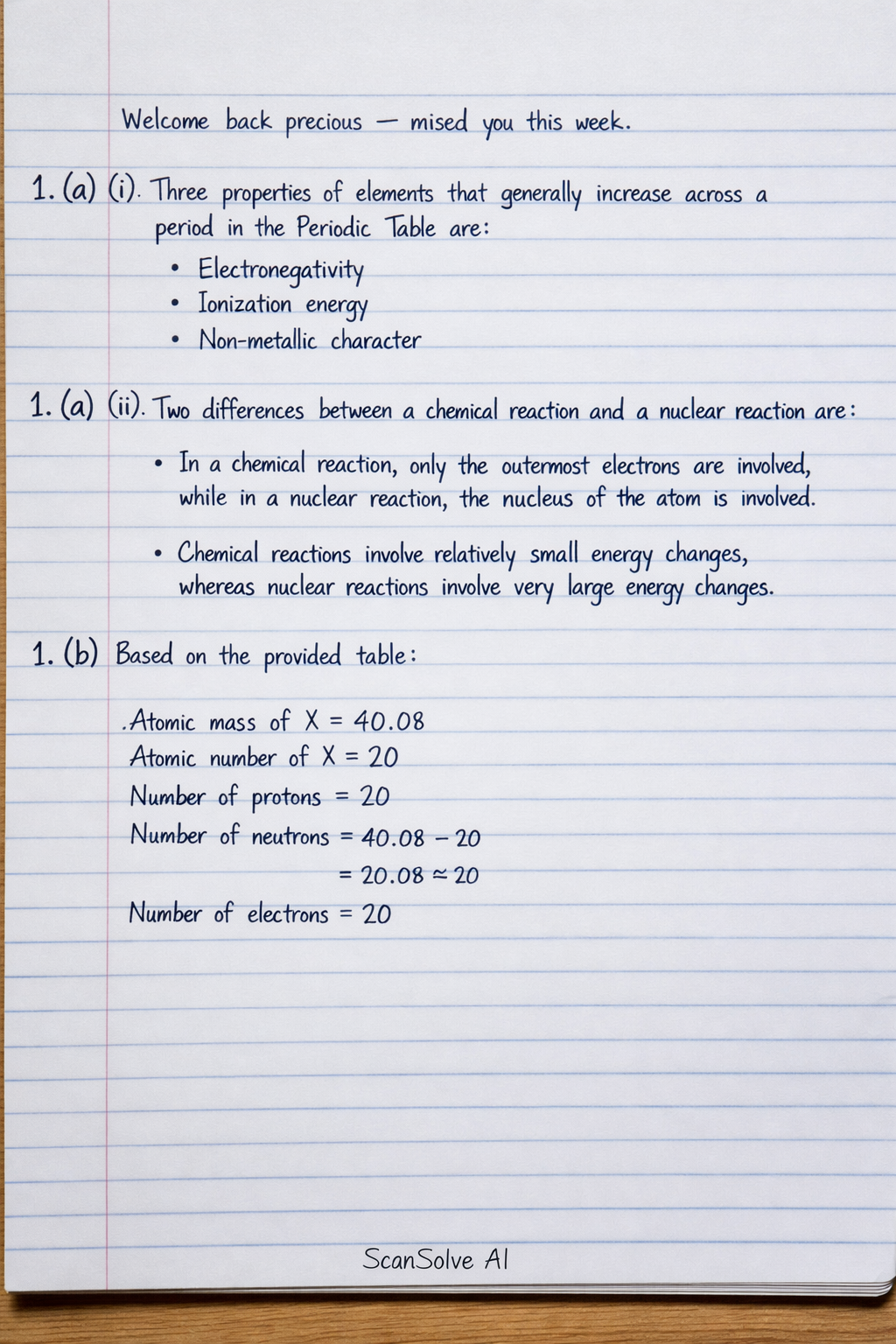
Three properties of elements that generally increase across a period in the Periodic Table are:
- Electronegativity
- Ionization energy
- Non-metallic character
1. (a) (ii)
Two differences between a chemical reaction and a nuclear reaction are:
- In a chemical reaction, only the outermost electrons are involved, while in a nuclear reaction, the nucleus of the atom is involved.
- Chemical reactions involve relatively small energy changes, whereas nuclear reactions involve very large energy changes.
1. (b)
Based on the provided table:
- P: Atomic Number (Z) = 8, Mass Number (A) = 16. Protons = 8, Neutrons = 16 - 8 = 8. Electron configuration = 2,6.
- Q: Atomic Number (Z) = 20, Mass Number (A) = 40. Protons = 20, Neutrons = 40 - 20 = 20. Electron configuration = 2,8,8,2.
- R: Atomic Number (Z) = 17, Mass Number (A) = 35. Protons = 17, Neutrons = 35 - 17 = 18. Electron configuration = 2,8,7.
- S: Atomic Number (Z) = 8, Mass Number (A) = 18. Protons = 8, Neutrons = 18 - 8 = 10. Electron configuration = 2,6.
- T: Atomic Number (Z) = 10, Mass Number (A) = 20. Protons = 10, Neutrons = 20 - 10 = 10. Electron configuration = 2,8.
(i) Atoms that are isotopes of the same element:
Isotopes have the same atomic number but different mass numbers.
- P and S (both have atomic number 8).
(ii) Atom that contains 18 neutrons:
Number of neutrons = Mass Number - Atomic Number.
- For R: .
- R
(iii) Atom that is chemically unreactive:
Unreactive atoms have a full outer electron shell (noble gases).
- T has an electron configuration of 2,8, which is a full outer shell.
- T
(iv) Atom that readily forms an ion with two positive charges:
Atoms that readily lose two electrons to form a +2 ion are typically Group 2 elements.
- Q has an electron configuration of 2,8,8,2, meaning it has 2 valence electrons.
- Q
(v) Atom that attains an octet structure by accepting one electron:
Atoms that need one electron to complete their octet are typically Group 17 elements.
- R has an electron configuration of 2,8,7, meaning it needs 1 electron.
- R
(vi) Atom that forms an ionic bond with R:
R is a non-metal (Group 17). It will form an ionic bond with a metal.
- Q is a metal (Group 2).
- Q
(vii) Atom that belongs to the s-block in the Periodic Table:
S-block elements are Group 1 or Group 2 elements, which have their valence electrons in the s-orbital.
- Q has 2 valence electrons in its outermost s-orbital (2,8,8,2).
- Q
1. (c)
(i) Conversion of to :
Heat copper(II) carbonate to decompose it into copper(II) oxide and carbon dioxide.
Reduce the copper(II) oxide to copper metal using a reducing agent like hydrogen gas or carbon.
or
(ii) Conversion of to :
Magnesium oxide is a basic oxide. It reacts with an acid to form a salt and water. To get magnesium sulfate, react it with sulfuric acid.2. (a) (i)
Graham's Law of Diffusion states that the rate of diffusion or effusion of a gas is inversely proportional to the square root of its molar mass (or relative molecular mass) at constant temperature and pressure.2. (a) (ii)
Determine the relative molecular mass of the triatomic gas X.
Given: Relative atomic mass of X = 16.
Since the gas is triatomic, its formula is .
Relative molecular mass of .Calculate the vapour density.
Vapour density is half of the relative molecular mass.
2. (a) (iii)
Relate the mass of molecules to molar mass.
Given that the mass of a molecule of Y is twice that of Z, we can infer that the molar mass of Y () is twice the molar mass of Z ().
Apply Graham's Law of Diffusion to compare average velocities.
Graham's Law states that the rate of diffusion (and thus average velocity) is inversely proportional to the square root of the molar mass.
Substitute the relationship between and .
This means .
Conclude which molecule has the greater average velocity.
Since , is approximately 0.707 times . Therefore, .
The molecule with the smaller molar mass will have the greater average velocity. Since is half of , molecule Z has the greater average velocity.Explanation: According to Graham's Law, lighter molecules move faster than heavier molecules at the same temperature. Since the mass of a molecule of Z is half that of Y, Z is lighter and will therefore have a greater average velocity.
Still stuck on this one?
Ask a follow-up, and the answer starts from this question.
More Chemistry Questions
Handwritten Step-by-Step Solution
Get this as a handwritten image on WhatsApp — like a tutor wrote it for you.
Try on WhatsApp