
We read your photo as:
Provide answers to the following questions, detailing the reasons for each.
ScanSolve AI Answer
This answer stops before the end.
It was cut off when it was first written. Ask ScanSolve this question again for the full working.
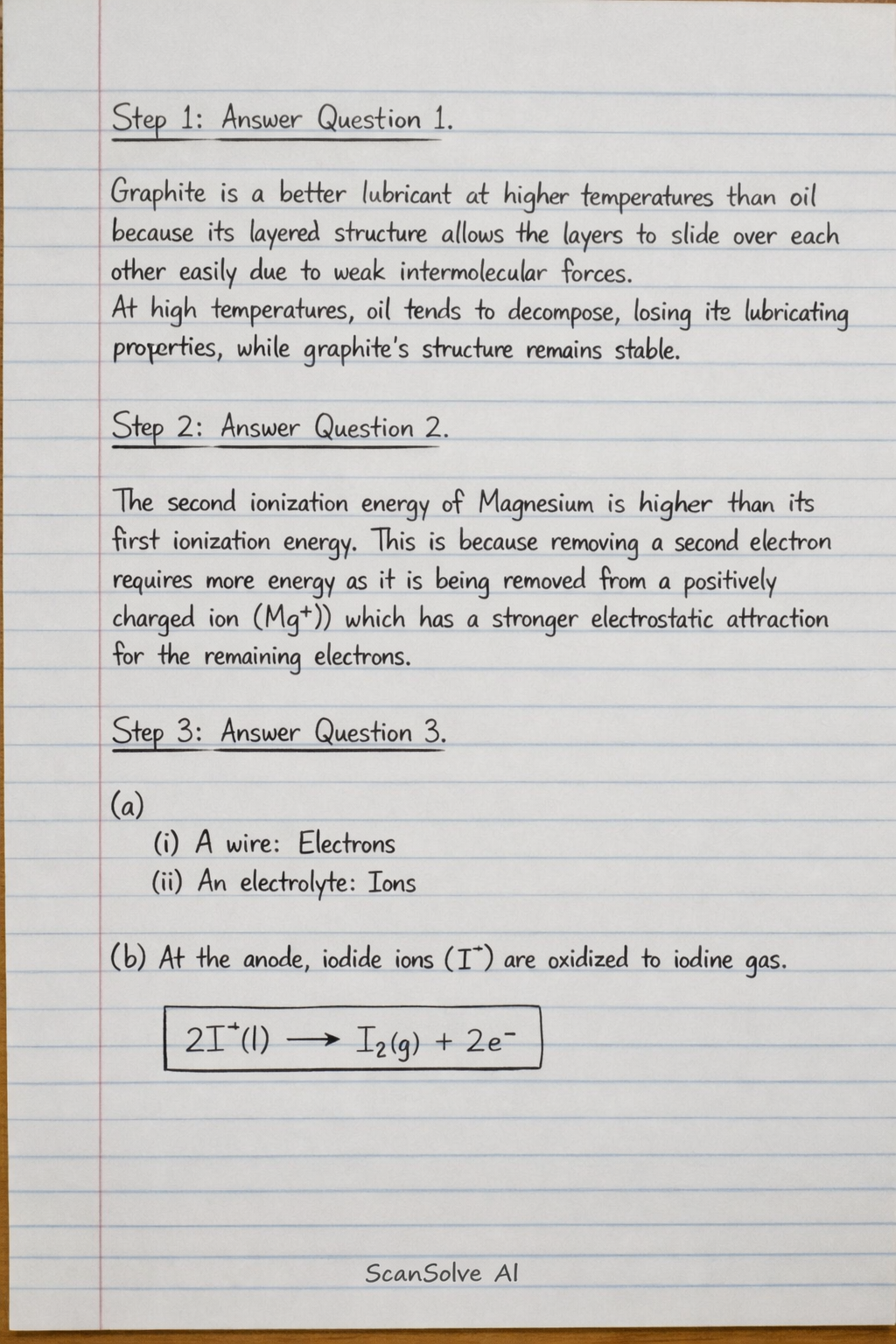
Step 1: Answer Question 1.
Graphite is a better lubricant at higher temperatures than oil because its layered structure allows the layers to slide over each other easily due to weak intermolecular forces. At high temperatures, oil tends to decompose, losing its lubricating properties, while graphite's structure remains stable.
Step 2: Answer Question 2.
The second ionization energy of Magnesium is higher than its first ionization energy. This is because removing a second electron requires more energy as it is being removed from a positively charged ion (Mg), which has a stronger electrostatic attraction for the remaining electrons.
Step 3: Answer Question 3.
a)
- (i) A wire: Electrons
- (ii) An electrolyte: Ions
b) At the anode, iodide ions (I) are oxidized to iodine gas.
Step 4: Answer Question 4.
a) HO
b) NH_4$$^+
Step 5: Answer Question 5.
a)
- (i) The yellow solution is iron(III) chloride ().
- (ii) If aqueous ammonia is added to the yellow solution, a reddish-brown precipitate of iron(III) hydroxide () would be observed.
- (iii) The balanced equation for the reaction when hydrogen chloride gas is passed over heated iron fillings is:
b) The equation for the reaction between concentrated hydrochloric acid and manganese(IV) oxide is:
c)
- (i) When chlorine gas is bubbled through iron(II) sulphate solution, the green solution turns yellow/brown as ions are oxidized to ions.
- (ii) When chlorine gas is bubbled through potassium bromide solution, the colourless solution turns orange/brown as bromine is displaced.
- (iii) The ionic equation for the observation in (ii) is:
- (iv) The reaction between chlorine and hydrogen is a photochemical reaction. Sunlight provides the energy to break the chlorine molecules into free radicals, initiating a rapid chain reaction that leads to an explosion.
d) When a burning piece of magnesium ribbon is lowered into a gas jar containing chlorine gas, the magnesium continues burning because magnesium is a very reactive metal and chlorine is a strong oxidizing agent. The reaction is highly exothermic, releasing enough heat to sustain the combustion.
e) The product formed in (d) is magnesium chloride (). When dissolved in water, forms a solution with a pH of approximately 7 (neutral), as it is a salt of a strong acid and a strong base.
f) Chlorine acts as a bleaching agent in the presence of water by reacting with water to form hypochlorous acid (). This then decomposes to release nascent oxygen, which is a powerful oxidizing agent. This nascent oxygen oxidizes the colored substances, rendering them colorless.
g) Three other uses of chlorine apart from bleaching are:
- Disinfection of water.
- Manufacture of hydrochloric acid.
- Manufacture of plastics like PVC.
Still stuck on this one?
Ask a follow-up, and the answer starts from this question.
More Chemistry Questions
Handwritten Step-by-Step Solution
Get this as a handwritten image on WhatsApp — like a tutor wrote it for you.
Try on WhatsApp