

This chemistry question involves key chemical concepts and calculations. The detailed solution below walks through each step, from identifying the reaction type to computing the final answer.
ScanSolve AI Answer
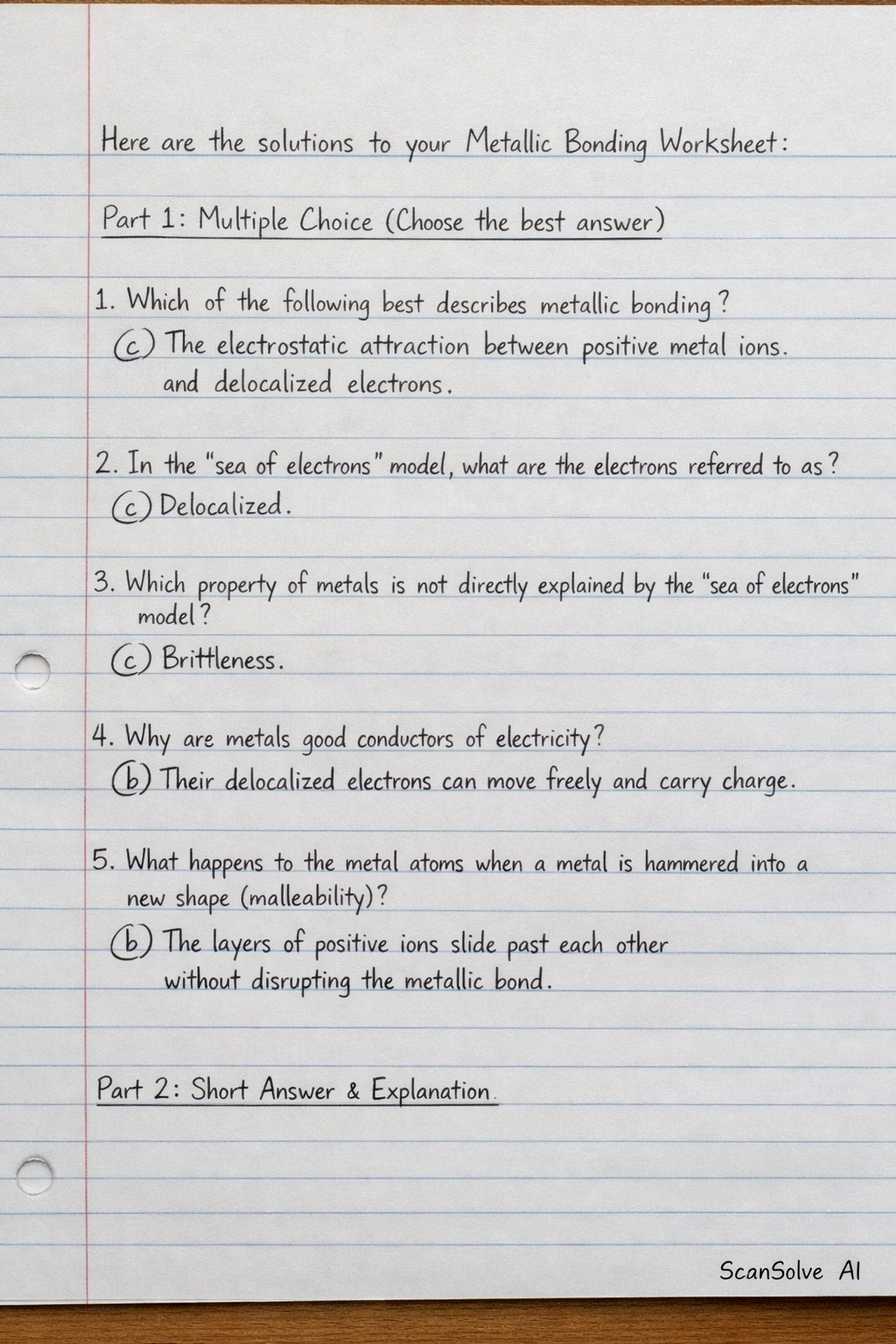
Here are the solutions to your Metallic Bonding Worksheet: Part 1: Multiple Choice (Choose the best answer) 1. Which of the following best describes metallic bonding? c) The electrostatic attraction between positive metal ions and delocalized electrons. 2. In the "sea of electrons" model, what are the electrons referred to as? c) Delocalized. 3. Which property of metals is not directly explained by the "sea of electrons" model? c) Brittleness. 4. Why are metals good conductors of electricity? b) Their delocalized electrons can move freely and carry charge. 5. What happens to the metal atoms when a metal is hammered into a new shape (malleability)? b) The layers of positive ions slide past each other without disrupting the metallic bond. Part 2: Short Answer & Explanation 1. The "sea of electrons" model describes metallic bonding as a lattice of positive metal ions surrounded by a "sea" of mobile, delocalized electrons. These electrons are not associated with any single atom but are free to move throughout the entire metallic structure. 2. Metals are good conductors of heat because their delocalized electrons can rapidly transfer kinetic energy through the metallic lattice. When one part of the metal is heated, these free electrons gain energy and quickly move to cooler regions, distributing the heat efficiently. 3. Metals are generally lustrous (shiny) because their delocalized electrons can absorb and re-emit light across a wide range of wavelengths. When light strikes the surface of a metal, these electrons are excited and then quickly fall back to their original energy levels, releasing the absorbed energy as reflected light. 4. Comparison of Ionic and Metallic Bonding: Similarity: Both involve strong electrostatic forces of attraction*. In ionic bonding, it's between oppositely charged ions. In metallic bonding, it's between positive metal ions and delocalized electrons. Difference 1: Ionic bonding involves the transfer of electrons to form discrete positive and negative ions, which are then held in a rigid lattice. Metallic bonding involves the sharing of delocalized electrons* among positive metal ions, with no electron transfer between specific atoms. Difference 2: In ionic compounds, electrons are localized within the ions, making them poor electrical conductors in the solid state. In metallic bonding, the delocalized electrons* are free to move, making metals excellent electrical conductors in both solid and liquid states. 5. Substance A: Metallic bonding because it is a good electrical conductor in both solid and liquid states and is malleable. These properties are characteristic of metals due to their delocalized electrons and ability for layers of atoms to slide. Substance B: Ionic bonding because it is a poor electrical conductor in both states and is brittle. Ionic compounds typically do not conduct electricity as solids (ions are fixed) and are brittle because a shift in the lattice can bring like-charged ions together, causing repulsion and fracture. Part 3: Diagram & Application 1. Diagram representing metallic bonding: A simple diagram would show a regular arrangement of positively charged circles (representing positive metal ions) with many small negative dots (representing delocalized electrons) scattered randomly throughout the spaces between the positive ions. The electrons should not be attached to any specific ion, illustrating their mobility. 2. Alloys are often harder than pure metals because the introduction of atoms of different sizes (from the mixed metals) disrupts the regular, uniform arrangement of atoms in the metallic lattice. This disruption makes it more difficult for the layers of positive metal ions to slide past each other, which is the mechanism for malleability and ductility in pure metals. The irregular packing creates more resistance to deformation, increasing hardness. Last free one today — make it count tomorrow, or type /upgrade for unlimited.