
We read your photo as:
Q6. Identify the common ions from the following compounds and write the balance chemical equations to show how its compound has formed.
Chemistry
ScanSolve AI Answer
This answer stops before the end.
It was cut off when it was first written. Ask ScanSolve this question again for the full working.
Here are the solutions for the questions in the image.
Q6. Identify the common ions from the following compounds and write the balance chemical equations to show how its compound has formed.
-
a.
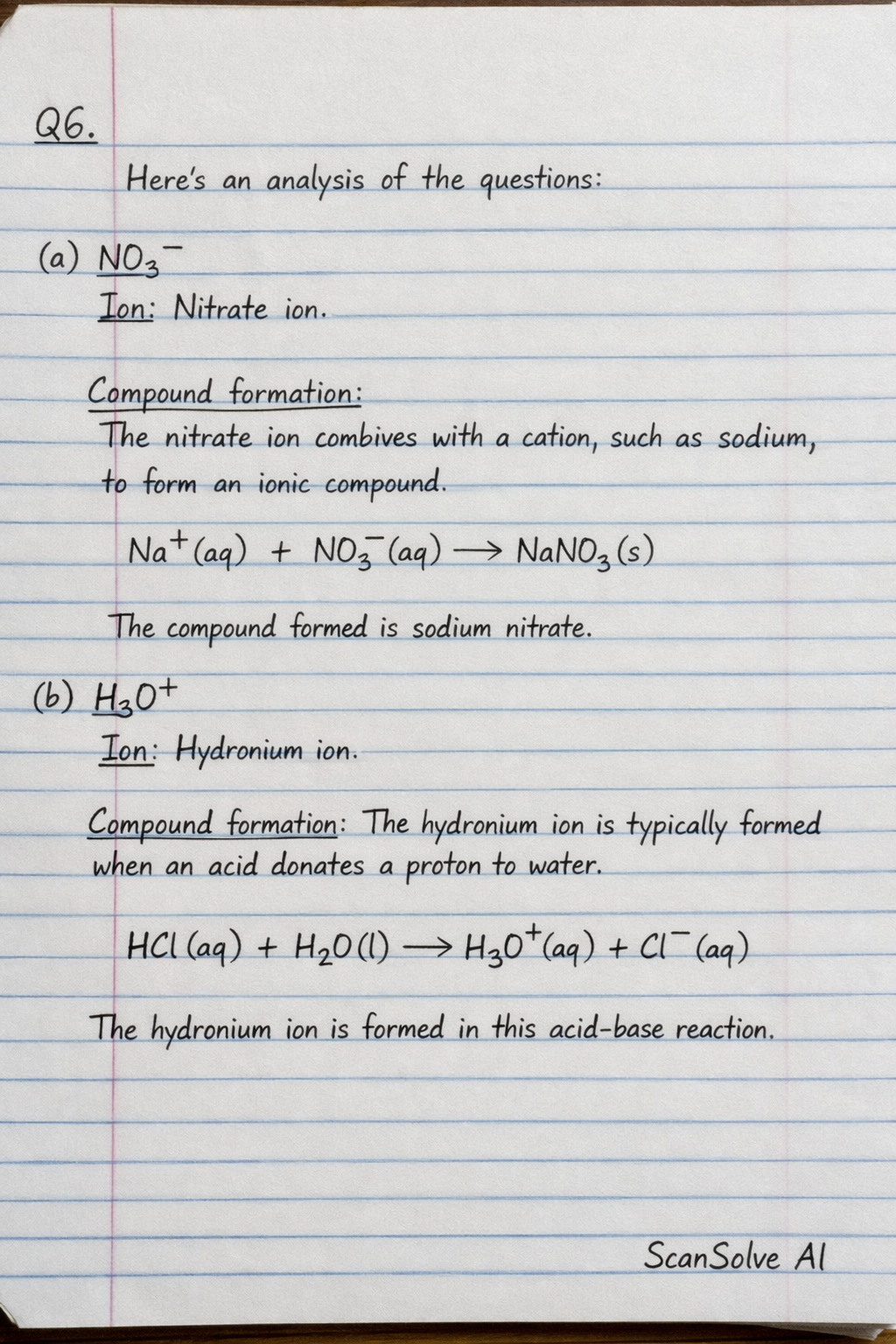
- Ion: Nitrate ion
- Compound formation: The nitrate ion combines with a cation, such as sodium, to form an ionic compound. The compound formed is sodium nitrate.
-
b.
- Ion: Hydronium ion
- Compound formation: The hydronium ion is typically formed when an acid donates a proton to water. The hydronium ion is formed in this acid-base reaction.
-
c.
- Ion: Trimethylsulfonium ion (). The given formula is likely missing the positive charge.
- Compound formation: The trimethylsulfonium ion combines with an anion, such as chloride, to form an ionic compound. The compound formed is trimethylsulfonium chloride.
-
d.
- Compound: This formula represents methanol (), which is a molecular compound. It does not contain common ions in the same way ionic compounds do.
- Ion formation from compound: Methanol can react with a strong base (like sodium hydride) to form the methoxide ion () as part of an ionic compound. The compound formed is sodium methoxide.
-
e.
- Compound: This formula also represents methanol (), which is a molecular compound. It is identical to option d.
- Ion formation from compound: Methanol can react with a strong base (like sodium hydride) to form the methoxide ion () as part of an ionic compound. The compound formed is sodium methoxide.
-
f.
- Ion: Ammonium ion
- Compound formation: The ammonium ion combines with an anion, such as chloride, to form an ionic compound. The compound formed is ammonium chloride.
Carbon Allotropes Table
Here are the carbon allotropes corresponding to the descriptions:
| Carbon Allotropes | Description
Was this helpful?
Still stuck on this one?
Ask a follow-up, and the answer starts from this question.
Got a different question?Ask your own question
More Chemistry Questions
QWrite the balanced chemical equations and word equations for the reactions represented by the…QIdentify the ions present based on the observations from the chemical tests.QWrite the balanced chemical equations for the following reactions, including state symbols:QIdentify the cation and anion for the following compounds using qualitative analysis tests and…QWrite the balanced chemical equations for the following reactions: [list of reactions]
Handwritten Step-by-Step Solution
Get this as a handwritten image on WhatsApp — like a tutor wrote it for you.
Try on WhatsApp