
We read your photo as:
Identify the cation and anion for the following compounds using qualitative analysis tests and describe the observations.
Chemistry
ScanSolve AI Answer
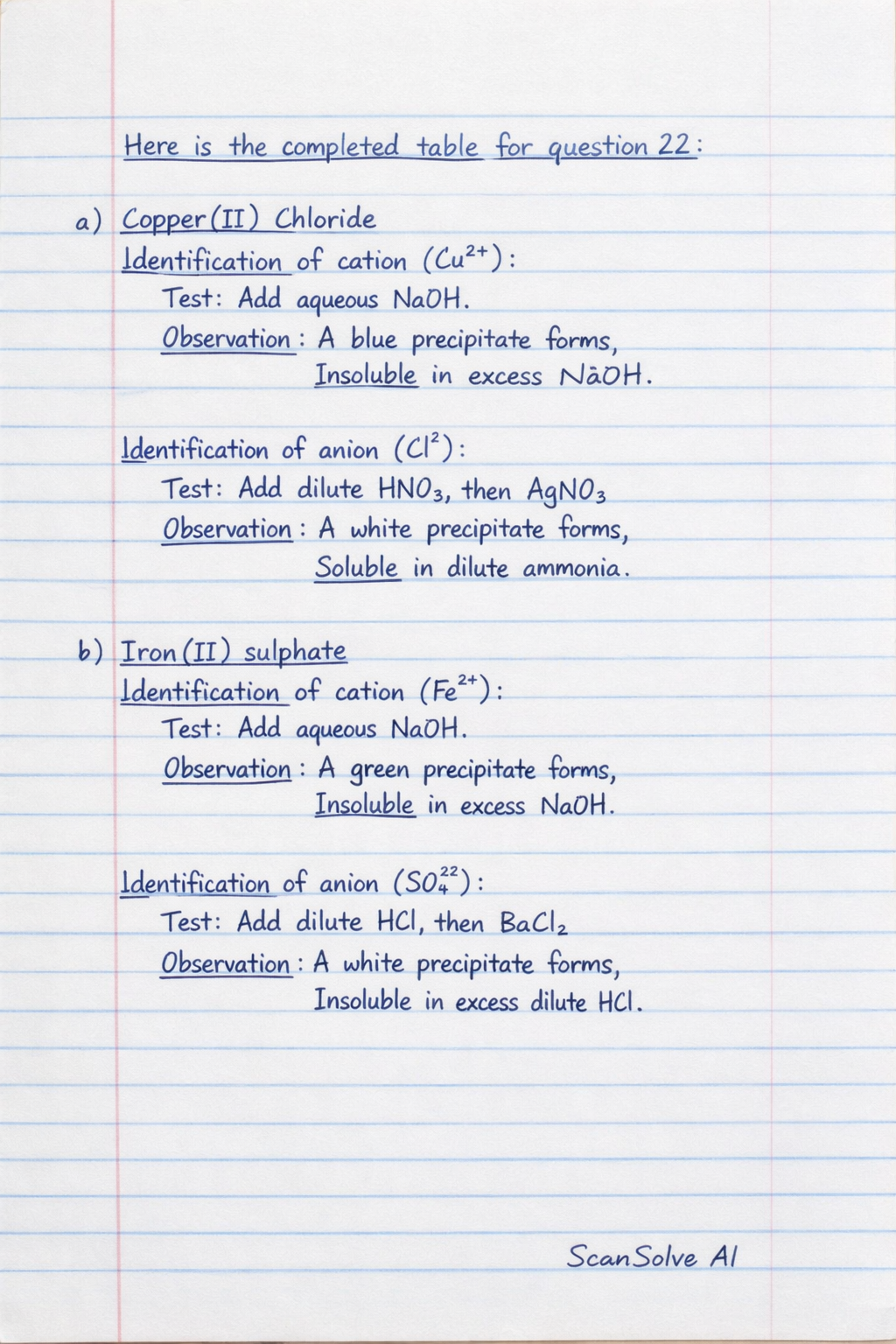
Here is the completed table for question 22:
-
a) Copper(II) Chloride
- Identification of cation (Cu²⁺): Test: Add aqueous sodium hydroxide (NaOH). Observation: A blue precipitate forms, which is insoluble in excess NaOH.
- Identification of anion (Cl⁻): Test: Add dilute nitric acid (HNO₃) followed by aqueous silver nitrate (AgNO₃). Observation: A white precipitate forms, which is soluble in dilute aqueous ammonia.
-
b) Iron(II) sulphate
- Identification of cation (Fe²⁺): Test: Add aqueous sodium hydroxide (NaOH). Observation: A green precipitate forms, which is insoluble in excess NaOH.
- Identification of anion (SO₄²⁻): Test: Add dilute hydrochloric acid (HCl) followed by aqueous barium chloride (BaCl₂). Observation: A white precipitate forms, which is insoluble in excess dilute HCl.
-
c) Iron(III) bromide
- Identification of cation (Fe³⁺): Test: Add aqueous sodium hydroxide (NaOH). Observation: A reddish-brown precipitate forms, which is insoluble in excess NaOH.
- Identification of anion (Br⁻): Test: Add dilute nitric acid (HNO₃) followed by aqueous silver nitrate (AgNO₃). Observation: A cream precipitate forms, which is sparingly soluble in dilute aqueous ammonia.
-
d) Ammonium hydroxide
- Identification of cation (NH₄⁺): Test: Add aqueous sodium hydroxide (NaOH) and warm gently. Observation: A pungent gas is evolved, which turns damp red litmus paper blue.
- Identification of anion (OH⁻): Test: Test the solution with red litmus paper. Observation: The red litmus paper turns blue.
-
e) Sodium carbonate
- Identification of cation (Na⁺): Test: Perform a flame test. Observation: A golden yellow flame is observed.
- Identification of anion (CO₃²⁻): Test: Add dilute hydrochloric acid (HCl). Observation: Effervescence occurs, and the gas produced turns limewater milky.
Was this helpful?
Still stuck on this one?
Ask a follow-up, and the answer starts from this question.
Got a different question?Ask your own question
More Chemistry Questions
QContinue the qualitative analysis of ions, focusing on specific tests and observations for cations.QIdentify the ions present based on the observations from the chemical tests.QIdentify the ions present in solid M based on the provided qualitative analysis test results.QVolumetric Analysis Quantitative analysis Qualitative analysis Neutralization reaction Acid bases…QDescribe the tests used to identify the following ions: a) Chloride, b) Sulphate, c) Potassium, d)…
Handwritten Step-by-Step Solution
Get this as a handwritten image on WhatsApp — like a tutor wrote it for you.
Try on WhatsApp