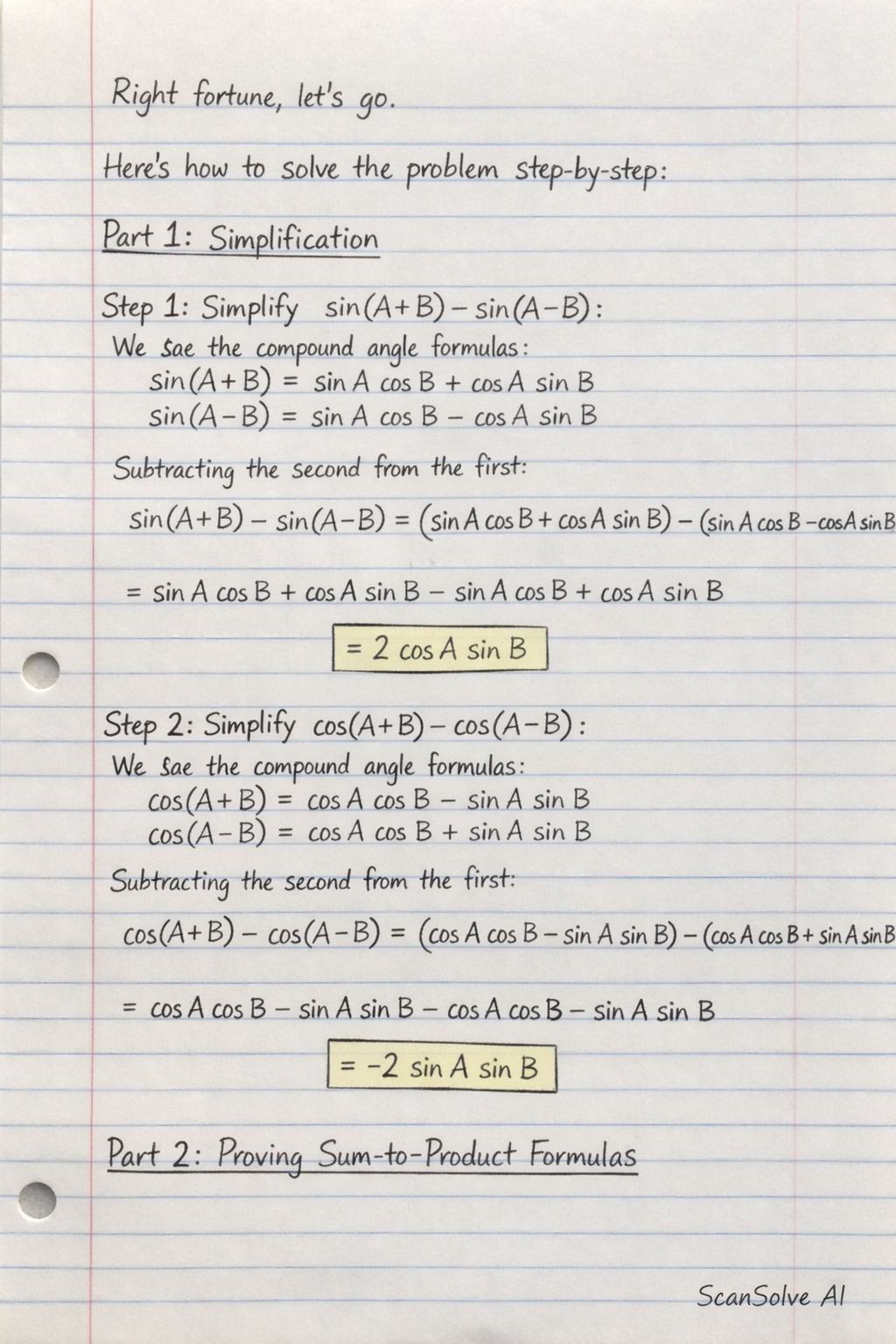
Here's how to solve the problem step-by-step:
Part 1: Simplification
Step 1: Simplify sin(A+B)−sin(A−B).
We use the compound angle formulas:
sin(A+B)=sinAcosB+cosAsinB
sin(A−B)=sinAcosB−cosAsinB
Subtracting the second from the first:
sin(A+B)−sin(A−B)=(sinAcosB+cosAsinB)−(sinAcosB−cosAsinB)
=sinAcosB+cosAsinB−sinAcosB+cosAsinB
=2cosAsinB
Step 2: Simplify cos(A+B)−cos(A−B).
We use the compound angle formulas:
cos(A+B)=cosAcosB−sinAsinB
cos(A−B)=cosAcosB+sinAsinB
Subtracting the second from the first:
cos(A+B)−cos(A−B)=(cosAcosB−sinAsinB)−(cosAcosB+sinAsinB)
=cosAcosB−sinAsinB−cosAcosB−sinAsinB
=−2sinAsinB
Part 2: Proving Sum-to-Product Formulas
Given X=A+B and Y=A−B.
We need to express A and B in terms of X and Y.
Adding the two equations:
X+Y=(A+B)+(A−B)=2A⟹A=2X+Y
Subtracting the second equation from the first:
X−Y=(A+B)−(A−B)=2B⟹B=2X−Y
Step 3: Show that sinX−sinY=2sin21(X−Y)cos21(X+Y).
From Step 1, we have sin(A+B)−sin(A−B)=2cosAsinB.
Substitute X=A+B, Y=A−B, A=2X+Y, and B=2X−Y into this equation:
sinX−sinY=2cos(2X+Y)sin(2X−Y)
This matches the required formula.
\sin X - \sin Y = 2 \sin \frac{1{2}(X-Y) \cos \frac{1}{2}(X+Y)}
Step 4: Show that cosX+cosY=2cos21(X+Y)cos21(X−Y).
First, we need to simplify cos(A+B)+cos(A−B):
cos(A+B)+cos(A−B)=(cosAcosB−sinAsinB)+(cosAcosB+sinAsinB)
=cosAcosB−sinAsinB+cosAcosB+sinAsinB
=2cosAcosB
Now, substitute X=A+B, Y=A−B, A=2X+Y, and B=2X−Y into this result:
cosX+cosY=2cos(2X+Y)cos(2X−Y)
This matches the required formula.
\cos X + \cos Y = 2 \cos \frac{1{2}(X+Y) \cos \frac{1}{2}(X-Y)}
Drop the next question.