
We read your photo as:
Describe the reaction type and expected observations for the following chemical reactions: a) 2KBr(aq) + Cl2(g) → 2KCl(aq) + Br2(aq) b) CuO(s) + H2(g) → Cu(s) + H2O(l) c) CH2=CH2(g) + H2(g) → CH3CH3(g
Chemistry
ScanSolve AI Answer
Here are the short notes for each equation, including the reaction type and observations:
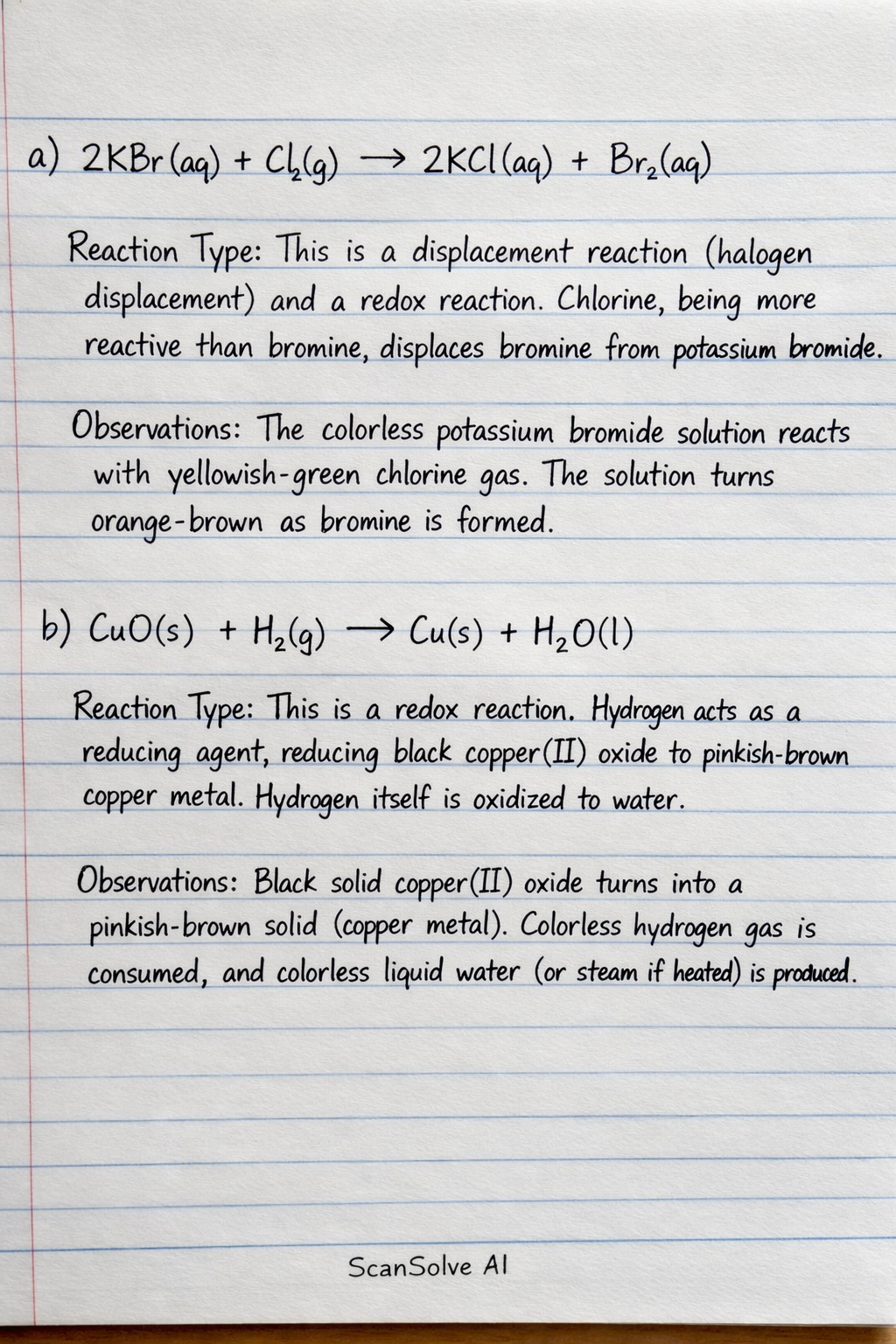
a)
- Reaction Type: This is a displacement reaction (specifically, a halogen displacement) and a redox reaction. Chlorine, being more reactive than bromine, displaces bromine from potassium bromide.
- Observations: The colorless potassium bromide solution reacts with yellowish-green chlorine gas. The solution turns orange-brown as bromine is formed.
b)
- Reaction Type: This is a redox reaction. Hydrogen acts as a reducing agent, reducing black copper(II) oxide to pinkish-brown copper metal. Hydrogen itself is oxidized to water.
- Observations: Black solid copper(II) oxide turns into a pinkish-brown solid (copper metal). Colorless hydrogen gas is consumed, and colorless liquid water (or steam if heated) is produced.
c)
- Reaction Type: This is an addition reaction, specifically hydrogenation. Ethene (an alkene) reacts with hydrogen in the presence of a catalyst (e.g., nickel) to form ethane (an alkane).
- Observations: Both reactants (ethene and hydrogen) and the product (ethane) are colorless gases. There are no visible changes in color or state. The reaction typically requires heating and a catalyst.
d)
- Reaction Type: This is an esterification reaction. Ethanol (an alcohol) reacts with ethanoic acid (a carboxylic acid) to form ethyl ethanoate (an ester) and water. It is a reversible reaction, usually catalyzed by concentrated sulfuric acid.
- Observations: Both reactants are colorless liquids. The key observation is the formation of a new product, ethyl ethanoate, which has a characteristic sweet, fruity smell.
Was this helpful?
Still stuck on this one?
Ask a follow-up, and the answer starts from this question.
Got a different question?Ask your own question
More Chemistry Questions
QFor each of the following equations, identify the type of reaction and describe the likely…QBalance the following chemical equations and identify the type of reaction: a) KBr2 + Cl2 -> KCl…QWhich reaction will NOT take place: A) Cl2(g) + 2KI(aq) -> 2KCl(aq) + I2(aq) B) I2(aq) + 2KBr(aq) ->…QA) State and explain the observations made. b) Write an equation for the reaction between chlorine…QComplete the following chemical reactions and illustrate chemical mechanisms: a) CH3CH2CCH2CH3 + HCN…
Handwritten Step-by-Step Solution
Get this as a handwritten image on WhatsApp — like a tutor wrote it for you.
Try on WhatsApp