
Draw a born haber cycle of sodium chloride with the given values Calculate the lattice dissociation of sodium chloride Name the law applied State the law named
ScanSolve AI Answer
Answer
Step-by-step solution
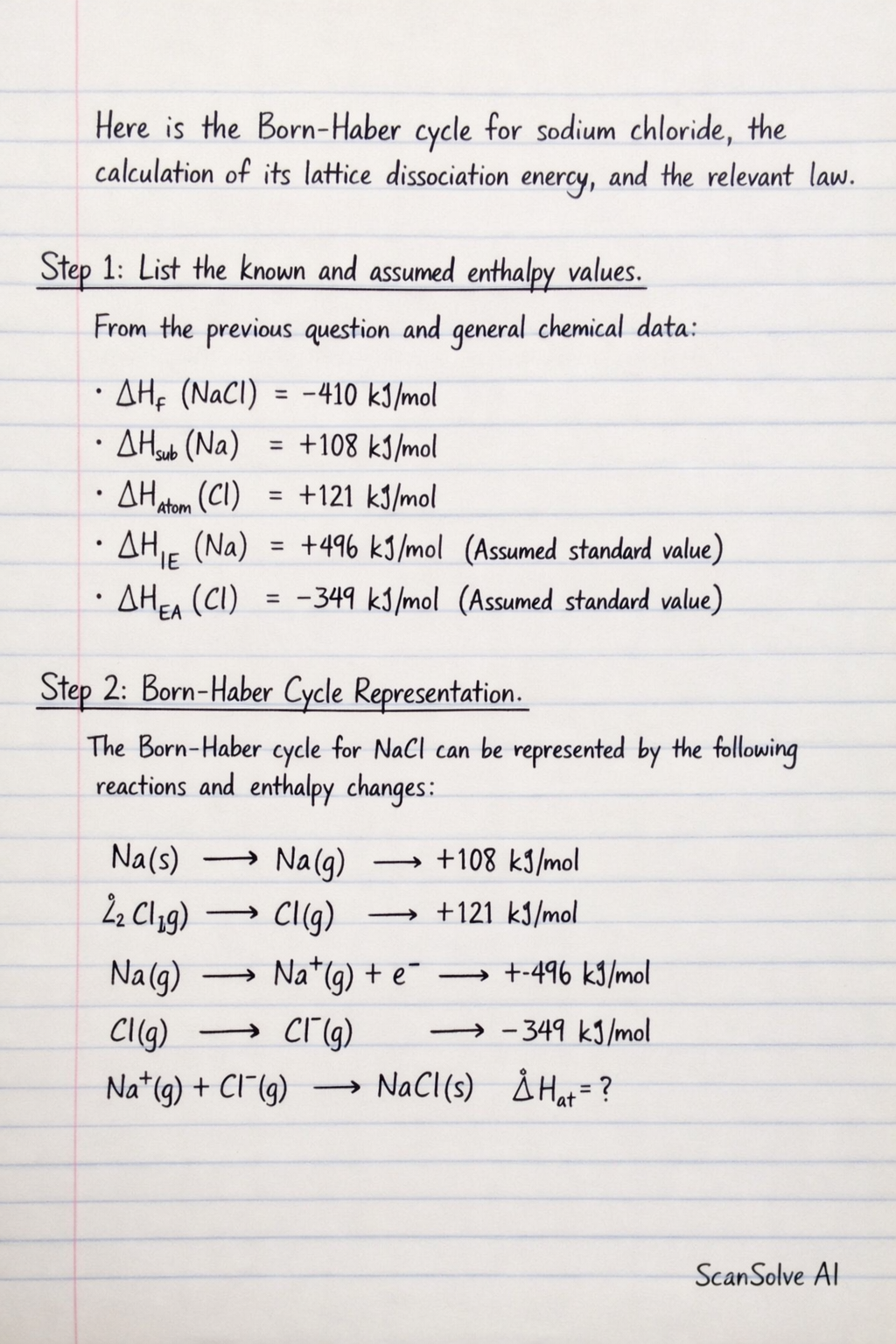
5 stepsHere is the Born-Haber cycle for sodium chloride, the calculation of its lattice dissociation energy, and the relevant law.
List the known and assumed enthalpy values.
From the previous question and general chemical data:
- Heat of formation of ,
- Sublimation energy of ,
- Atomization energy of ,
- Ionization energy of , (Assumed standard value)
- Electron affinity of , (Assumed standard value)
Born-Haber Cycle Representation.
The Born-Haber cycle for can be represented by the following series of reactions and their enthalpy changes:
- Overall formation:
- Sublimation of sodium:
- Atomization of chlorine:
- Ionization of gaseous sodium:
- Electron affinity of gaseous chlorine:
- Lattice formation of sodium chloride:
Calculate the lattice formation energy of sodium chloride.
According to Hess's Law, the overall enthalpy change for the formation of is equal to the sum of the enthalpy changes of the individual steps:
Substitute the known values:
Calculate the lattice dissociation energy of sodium chloride.
Lattice dissociation energy is the energy required to break one mole of an ionic solid into its constituent gaseous ions. It is the negative of the lattice formation energy.
Name and state the law applied.
The law applied is Hess's Law.
Hess's Law states that the total enthalpy change for a chemical reaction is the same, regardless of the pathway taken, as long as the initial and final conditions are the same.
Still stuck on this one?
Ask a follow-up, and the answer starts from this question.
More Chemistry Questions
Handwritten Step-by-Step Solution
Get this as a handwritten image on WhatsApp — like a tutor wrote it for you.
Try on WhatsApp