
Explain the question and the answer
ScanSolve AI Answer
Answer
The question asks to identify the enthalpy change () values corresponding to three specific energy changes involved in the formation of sodium chloride (). These values are typically part of a Born-Haber cycle, which is used to calculate lattice energy.
-
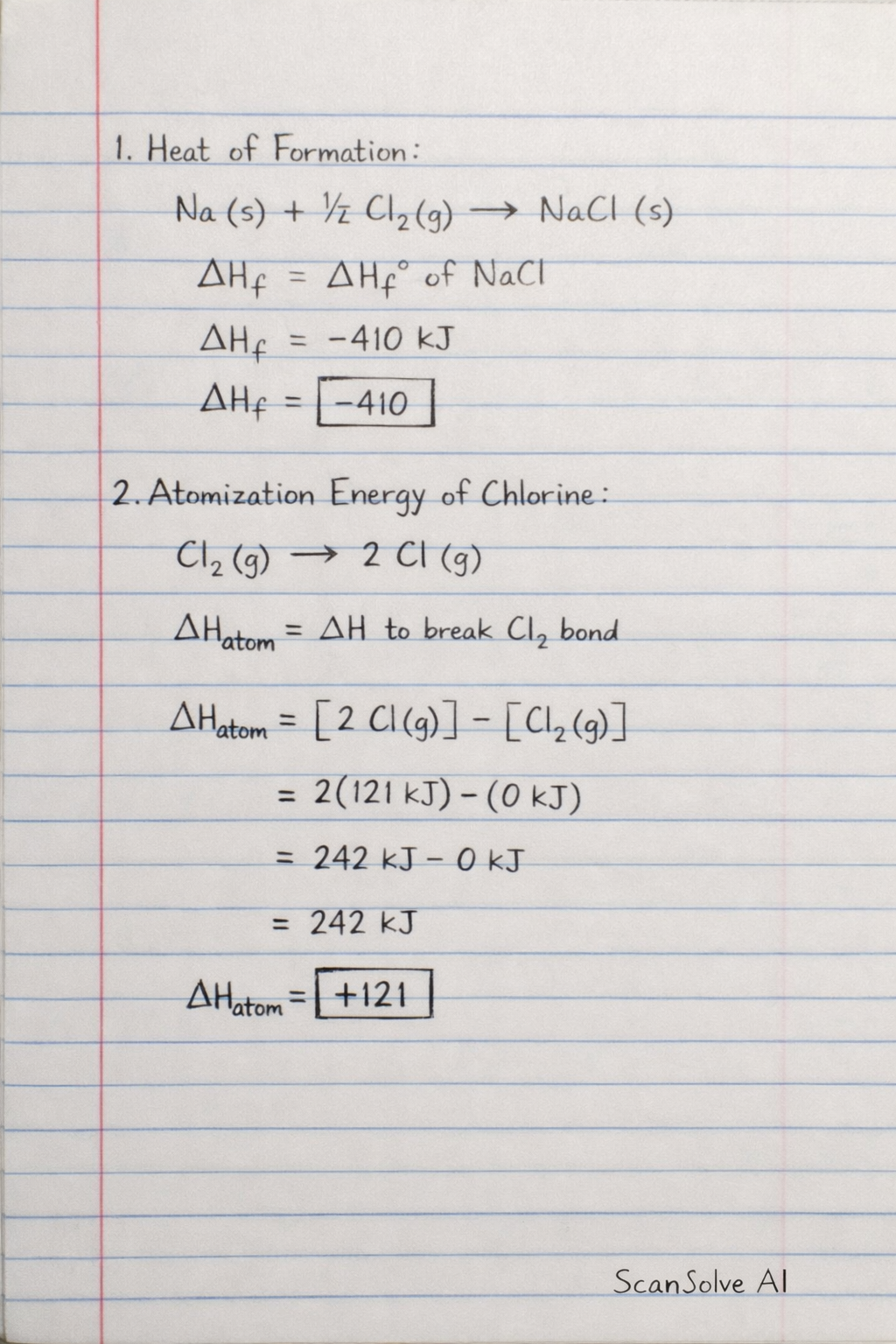
Heat of formation: This is the enthalpy change when one mole of a compound is formed from its constituent elements in their standard states. For , this is the formation from solid sodium () and chlorine gas (). The value represents the overall energy released when is formed.
-
Atomization energy: This is the enthalpy change required to produce one mole of gaseous atoms from an element in its standard state. For chlorine, it's the energy needed to break the bond in to form individual gaseous chlorine atoms (). The value is positive because energy is absorbed to break bonds.
-
Sublimation energy: This is the enthalpy change required to convert one mole of a solid directly into a gas. For sodium, it's the energy needed to change solid sodium () into gaseous sodium atoms (). The value is positive because energy is absorbed to overcome intermolecular forces and change state.
Try one yourself
A new problem that tests the same skill.
Still stuck on this one?
Ask a follow-up, and the answer starts from this question.
More Chemistry Questions
Handwritten Step-by-Step Solution
Get this as a handwritten image on WhatsApp — like a tutor wrote it for you.
Try on WhatsApp