
We read your photo as:
Refer to the reaction in the combustion tube: a) Name the two substances that react in the combustion tube. b) i) Complete the diagram to show how dry carbon(II) oxide gas is collected. ii) Identify:
ScanSolve AI Answer
Step-by-step solution
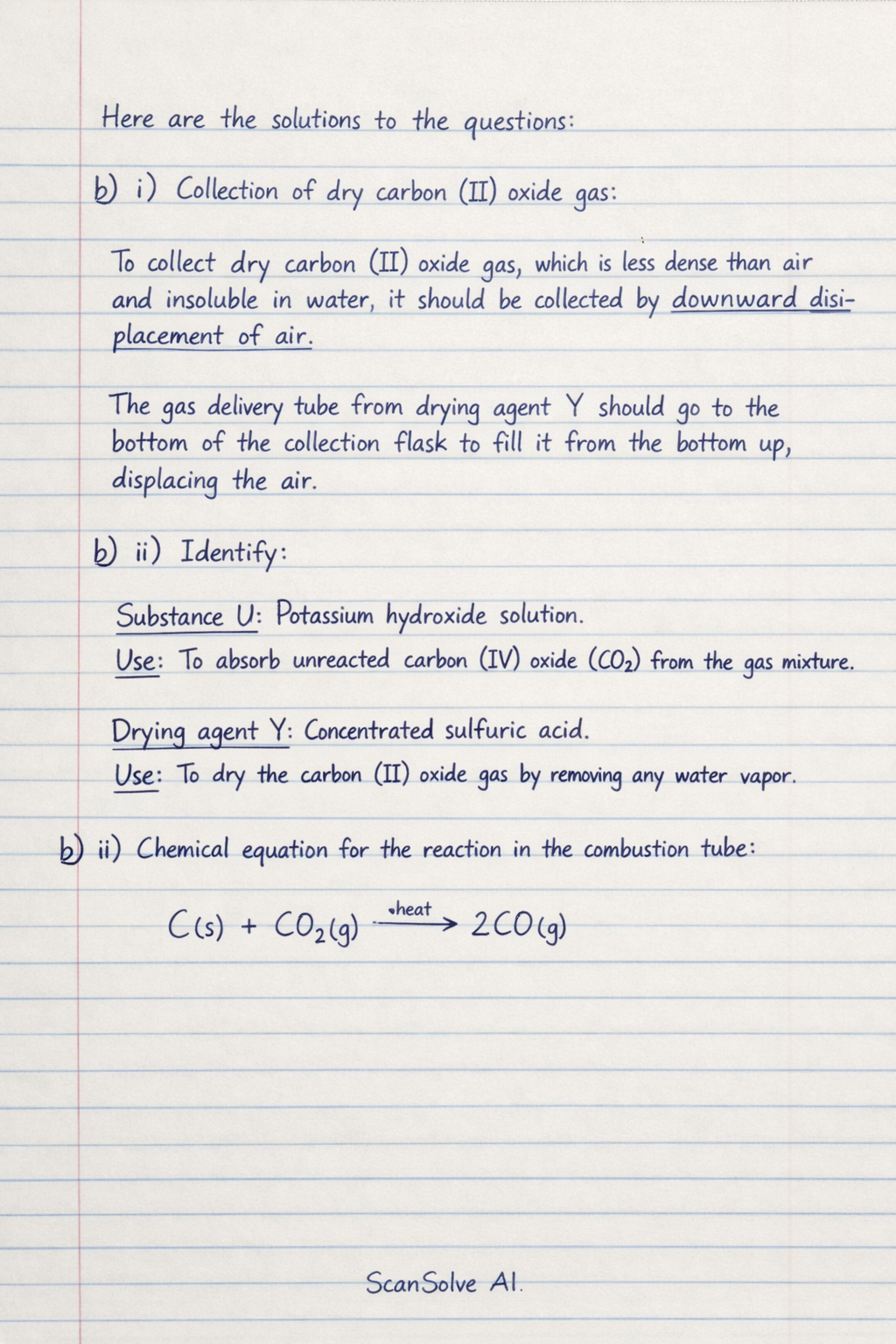
3 stepsHere are the solutions to the questions:
b) i) Complete the diagram to show how dry carbon (II) oxide gas is collected.
To collect dry carbon (II) oxide (CO) gas, which is slightly less dense than air and insoluble in water, it should be collected by downward displacement of air. This means the gas delivery tube from drying agent Y should extend to the bottom of the collection flask, allowing the CO gas to fill the flask from the bottom up, displacing the air.
b) ii) Identify:
-
Substance U and state its use Substance U: Potassium hydroxide solution (or sodium hydroxide solution). Use: To absorb unreacted carbon (IV) oxide (CO2) from the gas mixture.
-
Drying agent Y Drying agent Y: Concentrated sulfuric acid. Use: To dry the carbon (II) oxide gas by removing any water vapor.
b) iii) Write a chemical equation for the reaction which takes place in the combustion tube.
b) iv) Carbon (II) oxide is a major environmental pollutant.
a) Give one major source of carbon (II) oxide in the atmosphere
Incomplete combustion of fossil fuels in internal combustion engines (e.g., in vehicles) or industrial processes.
b) Explain how carbon (II) oxide causes poisoning
Carbon monoxide (CO) binds strongly and irreversibly to hemoglobin in red blood cells, forming carboxyhemoglobin. This prevents hemoglobin from transporting oxygen, leading to oxygen deprivation in the body's tissues and organs, which can be fatal.
c) State one use of carbon (II) oxide
It is used as a reducing agent in the extraction of metals from their ores (e.g., in a blast furnace to reduce iron ore).
d) Write an equation for the formation of water gas.
e) Explain why sodium hydroxide solution is not used in testing for carbon (IV) oxide gas, while calcium hydroxide is preferably used.
Calcium hydroxide solution (limewater) is preferred for testing carbon (IV) oxide (CO2) because it reacts to form insoluble calcium carbonate, which appears as a visible white precipitate, thus indicating the presence of CO2. Sodium hydroxide solution also reacts with CO2, but forms soluble sodium carbonate, so no visible change occurs, making it unsuitable for testing.
3. a) i) Name the enthalpy change represented by .
The enthalpy change represented by is the standard enthalpy change of formation of carbon monoxide ().
3. a) ii) Use the following information to calculate the value of for 144g of graphite.
Given:
Apply Hess's Law to find per mole of graphite.
From the energy cycle diagram, the direct path from C(graphite) to CO2(g) is . The indirect path is via CO(g), which involves followed by .
This value is for the combustion of 1 mole of graphite.
Calculate the number of moles in 144 g of graphite.
Molar mass of graphite (C) = 12 g/mol.
Calculate the total enthalpy change for 144 g of graphite.
The value of for 144g of graphite is .
Still stuck on this one?
Ask a follow-up, and the answer starts from this question.
More Chemistry Questions
Handwritten Step-by-Step Solution
Get this as a handwritten image on WhatsApp — like a tutor wrote it for you.
Try on WhatsApp