
We read your photo as:
Calculate the relative atomic mass of a divalent metal M if 0.66 g of it is deposited by passing a current of 1.35 A for 1500 s.
Chemistry
ScanSolve AI Answer
Answer
Step-by-step solution
2 stepsThis problem requires applying Faraday's First Law of Electrolysis.
Given:
- Mass of metal M deposited () = 0.66 g
- Current () = 1.35 A
- Time () = 1500 s
- Metal M is divalent, meaning its valency () = 2.
- Faraday's constant () = 96500 C/mol (This is a standard constant you should know for electrolysis problems).
Calculate the total quantity of electricity (charge, ) passed.
The formula for charge is .
Use Faraday's First Law to calculate the Relative Atomic Mass (RAM) of M.
Faraday's First Law states that the mass deposited () is given by:
We need to find RAM (which is the molar mass, ). Rearrange the formula:
Substitute the known values:
Rounding to three significant figures:
The relative atomic mass (RAM) of M is .
Was this helpful?
Try one yourself
A new problem that tests the same skill.
Still stuck on this one?
Ask a follow-up, and the answer starts from this question.
Got a different question?Ask your own question
More Chemistry Questions
QCalculate the current in Amperes if 36.0 g of a substance with an electrochemical equivalent of…QCalculate the mass of aluminium deposited from an aqueous solution of aluminum sulfate when a…QCalculate the mass of aluminum deposited from molten aluminum oxide when a current of 40,000 A is…QDefine relative atomic mass. A student reacts 0.245 g of a metal carbonate X₂CO₃ with 23.6 cm³ of…QDuring electrolysis 5g of a metal E was deposited by passing a current of 200Ampere for 30mins…
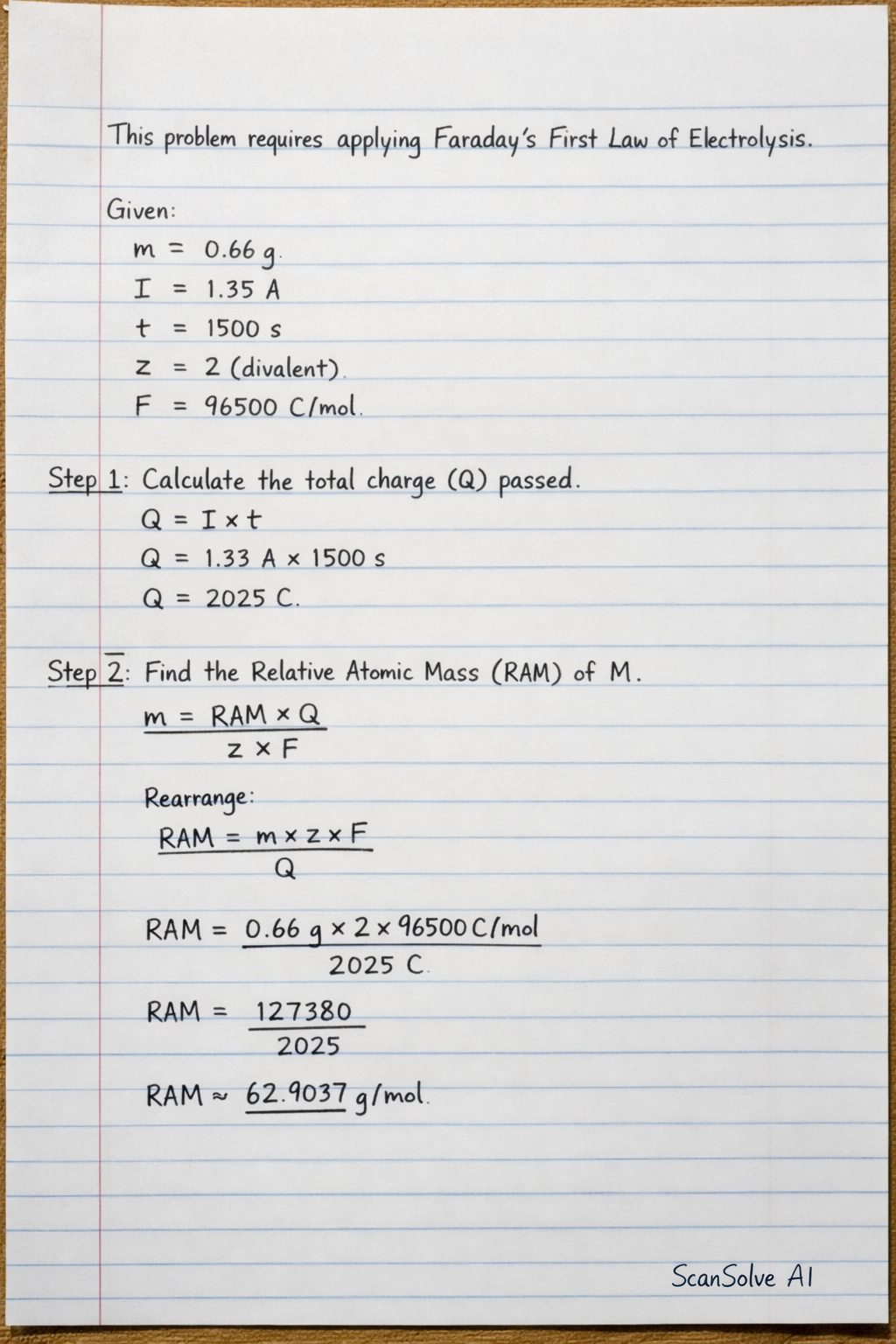
Handwritten Step-by-Step Solution
Get this as a handwritten image on WhatsApp — like a tutor wrote it for you.
Try on WhatsApp