
We read your photo as:
Write short note on caustic soda test and discourse the statement about preliminary tests with respect to physical appearance test only.
ScanSolve AI Answer
Step-by-step solution
3 stepsHere are the answers to the questions:
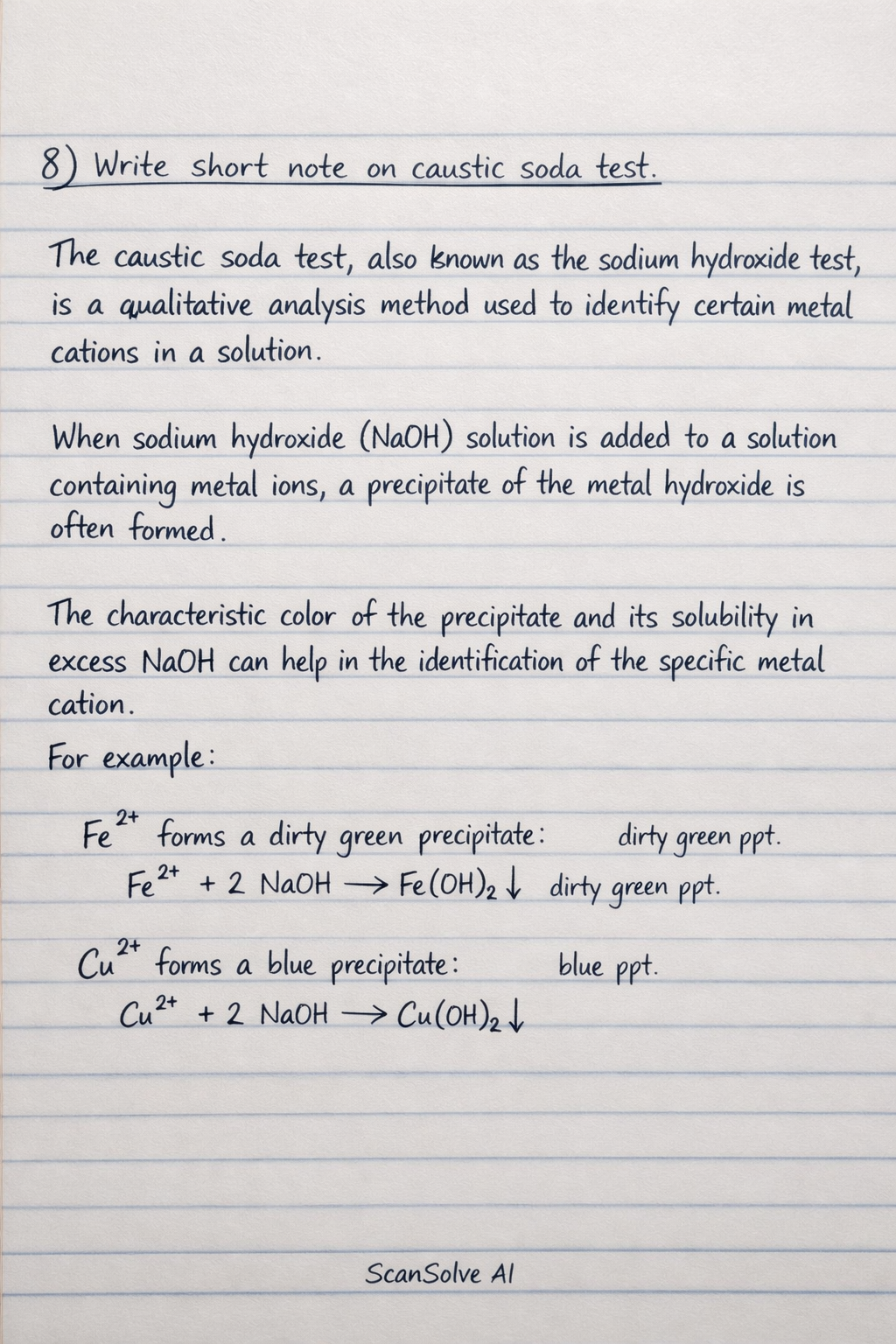
8) Write short note on caustic soda test
The caustic soda test, also known as the sodium hydroxide test, is a qualitative analysis method used to identify certain metal cations in a solution. When sodium hydroxide () solution is added to a solution containing metal ions, a precipitate of the metal hydroxide is often formed. The characteristic color of the precipitate and its solubility in excess can help in the identification of the specific metal cation. For example, forms a dirty green precipitate, while forms a blue precipitate.
9) Though the preliminary tests are exploratory in nature and rarely conclusive yet they provide information about various acid and basic radicals. Briefly discourse this statement with respect to physical appearance test only.
Preliminary tests, such as observing the physical appearance of a salt, are indeed exploratory and not conclusive on their own. However, they provide valuable initial clues about the possible presence of certain acid and basic radicals. For instance, the color of a salt can indicate the presence of specific transition metal cations (e.g., blue suggests , green suggests or , yellow/brown suggests ). The physical state (solid, liquid), crystal shape, and texture can also narrow down the possibilities, guiding the selection of more specific confirmatory tests.
10) A salt mixture containing and is to be treated with dilute . Briefly explain how you can identify the acid radicals present in the mixture.
To identify the acid radicals ( and ) in the mixture:
Add dilute sulfuric acid () to the salt mixture.
Both carbonate and sulfite will react to produce gases.
Pass the evolved gases through an acidified potassium dichromate(VI) solution ().
Sulfur dioxide () will reduce the orange dichromate solution to a green chromium(III) solution. This confirms the presence of the sulfite radical (). Carbon dioxide () does not react with acidified dichromate.
After passing through the acidified potassium dichromate(VI) solution (which removes ), pass the remaining gas through limewater ().
If the limewater turns milky, it indicates the presence of carbon dioxide (), confirming the carbonate radical (). This sequence ensures that the test for is not interfered with by , as also turns limewater milky.
Still stuck on this one?
Ask a follow-up, and the answer starts from this question.
More Chemistry Questions
Handwritten Step-by-Step Solution
Get this as a handwritten image on WhatsApp — like a tutor wrote it for you.
Try on WhatsApp