
We read your photo as:
What is the composition of gas after passing through caustic potash, and how does it affect tests like the glowing splint test?
ScanSolve AI Answer
Step-by-step solution
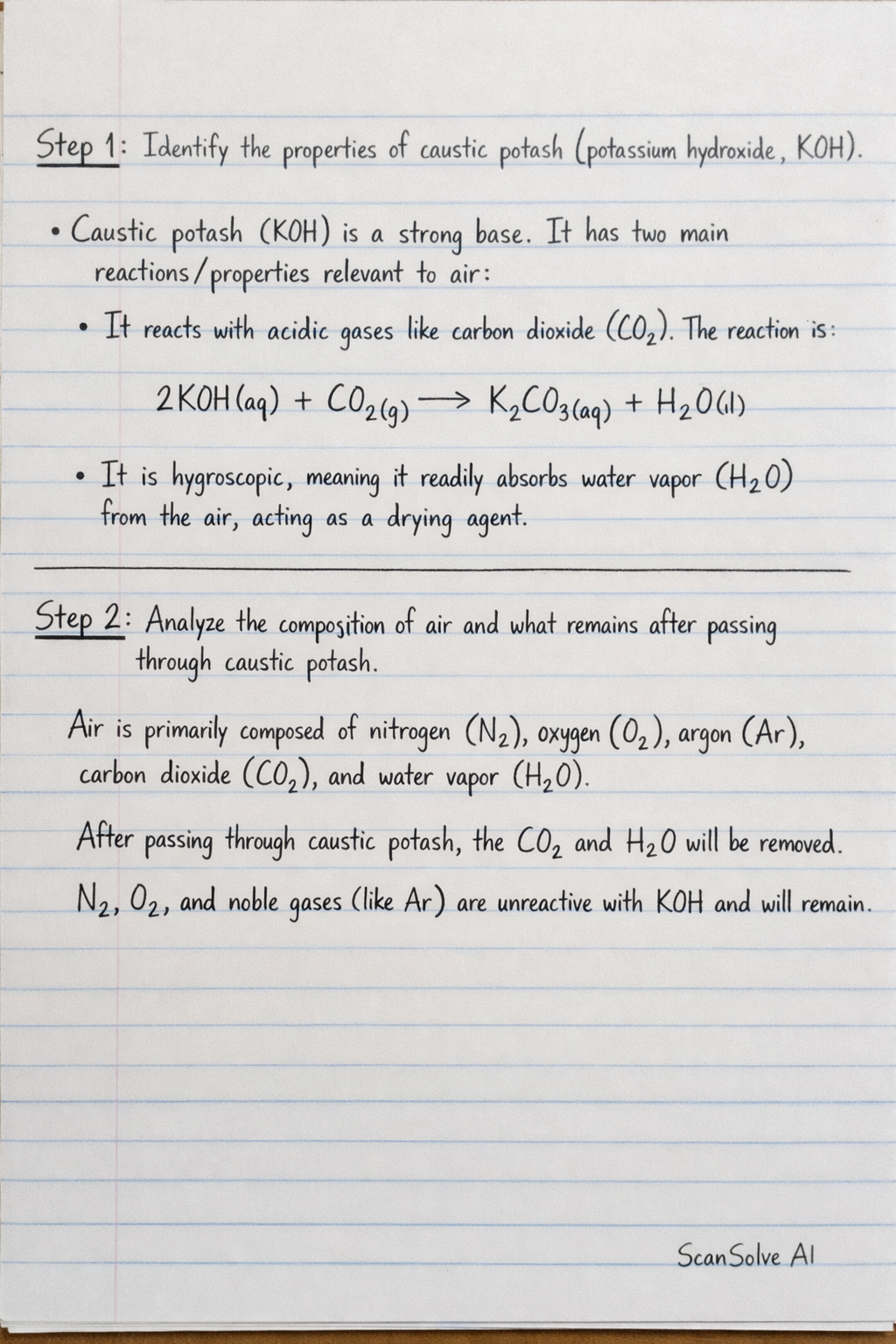
4 stepsIdentify the properties of caustic potash (potassium hydroxide, KOH).
Caustic potash (KOH) is a strong base. It has two main reactions/properties relevant to air:
- It reacts with acidic gases like carbon dioxide (). The reaction is:
- It is hygroscopic, meaning it readily absorbs water vapor () from the air, acting as a drying agent.
Analyze the composition of air and what remains after passing through caustic potash.
Air is primarily composed of nitrogen (), oxygen (), argon (), carbon dioxide (), and water vapor ().
After passing through caustic potash, the and will be removed. , , and noble gases (like ) are unreactive with KOH and will remain.Evaluate each option.
- A. contain more oxygen than nitrogen: Air is approximately 78% nitrogen and 21% oxygen. Since neither reacts with KOH, their relative proportions will not change in a way that makes oxygen more abundant than nitrogen. This statement is incorrect.
- B. rekindle a glowing splint: A glowing splint test is for oxygen. While oxygen remains, the concentration of oxygen in the remaining gas (mostly and ) is not high enough to rekindle a glowing splint, as air itself does not do this. This statement is incorrect.
- C. have no action on lime water: Lime water ( solution) is used to test for carbon dioxide. If is present, it reacts with lime water to form insoluble calcium carbonate, making the solution milky: . Since caustic potash removes , the air sample will no longer contain and thus will have no action on lime water. This statement is correct.
- D. contain no water vapour: Caustic potash is a strong desiccant and will absorb water vapor from the air. Therefore, the air sample will be dried and contain very little to no water vapor. This statement is also correct under ideal conditions.
- E. be free of noble gases: Noble gases are unreactive and will not be absorbed or reacted with by caustic potash. They will remain in the air sample. This statement is incorrect.
Choose the best answer between C and D.
Both C and D describe correct consequences of passing air through caustic potash. However, in chemistry questions, the removal of by a strong base is a characteristic chemical reaction, and the "no action on lime water" is a direct and specific chemical test result for the absence of . While KOH also dries air, its role as a scrubber is often highlighted as a primary chemical function. Therefore, option C is generally considered the most appropriate answer in this context.
The final answer is .
Still stuck on this one?
Ask a follow-up, and the answer starts from this question.
More Chemistry Questions
Handwritten Step-by-Step Solution
Get this as a handwritten image on WhatsApp — like a tutor wrote it for you.
Try on WhatsApp